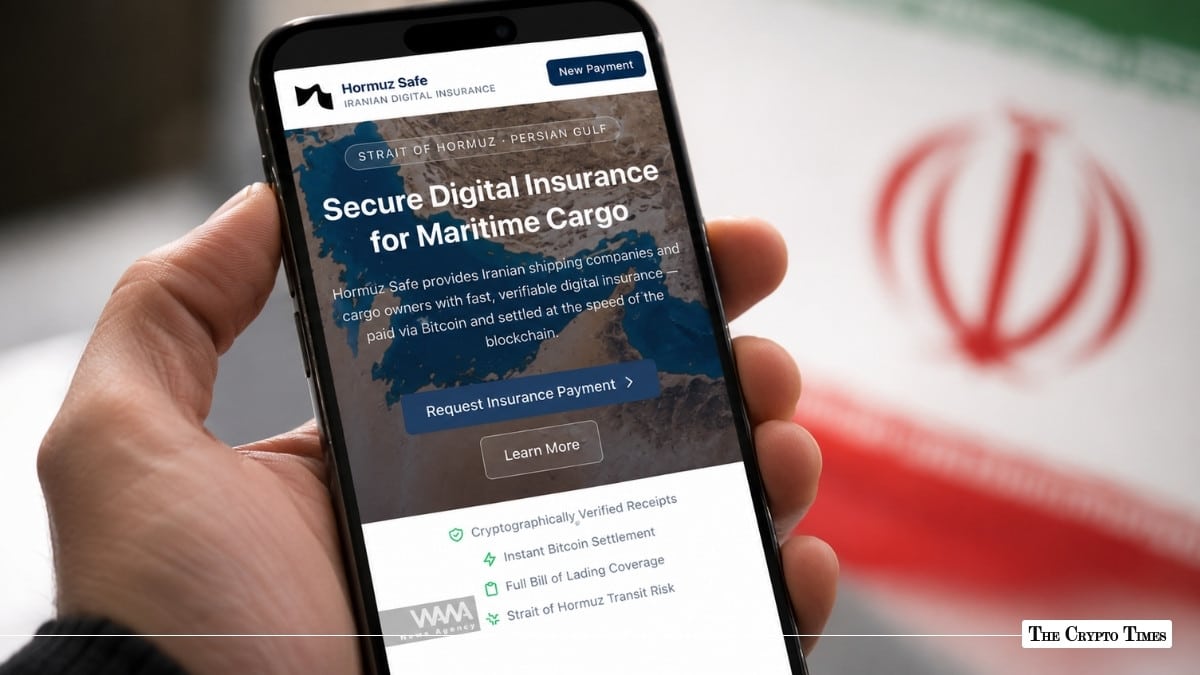
Iran has launched a state-backed digital insurance platform that turns one of the world’s most strategically important shipping lanes into a cryptocurrency-settled business.
The platform, called Hormuz Safe, issues digital maritime insurance policies for commercial vessels transiting the Persian Gulf, the Strait of Hormuz, and surrounding waterways, with premiums paid and settled in Bitcoin. The initiative was first reported on May 16, 2026, by Fars News Agency, an outlet affiliated with Iran’s Islamic Revolutionary Guard Corps (IRGC), citing a document obtained from Iran’s Ministry of Economic Affairs and Finance.
The Strait of Hormuz is the single most important chokepoint in the global energy trade. Roughly 20% of the world’s daily oil supply passes through the narrow channel between Iran and Oman. Every tanker and cargo vessel navigating that corridor requires marine insurance — coverage that has traditionally been underwritten and settled through Western financial institutions from which Iran, under years of international sanctions, is largely locked out. Hormuz Safe is designed to route around exactly that problem.
How the Platform Works
According to the Ministry’s framework, the platform offers shipping companies and independent cargo owners fast-track, cryptographically verifiable insurance policies. The operational protocol functions through a streamlined on-chain sequence:
- Premium Settlement: A vessel operator selects a custom risk tier and transmits the designated premium in Bitcoin to a state-controlled wallet ecosystem.
- Instant Coverage: The moment the transaction receives immutable validation on the blockchain network, the maritime cargo is considered active and insured.
- Cryptographic Proof: The vessel owner is immediately issued a digitally signed, cryptographically verifiable receipt to serve as proof of coverage for foreign port authorities.
According to the cited documents, the policy framework primarily covers the inspection, detention, and physical confiscation of vessels by regional actors. Notably, direct damage resulting from military or kinetic attacks is completely carved out of the standard coverage terms.
The Ministry explicitly noted that the verification system is engineered to grant Tehran “informational dominance” over the corridor, allowing the state to frictionlessly identify and audit data from different transiting nations.
The $10 Billion Claim
Iranian officials estimate the platform could generate more than $10 billion in revenue, on the assumption of what the document characterized as a low-risk approach. That figure should be treated with caution. As of now, no breakdown of how the $10 billion was calculated appears in the originating article, the platform is brand new, and full technical and legal specifications have not been publicly disclosed.
Whether Hormuz Safe becomes an operational insurance market or remains primarily a state-media announcement is not yet clear.
Why Iran Is Turning to Bitcoin
The deployment of Bitcoin as the core settlement layer is a calculated geopolitical move. Cut off from dollar-denominated clearing houses and the SWIFT messaging network, traditional premium routing would be instantly flagged and blocked by Western compliance filters.
Hormuz Safe marks an evolutionary shift in state-level crypto adoption. Rather than simply mining or holding Bitcoin as a passive treasury reserve asset, Tehran is weaponizing it as active operational financial infrastructure: using a decentralized ledger to assert administrative control over global shipping corridors.
The platform’s launch also directly coincides with an environment where insuring a Hormuz transit has become economically unviable for many operators. Since the outbreak of regional hostilities on February 28, war-risk insurance premiums have weaponized, skyrocketing from standard pre-conflict baselines of 0.25% to as high as 5% to 10% of a vessel’s total hull value per single voyage.
Under these conditions, a $100 million oil tanker faces a staggering $10 million insurance levy simply to cross the channel: a price shock that Iran hopes to exploit with its lower-cost crypto alternative.
The Sanctions Problem
For all its strategic logic from Tehran’s perspective, Hormuz Safe faces two formidable obstacles.
First, sanctions exposure. Western compliance experts and U.S. government advisories have long warned that payments to Iranian entities, including state-backed financial platforms, may trigger sanctions violations under the U.S. Office of Foreign Assets Control (OFAC). Any vessel operator considering using the platform would need to consult legal and sanctions counsel before engaging, and payments that benefit Iranian state bodies or the IRGC carry particular risk.
Second, international recognition. A ship arriving at Rotterdam, Singapore, or any major port with an insurance certificate issued by an Iranian state-backed platform may find that the coverage is worth nothing in the eyes of local regulators, port authorities, and the global maritime insurance market. An insurance policy is only as useful as the institutions willing to honor it, and Hormuz Safe begins life with no recognition from the Western-dominated marine insurance system.
A Word of Caution on Scams
There is also a fraud dimension. Cybersecurity professionals have noted that, since the start of the regional conflict, crypto scams have repeatedly impersonated Iranian government authorities, collecting fake “safe passage” fees from vessel operators.
Hormuz Safe appears to be a distinct, genuinely state-sanctioned initiative, but its launch creates exactly the kind of confusion that fraudsters exploit. Operators should be aware that the existence of a real state platform does not mean every “Hormuz passage payment” request circulating online is legitimate.
Ultimately, the Hormuz Safe rollout places Iran in direct competition with Washington’s own financial defense measures, notably the U.S. International Development Finance Corporation (DFC) insurance backstop, which covers cargo risks for ships traveling under American protection. For the broader market, the development also feeds the long-running “Bitcoin as geopolitical hedge” narrative. The announcement lands while Bitcoin is trading under the $77,000 range amid a broader risk-off market structure.
Whether Hormuz Safe becomes a functioning insurance market or remains a statement of intent, it underscores a trend that has accelerated through 2026: cryptocurrency is increasingly being drawn into the machinery of geopolitics; not at the margins, but at the chokepoints.
Also Read: Binance Research: Over $75 Billion in Illicit Crypto Stuck Onchain