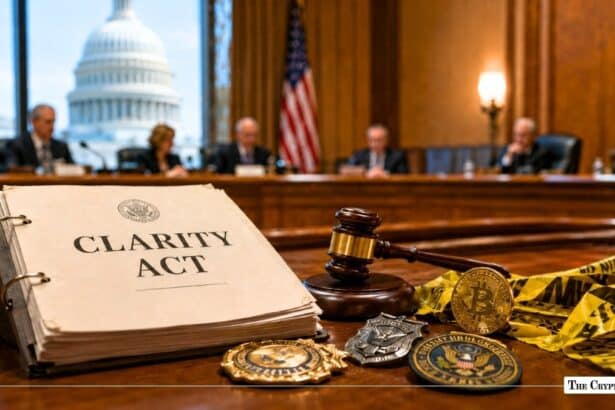
The most consequential piece of crypto legislation in US history is approaching its decisive moment, and the man tasked with getting it there is in a remarkable bind. As the Senate prepares to take up the Digital Asset Market Clarity Act, better known as the CLARITY Act, the Trump White House’s crypto point person is negotiating a government-ethics provision that Democrats insist must rein in the president’s own digital-asset ventures.
That official is Patrick Witt, the 37-year-old executive director of the President’s Council of Advisors for Digital Assets, his assignment captures one of the strangest dynamics of Trump’s second term: a Trump appointee trying to cut a deal that his own boss’s critics hope will crack down on the Trump family.
The man in the middle
Witt took a roundabout path to the role, which he assumed last year after stints on the 2024 Trump transition team and at the newly reorganized Department of War (DoW), following earlier work at McKinsey and the Office of Personnel Management during Trump’s first term. A Yale and Harvard Law graduate with no prior Capitol Hill experience, he now sits at the center of the administration’s top remaining legislative priority for the year and must somehow satisfy both Trump and some of the president’s fiercest congressional opponents.
The job has earned him bipartisan praise. Republican Senators Cynthia Lummis, Thom Tillis, and Banking Chair Tim Scott have publicly commended his ability to act as a liaison between camps unaccustomed to talking to each other. David Sacks, Trump’s former crypto and AI czar, called Witt indispensable to the effort. Even Democrats in the room, including Senator Kirsten Gillibrand, have described him as constructive.
The ethics provision at the heart of it
The friction point is the ethics language. Democrats want the bill to bar federal employees, including the president and members of Congress, from sponsoring, endorsing or issuing digital assets, a restriction aimed squarely at the Trump family’s crypto interests. Those interests include a memecoin the president launched just before his inauguration and World Liberty Financial, the family-backed venture that issues two types of tokens.
This is not a new battle. During the Senate Banking Committee’s May markup, a Van Hollen ethics amendment that would have barred senior officials from holding certain crypto business interests failed 11-13, leaving the issue the single largest unresolved question heading to the floor. Democrats argue these businesses create opportunities for corruption, a characterization the White House firmly rejects; press secretary Karoline Leavitt has previously denied that Trump or his family have ever engaged in conflicts of interest. The administration has cast the holdup as Democratic obstruction. The leverage, however, is real: with a 53-seat majority, Republicans need at least seven Democratic votes to overcome the Senate’s 60-vote cloture threshold, and only two Democrats, Ruben Gallego and Angela Alsobrooks, backed the bill in committee, both stressing their votes were conditional.
The conflict-of-interest scrutiny has dogged the Trump family’s crypto empire for months; Senator Elizabeth Warren earlier called on the SEC to investigate World Liberty Financial, a request that briefly knocked the WLFI token lower.
Can Witt actually deliver?
A central question hanging over the talks is whether Witt has the authority to close a deal at all. Louisiana Republican Senator John Kennedy bluntly suggested the only person who can make the agreement is Trump himself. Democrats harbor a mirror-image worry, that even a deal struck with Witt could be overridden by the White House. Senator Adam Schiff, who is involved in the negotiations, questioned whether any agreement they reach could simply be shot down. Lummis, who is helping lead the GOP side, acknowledged Witt will not have the final say on language, that goes to the president, but credited him with the room to “thread the needle.”
Not the only fight on Witt’s plate
The ethics standoff is just one of several knots. Witt also brokered a provision with Senators Tillis and Alsobrooks aimed at resolving the clash between banks and crypto firms over stablecoin yield, though Wall Street lobby groups say it does not go far enough. And he has been working the law-enforcement front directly.
Witt and the White House Crypto Council convened a roughly 90-minute meeting at the Eisenhower Executive Office Building with Treasury, FinCEN, the Justice Department and several national law-enforcement organizations over the Blockchain Regulatory Certainty Act (BRCA), the provision shielding non-custodial DeFi developers, which police groups have resisted.
The reconciliation maze
Even a floor deal would not be the finish line. The bill must still reconcile the Banking Committee’s text with the Senate Agriculture Committee’s competing version, which advanced 12-11 on a party-line vote with no Democratic support, before the merged Senate product is squared with the House-passed CLARITY Act, which cleared the lower chamber 294-134 in July 2025. Only then does it reach the president’s desk.
The August recess clock
The urgency is structural. The CLARITY Act cleared the Senate Banking Committee 15-9 on May 14 and was placed on the Senate legislative calendar on June 1, making it eligible for a floor vote. But the path narrows fast: lawmakers and analysts widely agree the Senate must pass the bill before the August recess for it to have a realistic shot this year.
Lummis has set an end-of-July target and warned that missing the window could delay enforceable digital-asset rules until at least 2030, since a new Congress would have to restart the process. Markets reflect the doubt: Galaxy Research has pegged 2026 passage at roughly coin-flip odds, and Polymarket traders have drifted to the high-40s percent range, down sharply from the 80s earlier in the year.
The stakes are enormous
For the industry, the CLARITY Act would finally divide federal oversight of digital assets, handing the CFTC authority over digital commodities while the SEC retains jurisdiction over investment-contract assets, removing the single biggest source of legal uncertainty for US crypto businesses.
More than 200 firms, including Coinbase and Ripple, have urged the Senate to act. The irony is that the bill the industry has chased for years now hinges on a provision designed to limit the first family’s crypto profits, brokered by a Trump loyalist caught between the president and his opponents. How Witt threads that needle in the coming weeks may determine whether America gets its crypto rulebook in 2026, or waits until the end of the decade.
Also Read: Democrats Slam Trump’s $500M UAE Crypto Deal: “National Security For Sale”