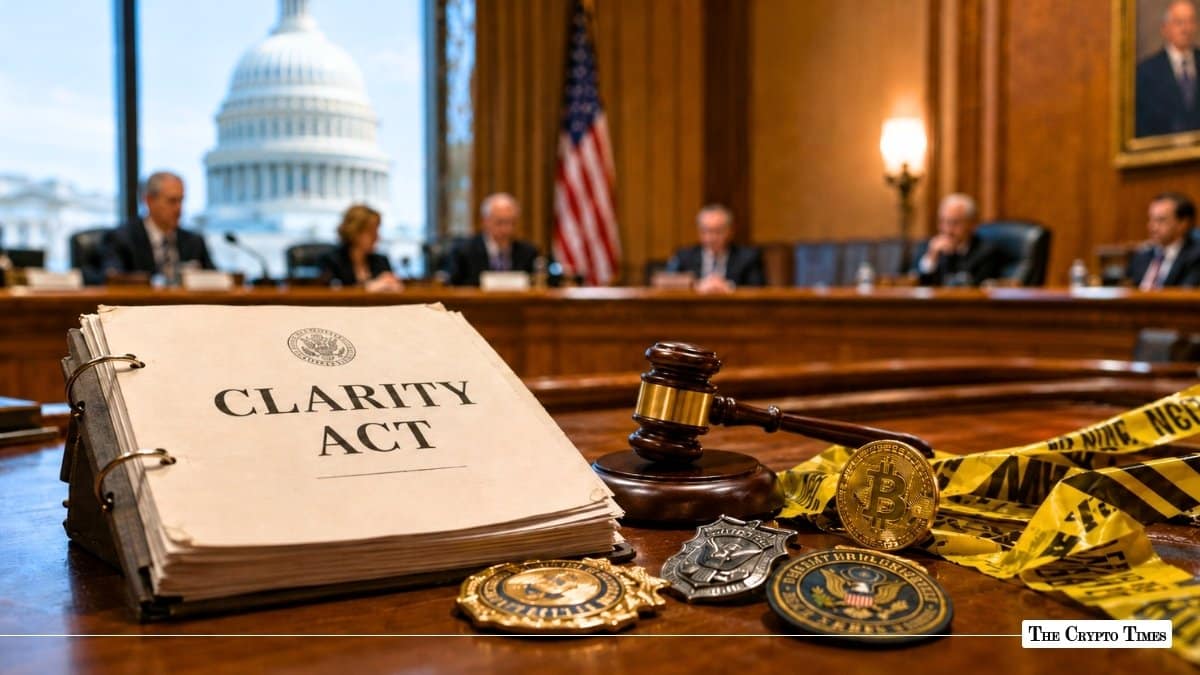
Four law-enforcement organizations representing more than 70,000 members wrote to the administration on Monday to say their concerns over Section 604 of the CLARITY Act remain unresolved, signaling that a key condition for the bill’s passage has yet to be met.
A warning aimed at the bill’s swing votes
The June 23 letter, addressed to Acting Attorney General Todd Blanche and White House digital-assets adviser Patrick Witt, came from the National District Attorneys Association, the National Association of Assistant U.S. Attorneys, the International Association of Chiefs of Police, and the National Sheriffs’ Association. While thanking the administration for weeks of engagement, the groups wrote that the core concern raised by law enforcement “remains unresolved.”
The timing gives the letter weight beyond its words. The CLARITY Act sits on the Senate Legislative Calendar, eligible for a floor vote, but needs 60 votes to advance, and Senators Mark Warner and Catherine Cortez Masto have tied their support to law enforcement’s sign-off on Section 604. A coalition declaring the issue unsettled directly complicates that math and pushes back on recent administration signals that the disagreements had narrowed.
The groups also broadened their objection beyond Section 604, warning that other provisions could weaken anti-money-laundering and counter-terrorism-financing safeguards and arguing that no class of participant, including mixers, tumblers, and some DeFi services, should receive a blanket exemption from registration, know-your-customer, or Bank Secrecy Act obligations.
What Section 604 actually does
At the center of the fight is a provision with a long history. Section 604 folds in the Blockchain Regulatory Certainty Act (BRCA), first introduced by Representative Tom Emmer in 2018, which establishes that a non-controlling developer or infrastructure provider, one who cannot move or control a user’s assets, is not a money transmitter under federal law, shielding such builders from money-services registration and money-transmission prosecution.
For the industry, the provision is foundational. More than 60 founders and investors from firms including Coinbase, a16z crypto, Uniswap, and Kraken urged the Senate to keep the BRCA intact, arguing that without legal certainty, open-source development moves offshore.
Supporters note the bill is written to preserve the criminal carve-out under 18 U.S.C. § 1960 — meaning anyone who knowingly facilitates the movement of criminal proceeds remains exposed—a reading that blockchain-intelligence firm TRM Labs has affirmed in its own analysis. Senator Cynthia Lummis has called the result the most pro-law-enforcement digital-asset bill Congress has considered, pointing to the 2025 conviction of Tornado Cash co-founder Roman Storm as the case the safe harbor is meant to clarify.
Law enforcement reads the same text differently. The signatories stressed their concern is not with those who “merely write or publish software code” but with broad exemptions they argue could shield entities that facilitate the movement of digital assets and weaken longstanding investigative tools. Where supporters see a settled compromise, the coalition sees gaps a sophisticated actor could exploit—the unresolved core of a disagreement that has run for months.
Cracks in the law-enforcement front
The most telling detail is in who did not sign. The letter carries four names, but two law-enforcement groups deeply involved in the negotiations — the Fraternal Order of Police and the National Association of Police Organizations — are absent from it.
That omission is sharper set against the record. At a roughly 90-minute White House meeting on the BRCA earlier this month, the Fraternal Order of Police and NAPO were among the groups that attended, while the National Sheriffs’ Association was invited but did not participate. Three weeks later, the alignment has flipped: the Sheriffs’ Association is now a signatory to the opposition letter, while the two groups that sat at the table with administration officials declined to add their names.
The pattern suggests the administration’s outreach may have peeled some organizations away from a unified front, isolating the holdouts; a split that matters, because the persuasiveness of the law-enforcement objection rests in part on its appearance of consensus.
A narrowing window
The letter lands with the legislative clock running. Supporters have warned the bill likely needs to clear the Senate before the August recess to have a realistic path this year, and prediction markets now price its 2026 passage near 48%, down from roughly 74% a month ago. Section 604 is not the only obstacle: a separate fight over ethics provisions addressing government officials’ crypto ties remain live, and the Senate bill must still be reconciled with parallel Agriculture Committee work before any floor vote.
The contrast across the Capitol is striking. The House Financial Services Committee has scheduled a July 17 field hearing in New York titled “Building the Future of Finance: How the CLARITY Act Unlocks Innovation,” an upbeat showcase announced by Chairman French Hill. But the House already passed its version of the bill in July 2025, making the hearing more a messaging exercise than a legislative gate—and its optimistic framing sits awkwardly beside a Senate process where law enforcement’s safeguards concerns remain unresolved.
For now, the coalition has restated a position it has held since the provision first drew scrutiny, while signaling it remains willing to keep negotiating. Whether the administration can convert that willingness into the sign-off swing senators are waiting for, and whether the groups now sitting out the letter reflect momentum or merely fatigue, will help decide if the most consequential crypto bill in years reaches the floor before the window closes.