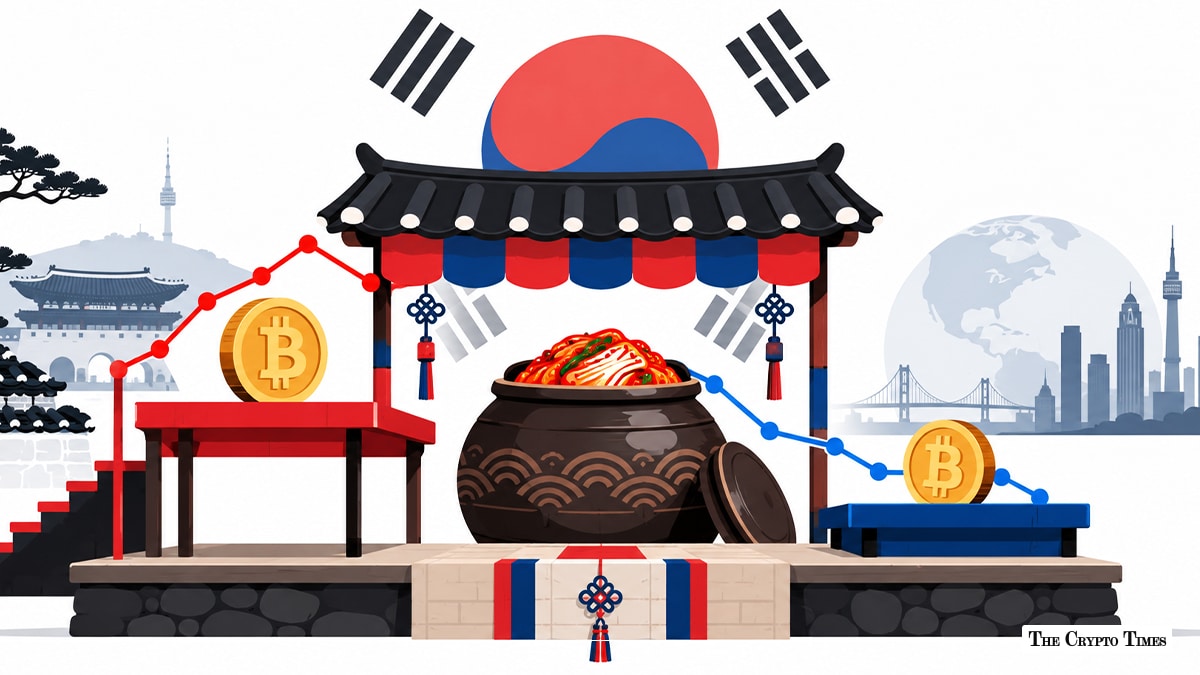
A Bitcoin buyer in South Korea may pay more for the cryptocurrency than someone purchasing the same asset on an overseas exchange. The gap can persist even though Bitcoin trades globally, around the clock.
That difference is known as the Kimchi premium, a closely watched measure of how cryptocurrency prices on South Korean exchanges compare with prices elsewhere.
Although the term originated with Bitcoin, it also describes price differences in dollar-pegged stablecoins such as Tether’s USDT. The two measurements provide different perspectives on the Korean cryptocurrency market.
The distinction matters. A rise in the Bitcoin premium does not necessarily mean dollar-linked stablecoins are becoming more expensive in Korea. Similarly, a decline in the USDT premium does not automatically indicate that demand for Bitcoin has weakened.
Understanding these differences requires looking beyond the headline percentage to the underlying asset, exchange-rate benchmark, market liquidity, and calculation methodology.
What is the Kimchi premium?
The Kimchi premium is the percentage difference between a cryptocurrency’s price on South Korean exchanges and its comparable international price, once both are converted into the same currency.
It is most commonly calculated using Bitcoin’s price in Korean won (KRW), its international price in U.S. dollars (USD), and a USD/KRW foreign-exchange reference rate.
When Bitcoin costs more on a Korean exchange than the converted international price, the premium is positive. When it costs less, the premium is negative, a condition generally called the reverse Kimchi premium.
Consider a hypothetical example:
| Market input | Example |
|---|---|
| Bitcoin price on a Korean exchange | ₩100,000,000 |
| Bitcoin price internationally | $70,000 |
| USD/KRW exchange rate | ₩1,400 per $1 |
| Converted international Bitcoin price | ₩98,000,000 |
| Kimchi premium | +2.04% |
In this example, Bitcoin costs approximately 2.04% more in South Korea. The figures are illustrative, not current market quotations.
Key takeaways
- A positive premium means a cryptocurrency is more expensive on Korean exchanges than its comparable global price. A negative premium indicates a discount.
- Bitcoin and USDT premiums are different measures. The Bitcoin premium reflects a regional price gap for a volatile asset; the USDT premium also requires attention to the stablecoin’s international dollar price.
- The premium is not guaranteed trading profit. Foreign-exchange restrictions, account eligibility, transfer delays, liquidity, transaction fees, and price movements can all prevent traders from capturing the difference.
Why does the Kimchi premium exist?
Cryptocurrencies can move between blockchain addresses across national borders, but the money used to buy them does not move as freely between banking systems.
South Korea has a large domestic cryptocurrency market operating under banking, foreign-exchange, and anti-money-laundering requirements. These conditions can make it difficult for traders to move capital and cryptocurrencies between Korean and international markets fast enough to eliminate price differences.
Three factors are particularly important.
1. Domestic buying and selling pressure
When Korean investors increase purchases of Bitcoin or other cryptocurrencies, local order-book prices can rise faster than prices on international exchanges. Conversely, heavy selling or limited buying interest can push Korean prices below international levels.
However, a premium alone cannot establish the cause of a price movement. Trading activity, available liquidity, investor positioning, and broader market conditions must also be considered.
Academic research published in Finance Research Letters found that elevated Korean Bitcoin trading volumes and price volatility helped explain movements in the Kimchi premium. The findings suggest that speculative activity and market uncertainty can contribute to regional price differences.
2. Banking and foreign-exchange frictions
In a fully integrated market, traders could theoretically buy cryptocurrency where it is cheaper and sell it where it is more expensive, narrowing the spread. South Korea’s financial rules complicate that process.
The country’s Financial Services Commission has established real-name account and anti-money-laundering requirements for virtual-asset service providers. Eligibility restrictions, banking arrangements, and foreign-exchange compliance can limit how participants move funds into and out of Korean cryptocurrency markets.
These requirements do not make arbitrage universally impossible. They make it more complex, costly, and dependent on a trader’s circumstances.
Research by Kyoung Jin Choi, Alfred Lehar, and Ryan Stauffer, titled Bitcoin Microstructure and the Kimchi Premium, identified capital controls, transaction costs, Bitcoin volatility, and settlement risks as factors that can allow the price gap to persist.
3. Differences in exchange liquidity
Not every cryptocurrency exchange has the same order-book depth. An exchange with fewer buyers and sellers near the prevailing market price may experience larger price movements when a substantial order arrives.
The gap can also vary between Upbit, Bithumb, Coinone, and Korbit, even when these exchanges list the same asset. Consequently, a premium calculated from one exchange can differ from an index that combines prices across several venues. Neither should automatically be treated as the price available to every Korean investor.
How large has the Kimchi premium been historically?
The Kimchi premium became more prominent during earlier periods of strong cryptocurrency speculation.
In their study of Bitcoin markets between January 2016 and January 2020, Choi, Lehar, and Stauffer found that Bitcoin traded at an average premium of approximately 2.27% in South Korea compared with the United States.
The gap has occasionally been far wider. A study published in Finance Research Letters by Jangyoun Lee and Taehee Oh documented a Kimchi premium of 20.8% on May 19, 2021. Using administrative data, the researchers also examined the relationship between the premium and overseas remittance activity.
More recently, the premium has moved in both directions. In May 2026, Seoul Economic Daily reported that USDT was trading at a discount of approximately 0.7% on Upbit during one observed period, with deeper discounts reported earlier that month.
These observations refer to different assets, periods, and measurement methods. They should not be combined into a single continuous historical series without first establishing that their methodologies are comparable.
What is the reverse Kimchi premium?
The reverse Kimchi premium occurs when a cryptocurrency trades at a lower price in South Korea than its international price after currency conversion. Instead of paying extra for an asset, a buyer in Korea can observe a local discount relative to the global benchmark.
Suppose Bitcoin costs ₩96 million on a Korean exchange while its global dollar price, converted into won, is ₩98 million.
The calculation is:
Reverse premium = [(₩96,000,000 ÷ ₩98,000,000) − 1] × 100 = −2.04%
That negative reading means Bitcoin is approximately 2.04% cheaper in the Korean market under the selected reference prices.
A reverse premium can reflect relatively weak local buying pressure, stronger selling, differences in liquidity, or temporary market dislocations. It does not, by itself, prove that capital is leaving South Korea or that investors expect Bitcoin to decline.
A negative premium also does not guarantee an arbitrage opportunity. A trader still needs a legally available way to purchase the asset locally, transfer or hedge the exposure, sell it elsewhere, and settle the proceeds after accounting for costs.
For a broader example of how Korea’s Bitcoin price differential changes over time, see The Crypto Times’ earlier reporting on Bitcoin and the return of South Korea’s Kimchi premium in September 2026.
Bitcoin Kimchi premium vs. USDT Kimchi premium: What’s the difference?
Bitcoin and USDT can both exhibit a Kimchi premium, but they do not measure exactly the same economic conditions.
The Bitcoin premium compares the Korean price of BTC with its international dollar price. It captures a regional price difference for Bitcoin itself.
The USDT premium compares what one USDT costs in Korean won with a dollar-based reference. Because USDT is designed to track the dollar, this measure offers insight into the local market price of dollar-linked crypto liquidity. However, USDT does not necessarily trade at precisely $1 internationally. That difference must be considered when interpreting the Korean premium.
| Measurement | Bitcoin premium | USDT premium |
|---|---|---|
| Local trading pair | BTC/KRW | USDT/KRW |
| International reference | BTC/USD | USDT/USD |
| Main question | Is Bitcoin more expensive in Korea? | Is USDT more expensive in Korea? |
| Global asset-price volatility | Significant | Usually smaller, but not zero |
| Peg adjustment | Not applicable to a direct BTC/USD comparison | Relevant |
| Can turn negative? | Yes | Yes |
For example, Bitcoin could trade at a positive premium while USDT trades near its international converted price. This would indicate that the two assets have different regional price gaps at that moment. The reverse can also occur.
Neither measure should be described as a direct reading of capital flows, the black-market dollar rate, or the overall health of Korea’s cryptocurrency market. They are observed price relationships. Explaining why those relationships change requires additional evidence.
How to calculate the Kimchi premium yourself
Calculating a basic Kimchi premium requires three price inputs collected at approximately the same time. For Bitcoin, the inputs are the BTC/KRW price on a Korean exchange, the international BTC/USD price, and the USD/KRW reference rate.
The formula is:
Kimchi premium (%) = [(Korean BTC price in KRW ÷ (Global BTC price in USD × USD/KRW)) − 1] × 100
Step 1: Find Bitcoin’s price in Korean won
Start with the BTC/KRW market on a Korean cryptocurrency exchange. For a simple calculation, use the midpoint between the best available bid and ask rather than a stale last-traded price.
The formula is:
Midpoint = (Best bid + Best ask) ÷ 2
This midpoint gives a consistent indication of the prevailing order-book price. It is not necessarily the execution price for a large trade.
South Korea’s Upbit publishes public order-book API documentation, allowing users to inspect bids, asks, and available quantities for supported trading pairs.
Step 2: Find the international Bitcoin price
Obtain a BTC/USD spot price from an international exchange, preferably using the same bid-ask midpoint approach.
A true BTC/USD price is preferable when available. If using a BTC/USDT quote instead, the USDT amount must be converted using the stablecoin’s actual global USD price. Treating one USDT as exactly one dollar can introduce a measurement error.
Step 3: Select the USD/KRW reference rate
Find a reliable exchange rate expressed as Korean won per U.S. dollar.
The European Central Bank’s foreign-exchange reference rates provide independently published EUR/KRW and EUR/USD rates.
These can be used to derive USD/KRW:
USD/KRW = EUR/KRW ÷ EUR/USD
For example, if one euro is worth ₩1,540 and $1.10, the implied reference rate is ₩1,400 per dollar.
The ECB normally publishes its reference rates on European working days. They are informational benchmarks, not live executable foreign-exchange quotes. A historical or daily reference must therefore be identified by its date, particularly when cryptocurrency prices are sampled on weekends or while the foreign-exchange market is moving.
Step 4: Calculate the percentage difference
Using the earlier hypothetical figures:
Korean Bitcoin price = ₩100,000,000
Global Bitcoin price = $70,000
USD/KRW = ₩1,400
Converted international Bitcoin price:
$70,000 × 1,400 = ₩98,000,000
Therefore:
Kimchi premium = [(100,000,000 ÷ 98,000,000) − 1] × 100 = +2.04%
A positive result indicates a local premium; a negative result indicates a local discount. For a reliable time series, repeat the calculation using a consistent exchange selection, quote type, reference-rate policy, and timestamp convention.
Raw vs. peg-adjusted Kimchi premium: Why the difference matters
When measuring a dollar-linked stablecoin such as USDT, there are two useful ways to express the premium.
The raw premium compares USDT’s Korean won price directly with the USD/KRW exchange rate, effectively using $1 as the stablecoin’s global reference price.
The peg-adjusted premium compares the Korean won price with USDT’s actual international dollar price, converted into won.
The second method accounts for instances when USDT trades slightly above or below its intended dollar peg.
Raw premium formula
Raw premium (%) = [(USDT/KRW ÷ USD/KRW) − 1] × 100
Peg-adjusted premium formula
Peg-adjusted premium (%) = [(USDT/KRW ÷ (USD/KRW × USDT/USD)) − 1] × 100
Here, USDT/USD is the measured international dollar price of one USDT, not an assumed $1 value.
Example: Why the two readings can differ
Assume the following hypothetical prices:
| Input | Value |
|---|---|
| USDT price in Korea | ₩1,450 |
| USD/KRW reference | ₩1,400 |
| Global USDT/USD price | $0.998 |
| Raw premium | +3.57% |
| Peg-adjusted premium | +3.78% |
The raw calculation is:
[(1,450 ÷ 1,400) − 1] × 100 = +3.57%
For the peg-adjusted calculation, first calculate the global USDT price in won:
₩1,400 × $0.998 = ₩1,397.20 per USDT
Then:
[(1,450 ÷ 1,397.20) − 1] × 100 = +3.78%
The peg-adjusted premium is higher because USDT trades below $1 globally in this example.
The raw premium answers how much more one USDT costs relative to a one-dollar foreign-exchange reference. The peg-adjusted premium answers how much more it costs relative to USDT’s actual international market price.
Both are legitimate measurements, provided their definitions are disclosed and applied consistently. Peg adjustment does not eliminate exchange liquidity differences, stale references, or other market frictions. It removes the effect of the stablecoin’s observed global price deviating from its intended peg.
Readers interested in this distinction can also explore how stablecoins work and maintain their dollar pegs.
How to interpret a Kimchi premium index correctly
A single exchange quotation provides a snapshot. A published index attempts to produce a more consistent, repeatable measurement. To interpret an index properly, readers need to understand the prices it uses and how those prices are combined.
Exchange coverage: An index based on several eligible exchanges can produce a different result from one using only Upbit or Bithumb. Constituent lists and exclusion policies matter.
Quote quality: Best bids, best asks, trading spreads, and available order-book depth influence the reliability of the underlying observations.
Timing: Bitcoin can move materially within minutes. Korean and international crypto quotes should be paired closely in time to avoid misclassifying ordinary price movements as a regional premium.
Foreign-exchange references: The chosen USD/KRW benchmark and its observation date affect the result. A reference calculated from ECB data can differ from a simultaneously executable bank or interbank rate.
Calculation methodology: Median prices, depth-weighted medians, and single-venue snapshots are not interchangeable.
Publication status: A live indicative reading and a finalized daily reference point may be calculated over different observation windows, and should be labeled separately.
For these reasons, a premium index is best read together with its methodology, observation time, constituent exchanges, and historical data.


How The Crypto Times is approaching regional crypto premiums
The Crypto Times is expanding its cryptocurrency market-data coverage to examine price differences between local exchanges and international benchmarks. Its existing crypto premium data hub includes the India USDT Premium Index and the India USDC Premium Index. These indices distinguish raw and peg-adjusted stablecoin premiums, publish reference-rate information and explain the methodology behind their readings.
The same broader approach is informing the development of separate Korean-market indices for Bitcoin and USDT.
The planned Korea Bitcoin Premium Index, CTPI-BTC-SPOT-KRW, is designed to measure the regional price difference for Bitcoin using Korean BTC/KRW quotations and a synchronized international BTC/USD reference.
The planned Korea USDT Premium Index, CTPI-USDT-SPOT-KRW, is designed to publish both raw and peg-adjusted premiums, accounting for USDT’s international dollar price.
Each measures a different asset and therefore answers a different question, so their readings should not be assumed to move together. Comparisons between Korea and India also require care: market coverage, observation times, constituent liquidity, and local currency conditions can vary even when the indices belong to the same methodology family.
The bottom line
The Kimchi premium is more than a gap between two cryptocurrency prices. It reflects the interaction between local trading demand, international markets, exchange liquidity, and the financial systems through which capital moves.
Bitcoin’s Kimchi premium shows whether the asset is relatively more or less expensive in South Korea. The USDT premium offers a different view, the local price of dollar-linked crypto liquidity, while peg adjustment helps separate that price gap from USDT’s own international movements.
For readers, the essential questions are straightforward: Which asset is being measured? Which exchanges are included? What international and foreign-exchange benchmarks are used? And when were the prices observed?
Without those answers, a headline premium percentage tells only part of the story.
Frequently asked questions
1. Is the Kimchi premium always positive?
No. The premium can be positive, close to zero, or negative. A negative reading is called the reverse Kimchi premium and indicates that the local cryptocurrency price is below its comparable international price after currency conversion.
2. Does a high Kimchi premium mean Bitcoin will rise?
Not necessarily. A high premium may accompany strong domestic buying demand, but it does not reliably predict Bitcoin’s future price. The premium can narrow because Korean prices fall, global prices rise, foreign-exchange inputs change, or several factors occur together.
3. Can USDT have a Kimchi premium?
Yes. USDT can trade above or below its internationally converted dollar price on South Korean exchanges. The raw measurement compares USDT/KRW with USD/KRW, while the peg-adjusted measurement also considers USDT’s global USD market price.
4. Is the Kimchi premium an exchange fee?
No. It is a price difference between markets, not a fee imposed by a cryptocurrency exchange. Trading fees, spreads, withdrawal expenses, and other costs are separate considerations and may further affect the amount a buyer or seller actually pays.
5. Can traders profit from the Kimchi premium?
Cross-market arbitrage may be theoretically possible for eligible participants, but the observed premium is not guaranteed profit. Regulatory requirements, account access, transaction costs, settlement time, liquidity, and market volatility can substantially reduce or eliminate any apparent opportunity.
6. What is the difference between the Kimchi premium and the USDT/KRW exchange rate?
USDT/KRW is the market price of one USDT in Korean won. The Kimchi premium is a percentage comparison between that local price and a selected international benchmark. USDT/KRW is not the official USD/KRW foreign-exchange rate.
7. Does the Kimchi premium indicate a shortage of U.S. dollars in South Korea?
Not on its own. A high USDT premium can be consistent with strong local demand for dollar-linked crypto assets, but it cannot independently establish a shortage of bank dollars or identify the cause. Other financial and market evidence would be needed.
This article is for informational and educational purposes. The Kimchi premium is a market-price comparison, not an official foreign-exchange benchmark, a guaranteed arbitrage opportunity, or investment advice.