IREN stock gives investors exposure to a company operating at the intersection of Bitcoin mining, energy infrastructure and artificial intelligence computing. The Nasdaq-listed business began as Iris Energy, built large data centers around renewable-rich power and initially used that infrastructure mainly to mine Bitcoin. It is now redirecting a growing share of its capital and computing capacity toward AI Cloud services.
IREN is the Nasdaq ticker for IREN Limited, an Australian-incorporated data-center company. It completed its US initial public offering (IPO) on November 17, 2021, at $28 per share, raising approximately $231.5 million under its former name, Iris Energy Limited. The company began using the IREN brand in February 2024 and formally changed its corporate name to IREN Limited on November 28, 2024, per its restated financial statements filed with the SEC.
IREN stock means buying shares in a vertically integrated computing-infrastructure operator. IREN seeks to control much of the development chain, including land, grid connections, electrical infrastructure, data-center construction and the computing hardware installed inside its facilities. It is not a cryptocurrency, a spot Bitcoin exchange-traded fund or a company whose only asset is Bitcoin. It is an operating business with physical data centers, mining machines, GPU clusters, customers, debt and major construction commitments.
Note: IREN’s fiscal year ends June 30, which is standard for Australian-incorporated companies but can create confusion when reading its earnings reports alongside U.S. calendar-year data. When this article refers to “the quarter ended March 31, 2026,” it means IREN’s fiscal Q3 FY2026, not calendar-year Q1.
What Is IREN Stock?
IREN stock is the publicly traded equity of IREN Limited, a Nasdaq-listed data-center operator that generates revenue from Bitcoin mining and AI cloud computing services. The stock trades under the ticker IREN. Buying IREN shares gives investors exposure to the company’s mining operations, GPU infrastructure and data-center expansion, but it does not provide direct ownership of Bitcoin.
From Bitcoin miner to AI cloud company
IREN’s original business model centered on Bitcoin mining. It developed data centers in areas with access to large amounts of electricity, installed specialized mining machines known as ASICs and used them to compete for Bitcoin block rewards.
That experience gave IREN capabilities that became more valuable during the AI infrastructure boom: securing grid connections, building high-density data centers, managing power and cooling, and operating computing equipment at scale. Bitcoin mining and AI computing use different hardware, but both require substantial electricity, network connectivity and purpose-built facilities.
IREN launched AI Cloud Services in 2024, giving customers access to GPU computing for AI training and inference. It has since accelerated the transition by purchasing GPUs, converting some mining capacity to AI workloads and developing facilities that can support air-cooled and liquid-cooled systems. The company has not completely exited Bitcoin mining. Instead, it is becoming a two-engine business. Mining remains a major source of current revenue, while AI Cloud has become the main growth story investors are attempting to value.
How does IREN make money?
Bitcoin mining
IREN operates specialized mining machines that contribute computing power to the Bitcoin network. Bitcoin earned through mining pools is generally transferred to a trading platform and converted into fiat currency rather than retained as a large corporate Bitcoin treasury.
Revenue depends on Bitcoin’s market price, electricity costs, equipment efficiency, network difficulty, global hashrate and the block reward. Those variables can change quickly, making mining revenue and margins highly volatile.
AI Cloud services
IREN also provides GPU infrastructure for artificial intelligence workloads. Its services include bare-metal computing, where customers receive direct access to dedicated computing equipment, and managed cloud services, where IREN supplies a wider operating environment around the hardware. Customers may use that infrastructure to train AI models, run inference or support other compute-intensive applications. These contracts can provide longer-term revenue visibility than Bitcoin mining, but IREN must acquire GPUs, complete the relevant data centers and commission the equipment before that capacity can generate revenue.
One important distinction is the difference between reported revenue and annualized run-rate revenue, or ARR.
ARR estimates the annual revenue rate that deployed services could generate. It is not the same as revenue already recorded under accounting rules. Construction delays, late GPU deliveries, commissioning problems, or slower customer onboarding could prevent an ARR target from becoming reported revenue on schedule. IREN itself cautions that contracted capacity does not become revenue-generating until the relevant GPUs have been delivered, commissioned and placed into service.
What do IREN’s latest results show?
For the quarter ended March 31, 2026, IREN reported $144.8 million in total revenue. Bitcoin mining contributed $111.2 million, while AI Cloud Services generated $33.6 million. The company reported a net loss of $247.8 million, partly reflecting a $140.4 million impairment on mining and data center equipment and other non-cash items as it decommissioned some mining equipment and redirected capacity toward GPUs. These figures show that IREN is not yet an AI-only cloud company. Bitcoin mining still generated most of the quarter’s reported revenue.
However, AI Cloud revenue increased from $17.3 million in the previous quarter. The company’s contracted AI pipeline is also substantially larger than the AI revenue currently visible in its income statement.
The trajectory between recent quarters illustrates why single-quarter snapshots can mislead. IREN’s fiscal Q1 FY2026, the September 30, 2025 quarter, was in fact a record profit quarter, delivering $384.6 million in net income on $240.3 million in revenue (up 355% year over year), driven by strong Bitcoin mining economics. The subsequent fiscal Q3 FY2026 loss of $247.8 million on $144.8 million in revenue reflected the mining-equipment impairment as capacity was redirected to GPUs, not a fundamental deterioration in the business. At the fiscal-year level, the year ended June 30, 2025 was IREN’s first profitable annual result, with $86.9 million in net income on $501 million in revenue.
The gap between current financial results and future contracted capacity is central to understanding IREN stock. Investors are not valuing the company only on what it earns today. They are also attempting to estimate how much of its planned AI infrastructure will be delivered, contracted, and converted into recurring revenue.
Why IREN’s power assets matter
GPUs cannot generate revenue without data-center space, electrical infrastructure, cooling, fiber connectivity, and permission to draw large amounts of power from the grid. For AI infrastructure operators, access to power and the ability to deliver facilities on schedule can be as important as access to advanced chips.
IREN’s North American portfolio includes Childress and Sweetwater in Texas, a major Oklahoma development campus, and the Canal Flats, Mackenzie and Prince George sites in British Columbia. Its North American portfolio represents more than 4.5 GW of capacity across operational, under-construction and development projects. The company has separately described a global secured-power portfolio of approximately 5 GW as it expands beyond North America into Europe, Australia, and other potential markets. IREN markets its platform as powered by 100% renewable energy. The company defines this as electricity supplied from clean or renewable sources or supported through the purchase of renewable energy certificates. For investors, the more important operational question is whether IREN can convert its land and power rights into completed, energized and revenue-producing data centers at acceptable costs.
IREN’s AI Cloud capacity trajectory illustrates the scale of the transition: from approximately 3 megawatts of self-built AI capacity in September 2025, the company plans to deliver 480 MW during 2026 and expand to roughly 1.2 GW during 2027, a 400-fold expansion in less than two years, drawn from IREN’s approximately 2.91 GW of secured power capacity dedicated to AI cloud.
Securing a grid connection may create a valuable development opportunity, but it does not guarantee that a facility will be completed on time or that its computing capacity will operate profitably.
The anchor customer contracts
Two large multiyear anchor contracts underpin the majority of IREN’s current AI Cloud revenue visibility.
Microsoft (~$9.7 billion, November 2025): IREN signed a five-year strategic AI GPU services agreement with Microsoft in November 2025, with total contract value of approximately $9.7 billion. The deal includes a 200-megawatt lease at IREN’s Childress, Texas facility and covers GPU capacity tied to NVIDIA’s GB300 (Blackwell) systems. This is IREN’s largest single customer commitment and the one that most substantially reframed the investment community’s view of the company as a serious AI infrastructure provider rather than a Bitcoin miner with a side project. On the March 31, 2026 balance sheet, this contract was reflected in $710.3 million of remaining performance obligations.
NVIDIA ($3.4 billion, May 2026): In May 2026, IREN signed a separate five-year AI Cloud contract with NVIDIA Corporation valued at $3.4 billion, covering managed cloud services using Blackwell systems deployed across roughly 60 megawatts at the Childress campus. The NVIDIA agreement is unusual because it makes the world’s dominant GPU designer a customer of a company that also purchases GPUs from it, a relationship that provides IREN both hardware access and demand-side validation.
These two contracts together represent roughly $13.1 billion in five-year committed customer contract value before the additional $2.8 billion announced on July 20, 2026 is counted.
Why do crypto investors care about IREN?
IREN remains relevant to crypto investors because Bitcoin mining gives it direct operating exposure to Bitcoin network economics.
When Bitcoin’s price rises faster than mining costs, miners can experience rapid improvements in revenue and cash generation. When Bitcoin falls, network competition increases, or electricity becomes more expensive, profitability can weaken.
IREN also represents a broader trend across the mining industry: companies attempting to repurpose power-rich sites for artificial intelligence and high-performance computing.
Bitcoin miners spent years securing grid access and building facilities in locations where large amounts of electricity were available. The AI boom has created a potentially higher-value use for some of those sites.
IREN can therefore be viewed in several ways:
- A Bitcoin-linked equity with potential AI upside.
- An AI infrastructure company partly supported by mining revenue.
- A data-center developer whose Bitcoin mining history helped it secure valuable power capacity.
That hybrid identity can attract investors, but it can also make the stock difficult to value. IREN does not trade like a pure Bitcoin miner, a traditional data-center real estate company or a mature cloud provider.
Why has IREN’s AI pivot attracted attention?
In July 2026, IREN announced $2.8 billion in new multiyear AI Cloud contracts and increased its year-end 2026 AI Cloud ARR target from $3.7 billion to more than $4 billion. The company said approximately 85% of the revised target was under contract.
It also said recent agreements included customer prepayments representing approximately 45% of the GPU capital expenditure associated with those deployments. Such prepayments can reduce the amount IREN must initially finance using its own cash, debt or equity. The disclosed customer base includes Microsoft, NVIDIA, Perplexity, Figure AI, Together AI, Fluidstack, Fireworks AI, Fal AI, and Hume AI, along with another unnamed AI developer. The services span both bare-metal infrastructure and managed cloud offerings.
Contracts across the portfolio carry a weighted average term of approximately four years, providing meaningful multi-year revenue visibility. The announcement produced a sharp rise in IREN shares, demonstrating how strongly the stock can react when investors see evidence that planned AI capacity is being converted into signed customer demand.
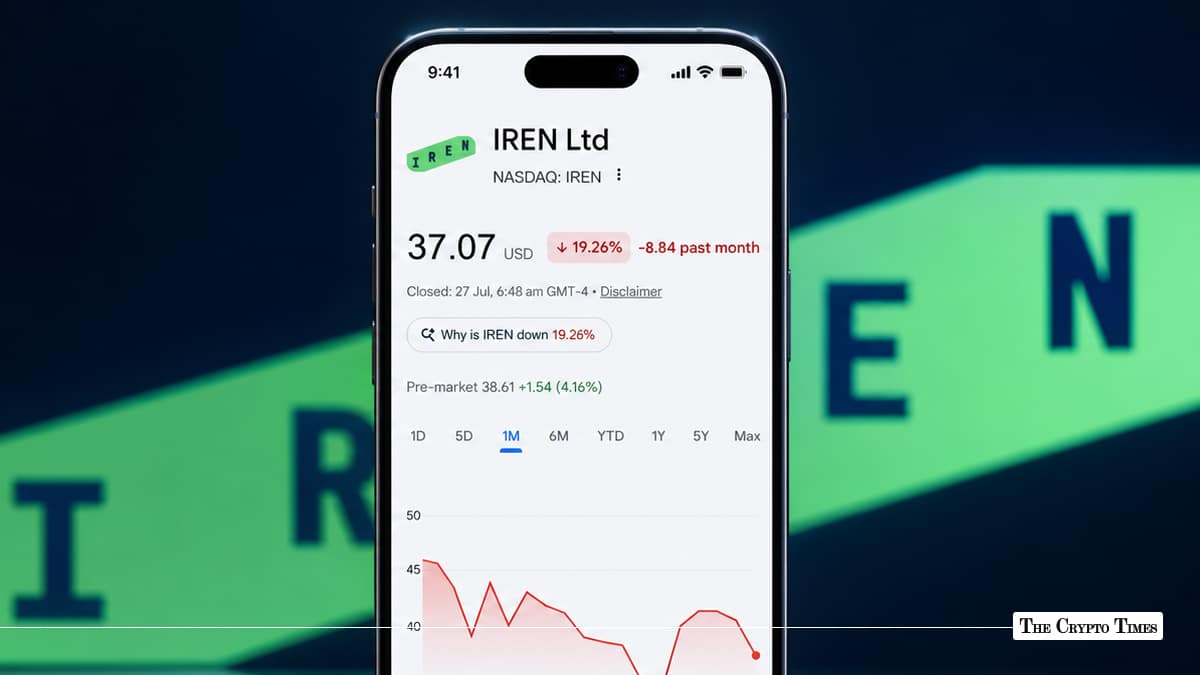
Per The Crypto Times’ July 20 coverage, IREN shares surged nearly 17-20% in premarket trading, climbing from below $33 the previous week to approximately $39-40, lifting the company’s market capitalization to approximately $12.11 billion.
What moves IREN stock?
IREN shares are influenced by several overlapping forces.
Bitcoin prices and mining economics still matter because mining remains an important part of the operating business. AI contract announcements can change expectations for future revenue and the valuation investors are willing to assign to the company.
Construction milestones, GPU deliveries, and data-center energization are also important. Even a major customer agreement cannot generate revenue if the supporting facility or hardware is delayed.
Financing is another major factor. Large data centers and GPU clusters require substantial upfront spending. IREN may use cash, customer prepayments, equipment financing, convertible debt, or equity issuance to support expansion.
Each funding source carries different consequences. Debt can increase interest costs and repayment obligations, while issuing new shares can dilute existing shareholders.
On the balance sheet, IREN reported approximately $7.6 billion in cash and cash equivalents as of June 30, 2026, more than triple its $2.21 billion cash position on March 31, 2026. That increase reflected significant equity issuances, new convertible notes ($3.69 billion carrying value on March 31), and customer prepayments including approximately $1.7 billion in restricted cash tied to the Microsoft contract’s GPU financing structure. Property, plant and equipment stood at approximately $4.37 billion on March 31, 2026, reflecting the ongoing GPU and data center build-out.
The stock is also sensitive to broader sentiment. Enthusiasm for AI infrastructure or crypto-linked equities can lift its valuation, while weaker risk appetite can quickly pressure a company combining construction risk, Bitcoin exposure, and high capital requirements.
Key risks investors should understand
Execution risk: IREN must complete facilities, secure equipment, connect power, and deliver services on schedule. A signed customer contract does not remove construction, supply-chain, or commissioning risk.
Capital and dilution risk: The AI expansion requires billions of dollars in infrastructure and hardware. Funding that expansion could increase debt, interest expense, or the number of shares outstanding.
Executive compensation risk: In June 2026, IREN granted each co-CEO, Daniel Roberts and William Roberts, 9,099,328 restricted stock units. The awards have a combined six-year vesting and holding period, but their size raised investor concerns about dilution and corporate governance. On July 8, 2026, IREN independent chair David Bartholomew published a shareholder letter defending the awards, citing the company’s market capitalization growth from less than $4 billion to more than $16 billion in the prior fiscal year, driven by the NVIDIA, Microsoft and other customer wins, plus expansion into two new continents, as the board’s rationale for the retention-focused package. The RSUs are held via Awassi Capital Trust #1, an entity through which the Roberts brothers hold their IREN shares while disclaiming certain beneficial-ownership provisions.
Bitcoin sensitivity: Weak Bitcoin prices, rising network difficulty or higher electricity costs can continue to pressure the mining business.
Customer concentration risk: Major contracts can improve revenue visibility, but reliance on a small number of large customers creates exposure if one customer delays, renegotiates, or fails to meet its obligations. Microsoft and NVIDIA together represent the majority of IREN’s contracted future revenue, giving both customers substantial leverage in any commercial negotiation.
Technology risk: GPUs and Bitcoin mining machines can become obsolete. Cloud-computing rental prices could also decline as more capacity enters the market.
Valuation risk: Investors may value IREN using AI revenue that has not yet been reported. A delay or reduction in expected ARR could therefore trigger a sharp reassessment of the stock.
Recent IREN stock performance
IREN’s recent trading illustrates its volatility.
The Crypto Times reported in early July that the company had approved restricted-stock awards worth approximately $700 million for co-founders and co-CEOs Daniel and William Roberts. The package covered roughly 18.2 million restricted stock units. Shares subsequently fell nearly 7% as investors focused on potential dilution, the size of the compensation package and the company’s continuing losses.
The stock later rebounded sharply after the company announced $2.8 billion in new AI Cloud contracts and raised its year-end ARR target. In premarket trading on July 20, 2026, IREN shares surged nearly 17-20%, climbing from below $33 the previous week to approximately $39-40, and the market capitalization increased to approximately $12.11 billion.
These moves reflect the market’s attempt to balance Bitcoin exposure and AI growth against major capital needs, execution risk and corporate-governance decisions.
Is IREN stock the same as owning Bitcoin?
No. IREN can be influenced by Bitcoin, but owning IREN shares is not the same as owning BTC.
IREN shareholders are exposed to management decisions, operating expenses, debt, equity issuance, construction execution, hardware depreciation, customer contracts, and stock-market valuation.
Bitcoin can rise while IREN falls because of company-specific developments. IREN can also rise while Bitcoin remains flat if investors become more optimistic about its AI Cloud business.
Investors seeking direct Bitcoin price exposure may therefore view IREN very differently from investors seeking a combination of Bitcoin mining, data-center infrastructure, and artificial intelligence growth.
The bottom line
IREN is a publicly traded data-center operator evolving from renewable-powered Bitcoin mining into large-scale AI Cloud infrastructure.
Its core asset is not simply a fleet of mining machines or GPUs. It is the combination of land, power access, grid-connected facilities, construction capabilities, and computing hardware.
The opportunity is significant. IREN is signing multiyear AI contracts and targeting billions of dollars in annualized revenue against a backdrop of $13+ billion in anchor customer commitments (Microsoft $9.7B and NVIDIA $3.4B) plus the $2.8 billion in additional contracts announced July 20, 2026. The risks are also substantial: those targets require major investment, timely execution, and sustained customer demand, while the existing business remains exposed to Bitcoin and the company may issue debt or equity to finance growth.
For readers asking, “What is IREN stock?”, the clearest answer is that it is a volatile hybrid of a Bitcoin miner, an AI cloud provider and a power-intensive data-center developer.
That combination can create considerable upside when execution and market conditions align, but it also makes the shares more complex than a straightforward bet on either Bitcoin or artificial intelligence.
Disclaimer: This article is for informational purposes only and does not constitute financial, investment or trading advice. IREN stock and crypto-linked equities can be highly volatile. Readers should conduct independent research and consult a qualified financial adviser before making investment decisions.