So far, DeFi sounds great. You trade directly with a contract, you own your keys, and you can earn fees.
But the blockchain is not a friendly place. It is often described as a Dark Forest.
In the traditional world, if you send a buy order to the stock exchange, regulated laws prevent brokers from cutting in line to buy it before you. In DeFi, cutting in line is not only legal; it is a multi-million dollar industry.
In this chapter, we will look at the invisible costs of trading—why you sometimes get less crypto than you expected, and who is lurking in the shadows waiting for you to click “Swap.”
1. Slippage: The Price of Size
First, let’s talk about a natural cost of trading called Slippage.
In an AMM (from Chapter 5), the price is determined by the ratio of tokens in the pool. If you make a huge trade, you significantly change that ratio, which changes the price while you are trading.
The Analogy: Imagine a small swimming pool. If a toddler jumps in, the water level barely changes. If an elephant jumps in, the water is displaced everywhere.
- Toddler (Small Trade): You buy $10 of ETH. The pool ratio barely shifts. You get the market price.
- Elephant (Whale Trade): You buy $10,000,000 of ETH. Your massive purchase eats up all the cheap ETH and starts forcing you to buy the expensive ETH. The average price you pay ends up being much higher than the spot price.
Slippage is the difference between the price you saw on the screen and the price you actually got.
How to fix it:
- Trade in pools with deeper liquidity (bigger swimming pools).
- Break large trades into smaller chunks.
2. The Mempool and MEV (The Dark Forest)
Now, let’s talk about the predators. This involves a concept called MEV (Maximal Extractable Value).
When you click “Swap” on Uniswap, your transaction doesn’t go onto the blockchain immediately. It goes into a waiting room called the Mempool (Memory Pool).
In this waiting room, your transaction is visible to everyone, but it hasn’t been confirmed yet. Miners (or Validators) pick transactions from this room to build the next block.
Here is the catch: Miners don’t have to process transactions in the order they arrived. They process them in the order of who pays the highest fee.
This allows sophisticated bots to bribe miners to reorder transactions.
3. Front-Running and Sandwich Attacks
The most common form of MEV is the Sandwich Attack. It is essentially electronic theft, but purely through code.
How a Sandwich Attack Works:
- The Victim: You submit a transaction to buy 100 ETH. A bot spots your transaction in the Mempool.
- The Front-Run (The Top Bread): The bot bribes the miner to place their buy order immediately before yours.
- Result: The bot buys the cheap ETH. The price goes up.
- The Victim Execution (The Meat): Your transaction goes through. Because the bot pumped the price, you are forced to buy at a higher price (high slippage).
- The Back-Run (The Bottom Bread): The bot immediately sells their ETH after your transaction.
- Result: Since you pushed the price up even further, the bot sells at a profit. You essentially paid for their lunch.
This happens in milliseconds. The user usually just thinks, “Oh, the market is volatile today,” not realizing they were just robbed of 1-2% of their trade.
4. Liquidity Fragmentation
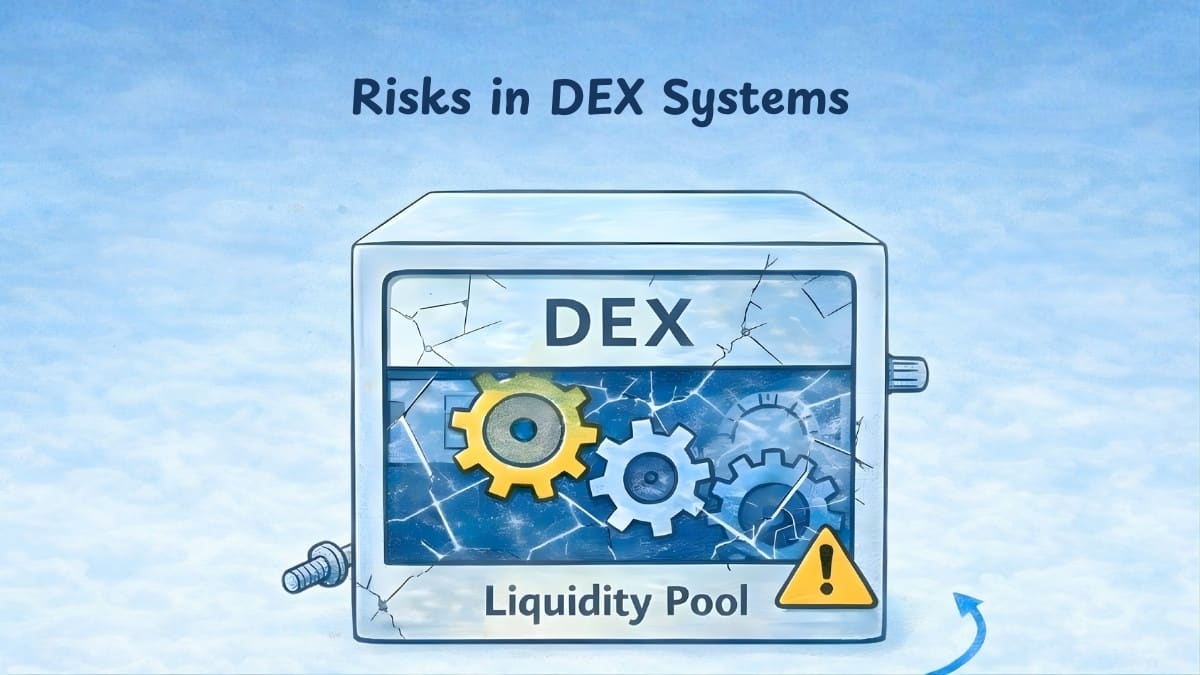
Another risk in DEX systems is that money is scattered.
In TradFi, the New York Stock Exchange is the central hub. In DeFi, liquidity for ETH/USDC might be split across:
- Uniswap on Ethereum
- SushiSwap on Ethereum
- Raydium on Solana
- TraderJoe on Avalanche
This is Liquidity Fragmentation.
If you trade on a small, isolated exchange, you will suffer from terrible pricing (high slippage) because the pool is shallow.
The Solution: This is why DEX Aggregators (like 1inch or Jupiter) are so popular. They act like travel booking sites (Expedia/Skyscanner), splitting your trade across multiple exchanges to find the best route and minimize slippage.
5. Oracle Dependency
We will cover Oracles deeply in Unit V, but it is worth mentioning here.
If a DEX relies on an external price feed (an Oracle) to determine the value of assets, and that Oracle gets hacked or manipulated, the DEX can be drained.
If the Oracle says “1 USDC = $100” (instead of $1), smart contracts will blindly allow someone to swap 1 USDC for $100 worth of ETH, bankrupting the pool in seconds.
Summary
DEXs are powerful tools for permissionless trading, but they demand awareness.
- Slippage is the cost of moving the market.
- MEV is the cost of trading in public view.
To survive in the Dark Forest, users set “Slippage Tolerance” (e.g., “If the price moves more than 0.5%, cancel the trade”) and use special “RPC endpoints” (like Flashbots) that hide their transactions from the Mempool until they are confirmed.
Coming Up Next:
We have conquered trading. Now we move to the other massive pillar of finance: Credit. In Unit III, we will explore how you can borrow millions of dollars without a credit check. We start with Chapter 8: DeFi Lending Protocols.
Disclaimer:
Some elements of this content may have been enhanced with the help of our artificial intelligence (AI) assistants for purposes such as basic refinement, review, image generation, and translation to deliver high-quality news in a shorter time frame. However, all AI-assisted content is reviewed and approved by our team to ensure accuracy, fairness, and editorial integrity.