In the old world, “making markets” was a game reserved for massive institutions like Citadel or Goldman Sachs. They had the capital, the algorithms, and the access.
In DeFi, you can be Goldman Sachs.
By becoming a Liquidity Provider (LP), you are essentially opening your own currency exchange booth. You put up the cash, you facilitate the trades, and you keep the fees. It sounds like passive income heaven, but as we will see, there is a catch.
1. The Role of the Liquidity Provider
Recall the AMM model from the last chapter (x * y = k). That formula only works if there are actually tokens in the pool to trade.
If a pool has 0 ETH and 0 USDC, the trading stops. The market dies.
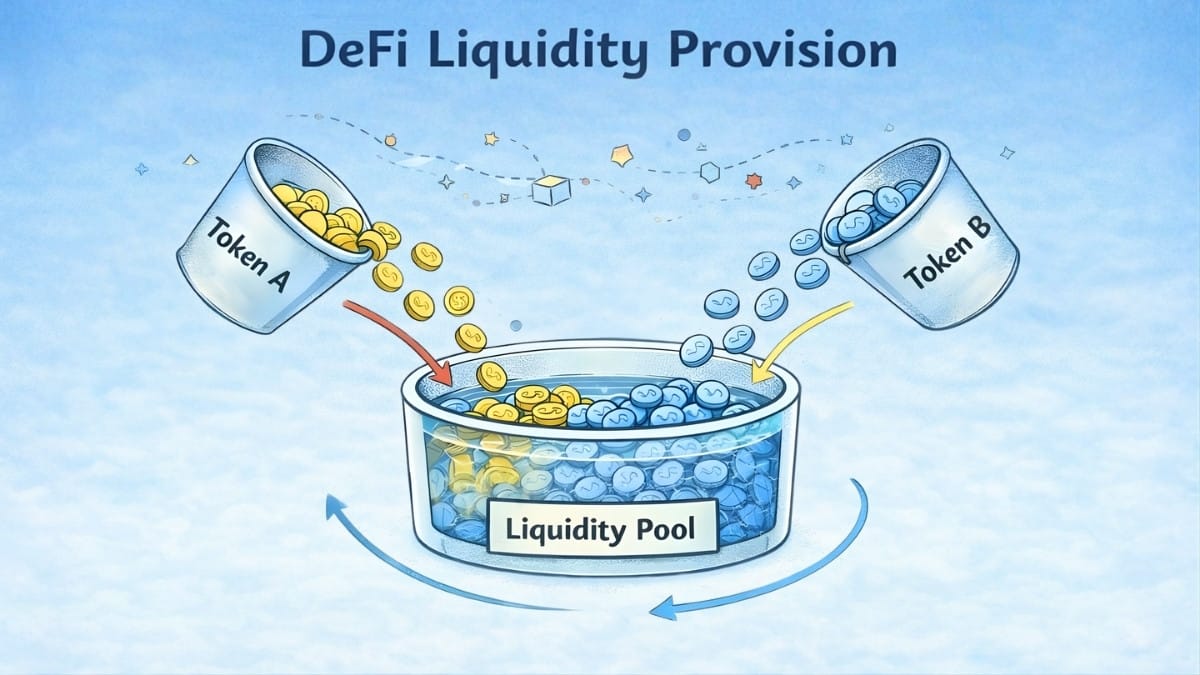
Liquidity Providers are the lifeblood of DeFi. They are the users who deposit their idle assets into these smart contracts to ensure there is always money available for traders to swap.
In exchange for locking up your funds, the protocol gives you:
- LP Tokens: A digital receipt representing your share of the pool.
- Trading Fees: A cut of every single trade that happens in that pool.
2. The Incentive: Trading Fees
Why would you lock your money in a smart contract instead of just holding it in your wallet? Yield.
When a trader swaps ETH for USDC on Uniswap, they pay a fee (typically 0.3%). This fee does not go to Uniswap the company; it is distributed directly to the Liquidity Providers, proportional to their share of the pool.
The Math:
- The pool has $1,000,000 in liquidity.
- You provided $10,000 (1% of the pool).
- The pool does $10,000,000 in trading volume today.
- Fees collected (0.3%) = $30,000.
- Your cut: You earn 1% of the fees = $300 for the day.
In a bull market with high trading volume, being an LP can be incredibly lucrative.
3. The Catch: Impermanent Loss (IL)
This is the concept that confuses beginners and bankrupts experts.
Impermanent Loss describes a situation where you would have made more money by just holding your tokens in your wallet than by providing liquidity.
How does it happen?
AMMs are designed to sell your winners and buy losers.
- If the price of ETH goes up, the AMM sells your ETH to buy USDC (balancing the pool).
- If the price of ETH goes down, the AMM sells your USDC to buy ETH.
The Scenario:
Imagine you deposit 1 ETH and $3,000 USDC into a pool. (Total value: $6,000).
- Suddenly, the market price of ETH explodes to $6,000.
- Arbitrage traders rush in. They buy the “cheap” ETH from your pool until the pool price matches the market.
- The Result: You now hold less ETH and more USDC.
- The Comparison: If you had just held that 1 ETH in your wallet, you would have $6,000 worth of ETH. But because the pool sold some of it on the way up, your total pool value might only be $5,500.
- The Loss: That $500 difference is your Impermanent Loss.
Why “Impermanent”?
Because if the price of ETH drops back down to exactly $3,000, your loss disappears. You only realize the loss permanently if you withdraw your funds while the prices are different from when you entered.
4. The Evolution: Concentrated Liquidity (Uniswap v3)
The standard AMM model (Uniswap v2) was inefficient. It spreads your liquidity across every possible price—from $0 to Infinity.
Think about it: If ETH is trading at $2,000, why are you providing liquidity for the $5 price point? ETH isn’t going to $5 today. That money is sitting there doing nothing.
Concentrated Liquidity (introduced by Uniswap v3) changed the game. It allows LPs to choose a specific Price Range.
The Analogy:
- Standard Liquidity: Spreading a thin layer of butter over a mile-long loaf of bread. Most of the butter is wasted on parts of the bread nobody is eating.
- Concentrated Liquidity: Putting a thick slab of butter on just the one slice of toast everyone is fighting for.
The Result:
- Capital Efficiency: You can put up less money and earn more fees because your liquidity is being used more often.
- Higher Risk: If the price of ETH moves outside your chosen range (e.g., below $1,800 or above $2,200), your liquidity becomes inactive. You stop earning fees entirely, and you are left holding 100% of the falling asset.
Summary
Liquidity Provision is the engine of DeFi, turning passive assets into productive, yield-bearing capital.
- Pros: You earn passive income from trading fees.
- Cons: You are exposed to Impermanent Loss. If the market is extremely volatile, your trading fees might not cover the loss in asset value.
Being an LP is not a “set it and forget it” strategy. It is an active management game of predicting volatility.
Coming Up Next:
Trading isn’t just about math; it’s about predators. In Chapter 7, we will look at the dark forest of the blockchain—MEV bots, Sandwich Attacks, and Slippage—and how to protect yourself.
Disclaimer:
Some elements of this content may have been enhanced with the help of our artificial intelligence (AI) assistants for purposes such as basic refinement, review, image generation, and translation to deliver high-quality news in a shorter time frame. However, all AI-assisted content is reviewed and approved by our team to ensure accuracy, fairness, and editorial integrity.