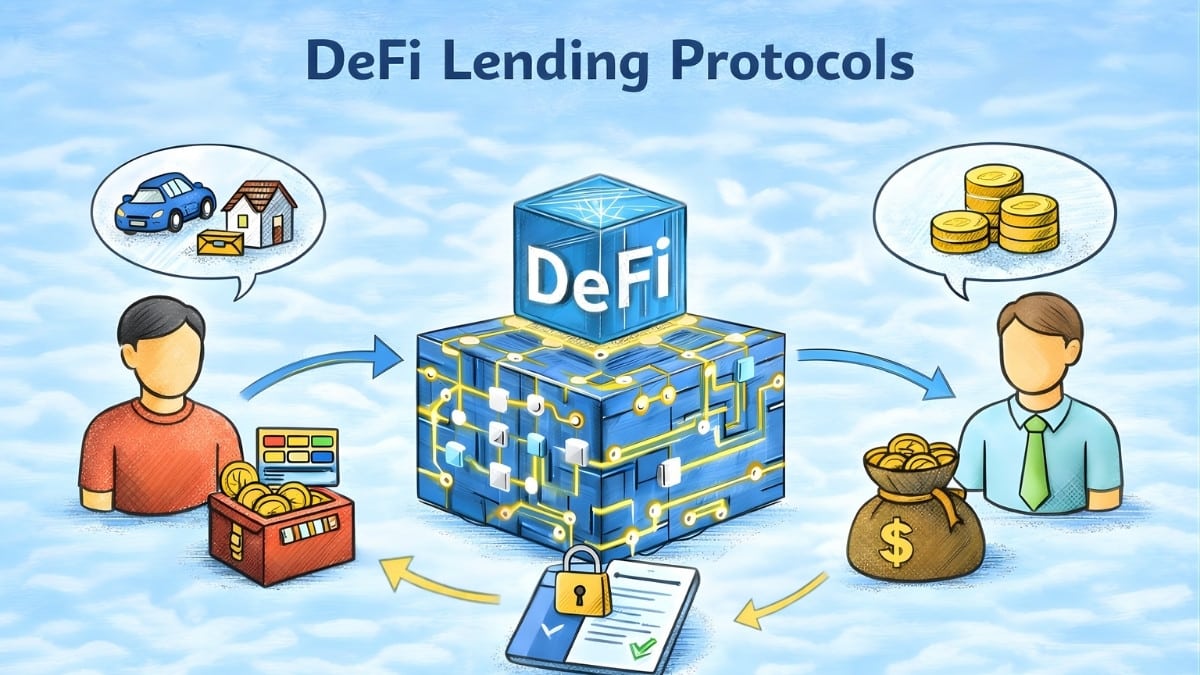
If DEXs are the “Stock Exchange” of DeFi, then Lending Protocols are the “Banks.”
In the traditional world, credit is the oil that keeps the economic engine running. Businesses borrow to expand, homeowners borrow to buy houses, and hedge funds borrow to amplify their trades.
In DeFi, we have rebuilt this entire credit system, but with one major twist: The protocol doesn’t care who you are. It doesn’t care about your credit score, your income, or your history. It only cares about your collateral.
In this chapter, we will look at how we built a lending system that works for anonymous strangers.
1. Why Lending Exists in DeFi
Why would anyone borrow crypto? You can’t exactly use Bitcoin to buy a house (yet).
In DeFi, borrowing is almost exclusively used for Leverage and Strategy, not for consumption.
- The Lender’s Motivation (Yield): If you have 10 ETH sitting in your wallet doing nothing, it is “lazy capital.” By depositing it into a protocol like Aave, you earn interest paid by borrowers. It is essentially a high-yield savings account that pays you every second.
- The Borrower’s Motivation (Leverage & Liquidity):
- Leverage (Long): You think ETH is going to $10,000. You don’t want to sell your ETH, but you want more ETH. You deposit your ETH as collateral, borrow stablecoins (USDC), and use that USDC to buy more ETH.
- Shorting: You think the price of SOL is going down. You borrow SOL, sell it immediately for USDC, wait for the price to crash, buy it back cheaper, repay the loan, and pocket the difference.
- Tax Efficiency: Selling crypto is a taxable event. Borrowing against it is (usually) not.
2. Peer-to-Peer vs. Peer-to-Pool
This is a critical distinction in understanding how DeFi scales.
The Old Way: Peer-to-Peer (P2P)
Imagine a bulletin board where Alice posts: “I want to borrow 1,000 USDC for 30 days at 5% interest.” Bob sees it and agrees.
- Problem: This is slow. Alice has to wait for Bob. If Bob wants his money back early, he can’t get it.
The DeFi Way: Peer-to-Pool (Pool-Based)
DeFi solved the speed problem by removing the direct match.
- The Pool: Alice and thousands of others deposit their money into a giant “bucket” (Smart Contract).
- The Borrower: Bob comes along. He doesn’t ask Alice for money; he takes it directly from the bucket. But he would first need to supply collateral.
- The Benefit: Instant liquidity. Alice can withdraw her money anytime (as long as the bucket isn’t empty), and Bob can borrow anytime without waiting for a counterparty.
Note on Efficiency: Newer protocols (like Morpho) are creating hybrid models. They try to match Peer-to-Peer first (because it’s more efficient/better rates) and fall back to the Pool if no match is found.
3. Supply and Borrow Mechanics
So, what does this look like in practice? Let’s walk through the lifecycle of a DeFi loan on a protocol like Aave or Compound.
Step 1: Supply (The Deposit)
You deposit $1,000 worth of USDC into the protocol.
- The protocol takes your USDC and adds it to the pool.
- The Receipt: The protocol instantly mints a new derivative token and gives it to you (e.g., aUSDC on Aave).
- The Magic: This token is your claim on the funds. As borrowers pay interest, the pool grows. Your aUSDC balance grows automatically in your wallet. You are earning interest literally every second (every Ethereum block).
Step 2: Borrowing
To borrow, you must first be a supplier. You cannot borrow with zero funds (remember: no credit scores).
- Deposit Collateral: You deposit $1,500 worth of ETH.
- Draw Debt: You click “Borrow” and take out $1,000 worth of USDC.
- The Lock: Your $1,500 of ETH is now “locked.” You cannot withdraw it until you repay the $1,000 USDC + Interest.
4. The “Utilization” Dynamic
How is the interest rate set? In a bank, the Federal Reserve influences rates. In DeFi, it is pure supply and demand, defined by Utilization Rate.
Utilization = Total Borrowed \ Total Supplied
- Low Utilization (10%): The pool is full of cash, but nobody is borrowing.
- Result: Interest rates drop to near 0% to encourage borrowing.
- High Utilization (90%): The pool is running dry! Lenders might not be able to withdraw!
- Result: Interest rates skyrocket (sometimes to 50%+ or more) to force borrowers to repay loans and attract new lenders to deposit.
This algorithm ensures the system never completely runs out of money.
Summary
DeFi lending replaces the “Credit Check” with “Collateral” and the “Bank Manager” with an “Algorithm.”
It is a system of Peer-to-Pool liquidity where interest rates fluctuate in real-time based on how much money is actually available in the bucket.
But wait—if I have to deposit $1,500 to borrow $1,000, isn’t that capital inefficient? Why would I do that? And what happens if the value of my ETH collateral drops overnight?
Disclaimer:
Some elements of this content may have been enhanced with the help of our artificial intelligence (AI) assistants for purposes such as basic refinement, review, image generation, and translation to deliver high-quality news in a shorter time frame. However, all AI-assisted content is reviewed and approved by our team to ensure accuracy, fairness, and editorial integrity.