Welcome to the bleeding edge of finance.
If you have ever felt frustrated by a bank charging you a fee to hold your own money, or wondered why sending funds across a border takes three days while an email takes three seconds, you already understand why decentralized finance (DeFi) exists.
In this first chapter, we are going to strip away the buzzwords and look at what DeFi actually is, how it challenges the traditional banking system, and the technological engine that keeps it running.
1. Definition of Decentralized Finance
At its core, Decentralized Finance (DeFi) is an umbrella term for financial services—like lending, borrowing, and trading—that operate on blockchains without central intermediaries.
In the traditional world, if you want to lend money, you go to a bank. If you want to trade stocks, you go to a broker. These intermediaries act as “gatekeepers.” They hold your funds, verify your identity, and grant you permission to transact.
DeFi removes these gatekeepers. Instead of trusting a bank to manage the ledger, you trust the immutable code.
The Simple Analogy:
Think of Traditional Finance (TradFi) like a vending machine run by a shopkeeper. You hand money to the shopkeeper, and they decide if they want to sell to you, at what price, and when.
While DeFi is a robotic vending machine made of glass. It runs automatically based on pre-written rules. Anyone can see exactly how the machine works, anyone can use it, and no shopkeeper can stop you from buying a snack if you have the money.
2. DeFi vs. Traditional Finance (TradFi)
To truly understand the shift, we have to look at how DeFi contrasts with the system we use today.
| Feature | Traditional Finance (TradFi) | Decentralized Finance (DeFi) |
|---|---|---|
| Intermediary | Banks, Brokers, Clearing Houses | Smart Contracts (Code) |
| Access | Permissioned (KYC, Citizenship, Credit Score) | Permissionless (Anyone with an internet connection) |
| Custody | Custodial (The bank holds your money) | Non-Custodial (You hold your own keys/money) |
| Transparency | Opaque (Ledgers are private) | Transparent (All transactions are auditable on-chain) |
| Settlement | Slow (T+2 days for stocks, hours for wires) | Near-Instant (Minutes or seconds, depending on the chain) |
| Market Hours | 9 AM – 5 PM (Mon-Fri) | 24/7/365 |
3. Why DeFi Emerged
DeFi didn’t appear in a vacuum. It was born out of specific failures and limitations in the legacy financial system.
- The Trust Crisis: The 2008 Financial Crisis highlighted the dangers of trusting centralized institutions with the world’s money. When banks gamble and lose, the public often pays the price. DeFi emerged from the ethos of Bitcoin: Don’t trust, verify.
- The Access Problem: According to the World Bank, roughly 1.4 billion adults are unbanked. TradFi is expensive to operate; banks simply don’t build branches in places where they can’t make a profit. DeFi requires no physical branches—just the internet.
- The Efficiency Problem: Why does it cost $30 to send a wire transfer? Because the money has to hop through three or four correspondent banks, each taking a cut. Meanwhile, DeFi is peer-to-peer, drastically reducing overhead.
4. Role of Blockchain and Smart Contracts
If DeFi is the car, Blockchain is the road it drives on, and Smart Contracts are the engine.
The Blockchain (The Ledger)
A blockchain is a shared, immutable database. In DeFi, it serves as the “source of truth.” It records who owns what and who owes what. Because it is decentralized, no single entity can erase or alter the history of transactions.
Smart Contracts (The Logic)
A smart contract is a self-executing program stored on the blockchain. This element is actually the magic sauce of DeFi.

Think of a standard legal contract: “If John pays Smith $100, then John transfers the car title to Smith.” In the real world, you need paperwork and sometimes even a lawyer to enforce this.
In DeFi, the Smart Contracts enforces it automatically:
- The code looks for the $100 payment.
- Once received, it instantly and automatically releases the digital title to Smith.
- No lawyer, no escrow agent, no delay.
5. Core Principles of DeFi
As we move through this course, you will see three words come up repeatedly. These are the pillars of the DeFi philosophy:
1. Permissionless
There are no bouncers at the door. You do not need to show your ID, reveal your credit score, or live in a specific country to use DeFi. If you have a crypto wallet, you are in. This creates a truly global, open market.
2. Non-Custodial
In TradFi, the bank is the “custodian” of your funds. If the bank freezes your account, you lose access. In DeFi, you retain self-custody. You hold the private keys to your assets. The protocol interacts with your wallet, but it (usually) doesn’t take ownership of your funds unless you explicitly authorize a trade.
3. Composable (“Money Legos”)
This is perhaps the most powerful feature in DeFi. Because DeFi runs on open-source code, developers can build financial applications on top of each other’s work.
Imagine if you could take the login system from Google, the interface from Apple, and the database from Amazon and snap them together to build a new app. That is impossible in the corporate world.
In DeFi, a developer can take a lending protocol (like Aave), combine it with a trading protocol (like Uniswap), and build a totally new product. This ability to stack applications is called Composability, often referred to as “Money Legos.”
Summary
DeFi is not just “banking on the internet” (which is what we have now); it is banking nativeto the internet. It replaces trust in institutions with trust in code, offering a system that is transparent, open to everyone, and incredibly fast.
However, stripping away the safeguards of the old world brings new risks. If you are your own bank, there is no customer support hotline to call if you lose your password.
Coming Up Next:
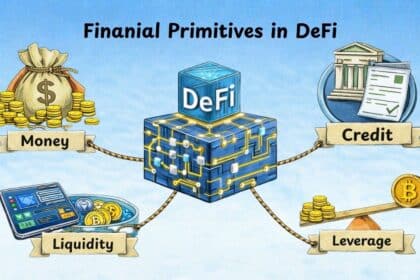
Now that we know what DeFi is, we need to understand the building blocks. In Chapter 2, we will explore the Financial Primitives in DeFi—how code recreates concepts like money, credit, and leverage from scratch.
Disclaimer:
Some elements of this content may have been enhanced with the help of our artificial intelligence (AI) assistants for purposes such as basic refinement, review, image generation, and translation to deliver high-quality news in a shorter time frame. However, all AI-assisted content is reviewed and approved by our team to ensure accuracy, fairness, and editorial integrity.