When you open a DeFi app on your phone, it feels like a single cohesive experience. But under the hood, it is actually a “stack” of distinct technologies working together.
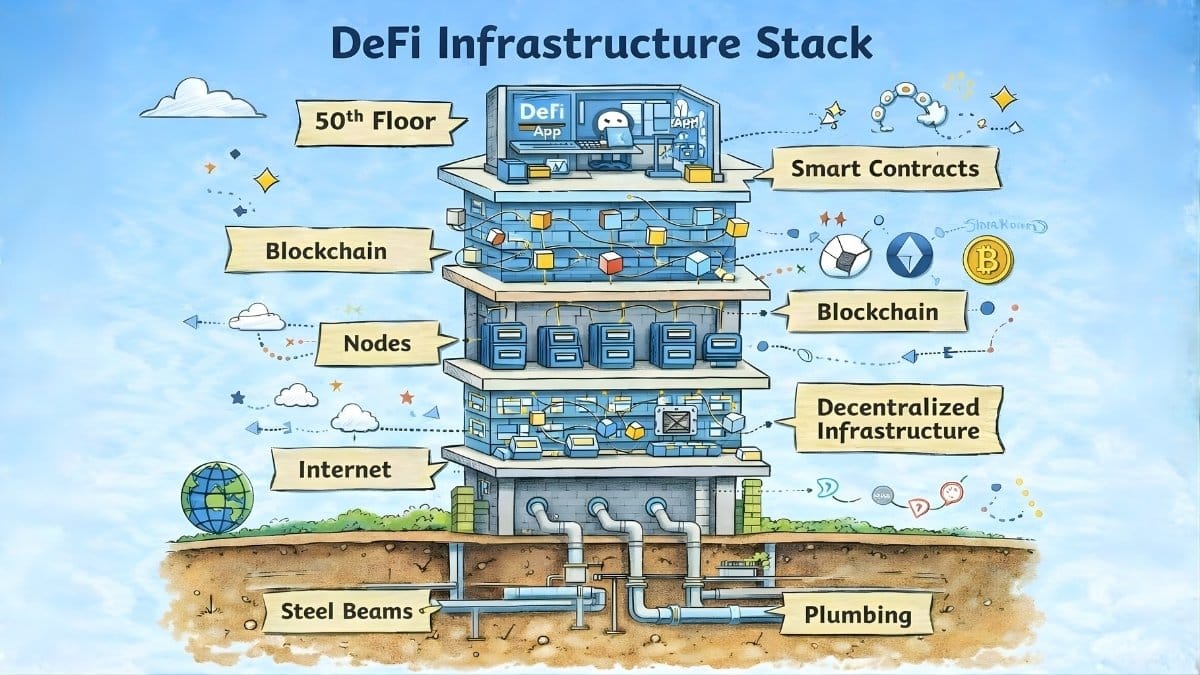
Think of DeFi like a skyscraper. You can’t just have an office on the 50th floor floating in the air; it needs steel beams, plumbing, a foundation, and land to sit on.
In this chapter, we are going to peel back the layers of the DeFi skyscraper, starting from the ground up.
1. The Base Layer (The Settlement Layer)
The Analogy: The land and the bedrock.
This is the blockchain itself—usually Ethereum, Solana, Tron, or any other.
This layer is responsible for the ultimate truth. It stores the ledger of who owns what. It provides security and consensus. When a transaction is “settled” here, it is final. It cannot be reversed.
The Base Layer has a distinct native currency (like ETH or SOL). This currency is used to pay for the “gas” required to occupy space on this digital land. Without the Base Layer, nothing else can exist.
2. The Smart Contract Layer (The Logic)
The Analogy: The steel framework and building codes.
The Base Layer alone is just a ledger. To build DeFi, we need logic.
The Smart Contract layer is where developers write the rules. This layer determines how assets can move. It introduces standards so that different applications can speak the same language.
- Token Standards: For example, ERC-20 is a standard on Ethereum that defines how a “fungible token” (like a stablecoin) behaves. Because of this standard, a wallet created in 2018 can still hold a token created in 2025.
- NFT Standards: ERC-721 defines how unique items (digital art, insurance policies, or Uniswap liquidity positions) are handled.
Besides, smart contracts involve logic, flow of funds, calculations and various other “programmable” capabilities that lead to a fully fledged financial ecosystem.
3. Middleware Layer (The Utilities)
The Analogy: The plumbing, electricity, and internet lines coming into the building.
Blockchains are isolated. They know everything that happens inside their own network, but they are blind to the outside world. A smart contract on Ethereum doesn’t know the price of Apple stock, the winner of the Super Bowl, or even the price of Bitcoin on another chain.
To fix this, we use Middleware:
- Oracles: These are third-party services (like Chainlink) that fetch data from the real world (e.g., “The price of Gold is $2,000”) and feed it onto the blockchain so smart contracts can use it. Without oracles, most DeFi apps would break.
- Keepers/Relayers: Smart contracts are “lazy.” They can’t trigger themselves; someone has to poke them. “Keepers” are automated bots that monitor the network to perform maintenance tasks, like liquidating a risky loan or harvesting yield, ensuring the system keeps running smoothly.
4. The Application Layer (The Protocols)
The Analogy: The specific businesses inside the skyscraper (The Bank, The Exchange, The Casino).
This is what we typically call “DeFi.” These are the actual programs deployed on the blockchain that users interact with.
- DEXs (Decentralized Exchanges): Protocols like Uniswap or Curve that allow trading.
- Lending Markets: Protocols like Aave or Compound that allow borrowing.
- Derivatives: Protocols like Hyperliquid or dYdX that allow betting on future prices.
Crucially, these applications are permissionless. Anyone can build a shop in this skyscraper. If you don’t like the rules of the “Bank” on the 4th floor, you can build a competitor on the 5th floor.
5. The User Interface (UI) / Aggregator Layer
The Analogy: The lobby, the directory, and the elevator buttons.
We generally don’t interact with code directly (unless you are a developer). We interact with a website or a mobile app. This is the Front End. This interaction is usually done by using crypto wallets.
- Wallets: Tools like MetaMask, Phantom, or Rabbit allow you to hold your keys and sign transactions. They are your “passport” to the building.
- Aggregators: Imagine if you wanted to buy milk, and you had a personal shopper who instantly checked the prices at 50 different grocery stores and bought it from the cheapest one. That is an Aggregator (like 1inch or Jupiter). They don’t hold liquidity themselves; they scan the Application Layer to find you the best deal.
Important Note on Risk:
A website (Layer 5) is just a window into the blockchain. If the website uniswap.org goes down, the Uniswap protocol (Layer 4) is still running on the blockchain. You could still interact with it directly through code or alternative interfaces. The building still stands even if the front door is locked.
Summary: The Full Stack
| Layer | Component | Function | Example |
|---|---|---|---|
| 5. UI/Aggregator | Front-end | User Access & Optimization | MetaMask, 1inch, Zapper |
| 4. Application | DApps | Financial Services | Uniswap, Aave, MakerDAO |
| 3. Middleware | Oracles / Keepers | Data & Automation | Chainlink, Gelato, The Graph |
| 2. Smart Contract | Standards | Rules & Token definitions | ERC-20, ERC-721 |
| 1. Base | Blockchain | Security & Settlement | Ethereum, Solana, Arbitrum |
Understanding this stack is vital for security. A failure at the UI layer (phishing site) hurts only you. A failure at the Base layer (blockchain halts) hurts everyone.
Coming Up Next:
We have finished the foundations! Now it is time to get our hands dirty with the actual mechanics of trading. In Unit II, Chapter 4, we will dive into Decentralized Exchanges (DEXs) and explore how trading without a broker actually works.
Disclaimer:
Some elements of this content may have been enhanced with the help of our artificial intelligence (AI) assistants for purposes such as basic refinement, review, image generation, and translation to deliver high-quality news in a shorter time frame. However, all AI-assisted content is reviewed and approved by our team to ensure accuracy, fairness, and editorial integrity.