In the blockchain ecosystem, delays in transactions and high costs have impacted the growth of decentralized applications (dApps). To deal with these challenges, here comes Aptos blockchain, which was developed by more than 350 developers over three years.
It aims to provide scalability, safety, reliability, upgradability, and novel innovations to the blockchain industry. In this article, we will go through the basics behind the Aptos blockchain by looking into their origin, features, functions, and what makes it unique.
What is Aptos Blockchain?
Aptos is a layer one blockchain network that was developed with key principles of scalability, reliability, upgradability, and safety. It was aimed to reform the layer one crypto ecosystem with novel ideas for consensus mechanism, smart contract design, system security, performance, decentralization, etc.
The core of the Aptos blockchain ecosystem is the Move Programming Language, which is a Rust-based framework developed for the safe and efficient working of smart contracts. The network depends on a proof-of-stake mechanism and Byzantine Fault Tolerance, which requires validators to stake Aptos native tokens to participate in transaction validation and governance.
Origin and History of Aptos Blockchain
The idea of Aptos blockchain emerged in late 2021, which was founded by the former Meta engineers Mo Shaikh and Avery Ching, who are also involved in the Diem blockchain project. After the discontinuation of the Diem blockchain project, they established Aptos Labs to develop a secure Layer 1 network.
Using their expertise, Aptos blockchain was developed to address the limitation of existing blockchain technology. It uses the Move Programming Language, which was originally developed for the Diem project to boost transaction, safety and efficiency.
The Aptos blockchain has gone through various tests before it launched its mainnet in 2022. In the beginning, it has faced various challenges like performance issues, community concerns, but it has shown commitment to improvement.
After the successful launch of Aptos it has gained funding from various investors like Andreessen Horowitz, Binance Labs, etc. It also partnered with Microsoft and Google Cloud to boost its infrastructure and services.
Key features of Aptos Blockchain
Here are some key features of the Aptos blockchain:
Parallel Transaction Execution
The Aptos blockchain uses Block-STM which is a parallel execution engine that processes multiple transactions and enables the blockchain to handle high transaction volumes.
Move Programming Language
The Move programming language ensures that smart contracts are developed efficiently and help in the development of decentralized applications (dApps).
AptosBFT Consensus Mechanism
Aptos uses the AptosBFT consensus protocol, which combines Byzantine fault tolerance with a proof-of-stake (PoS) mechanism. This combination of mechanisms helps the network maintain consensus even in the presence of faulty nodes.
Modular and Upgradable architecture
Aptos blockchain uses a modular design, which is helpful in facilitating upgrades without the disruption in the network. This unique feature helps in faster adoption of new technology.
High throughput and Low latency
The blockchain is popular due to its high throughput and ability to process thousands of transactions per second which is helpful in the development of decentralized applications.
Supports All Types of Nodes
The network supports all types of nodes, such as full nodes and light nodes which serves the user requirements of every individual.
High Security
The blockchain focuses on providing the most secure network by using features like Move Prover for formal verification of smart contracts. The security tools help in finding the vulnerabilities on the network to avoid security breaches on the network.
What makes Aptos Blockchain Unique?
The Aptos blockchain is unique due to its use of Move Programming Language, which offers fast transactions. Moreover, its built-in Move Prover ensures the safety of the network by finding security vulnerabilities in the network.
The use of flexible key management, hybrid custodial options, transaction signing process, etc by Aptos blockchain creates a good user experience. Further, its light client protocol boosts trust, especially in environments where full nodes are impractical.
The blockchain uses a modular architecture where the status of transaction processing runs in a parallel way. This parallel execution utilizes hardware effectively and achieves high throughput and low latency, which is helpful in real-world blockchain applications.
Aptos is different from other blockchains as it preserves atomicity in complex transactions without predefining data dependency. These features and abilities make it a unique blockchain ecosystem.
APT Token Utility Explained
APT is the native token of Aptos blockchain, priced at $4.94 with a market cap of $3.11 billion at the time of writing. It is used for the payment transaction fees, incentivizes validators through staking, and also empowers token holders by providing governance rights.
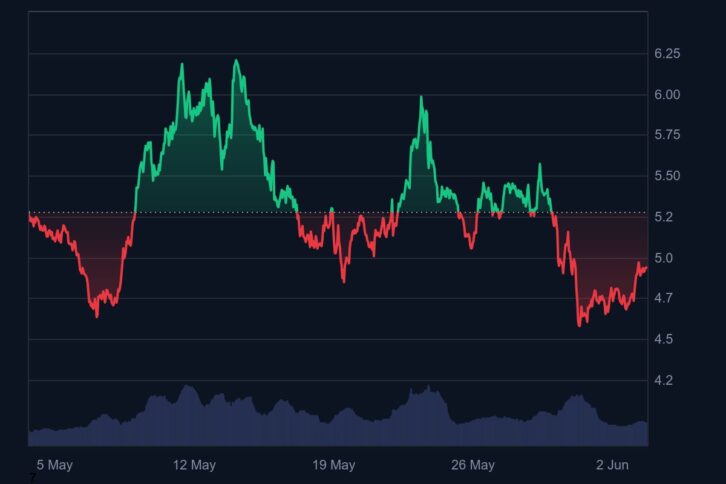
Other than the core functions of APT blockchain, it also plays an important role in the growth of the ecosystem. Further, it supports a range of dApps which include DeFi platforms, NFT marketplaces, gaming, social media projects, etc.
Future Aspects of Aptos Blockchain
With its new blockchain capabilities, Aptos is making great strides towards a decently scalable system. Importantly, the network showcased its ability to process 326 million transactions via an ecosystem game, boasting more than 37 transactions per second (TPS) in the ecosystem during the 2024 stress test without downtime or fee fluctuations.
In the future, the network will also work on dynamic parallelism and sharding, which are expected to pave the road to more efficient and faster operations. To help the global community adopt Web3, Aptos joined hands with Jambo to introduce the JamboPhone— a $99 Web3-enabled smartphone that can be purchased in 40+ countries in Africa, Southeast Asia, and Latin America.
The phone is pre-loaded with the Petra wallet and Jambo App, so the users are granted access to decentralized finance, gaming, and educational resources. Aptos also made future plans for itself to be transformed into a mainstream blockchain platform for consumer applications by combining Web2 features and Web3 infusion.
It is also focusing on user-friendly experiences and strong infrastructure to be the focal points to attract the next set of decentralized application adopters. Thus, it can be projected as one of the leading organizations in the ever-evolving Web3 space.
Final Words
Aptos blockchain is an advanced future-based blockchain that combines advanced technology with real-world scalability. It has a vision for global adoption and continuous innovation which has shaped the future of decentralization applications and has become a key player in the web3 ecosystem.
Also Read: Exploring THORChain: Traction, Ecosystem & Future Aspects
Disclaimer:
Some elements of this content may have been enhanced with the help of our artificial intelligence (AI) assistants for purposes such as basic refinement, review, image generation, and translation to deliver high-quality news in a shorter time frame. However, all AI-assisted content is reviewed and approved by our team to ensure accuracy, fairness, and editorial integrity.