Key Highlights
- Solana’s genesis block was created on March 16, 2020 — today marks its sixth anniversary.
- The network now processes 148 million non-vote transactions daily, up 148x from launch.
- SOL currently trades at ~$92–$94 after an all-time high of ~$295 in January 2025 (down ~69%).
- Solana survived 7+ major network outages (2021–2024), the FTX collapse, and a $320M bridge exploit.
Exactly six years ago today, on March 16, 2020, Solana’s first block was mined. The timing was almost poetically inauspicious—the world was shutting down amid a global pandemic, and crypto markets were still reeling from Black Thursday, the day when Bitcoin crashed below $4,000. Yet in the years since, the high-throughput chain conceived by former Qualcomm engineer Anatoly Yakovenko has evolved from a little-known experiment into one of the most widely used blockchains on the planet.
But the road from genesis to dominance has been anything but smooth. Solana’s six-year story includes record-shattering growth, crippling network outages, a $320 million bridge hack, an existential crisis triggered by the FTX collapse, a phoenix-like recovery, and a new chapter of institutional legitimacy. As it enters year seven, the competitive landscape has shifted: Ethereum is mounting a counteroffensive—not by matching Solana’s speed, but by building an institutional fortress around its staking economy.
The overall journey: From whitepaper to Wall Street
Solana’s story is one of audacious ambition, near-death experiences, and an improbable comeback. Here is how the network evolved, year by year.
2017–2019: Origins and early funding
Solana’s story begins in late 2017, when Anatoly Yakovenko published a whitepaper introducing Proof of History (PoH), a cryptographic timestamping mechanism designed to order transactions without the communication overhead that bottlenecked existing blockchains like Bitcoin and Ethereum. By February 2018, Yakovenko had teamed up with former Qualcomm colleagues Greg Fitzgerald and Raj Gokal to build what would eventually become Solana Labs.
Between 2018 and 2019, the project raised approximately $25.5 million across several private funding rounds, with token prices ranging from roughly $0.04 to $0.22. The team named the project after Solana Beach in San Diego, where the co-founders had lived and surfed—a fittingly Californian origin for a chain that would become synonymous with speed.
2020: A quiet launch amid global chaos
Solana’s mainnet beta launched on March 16, 2020 — the same week much of the world entered its first COVID-19 lockdown. SOL began trading at roughly $0.50, attracting only a small circle of early adopters. By year-end, the token had climbed to approximately $1.50, a modest gain that gave little indication of the explosive growth ahead.
2021: Explosive growth and the NFT boom
The year 2021 was Solana’s breakout moment. A $314 million funding round led by Andreessen Horowitz and Polychain Capital in June signalled serious institutional confidence. The launch of the Degenerate Ape Academy NFT collection in August—which sold out in eight minutes for $5.9 million—sent SOL to a then-ATH above $60. By November, the token had surged to $260, and the network’s market capitalization surpassed $70 billion. SOL grew nearly 12,000% that year, making it one of the best-performing major crypto assets of 2021.
2022: The year everything broke
If 2021 was Solana’s rise, 2022 was its reckoning. The network suffered multiple outages (detailed below), an $8 million wallet hack in August traced to Slope Finance’s wallet software, and the catastrophic $320 million Wormhole bridge exploit in February—at the time the largest DeFi hack ever. Then came November: the collapse of FTX and Alameda Research, which together held nearly $1 billion in SOL tokens, triggered a 40% single-day price crash. By year-end, SOL had fallen 94% from its peak to approximately $10, and Solana had lost over $50 billion in market capitalization. Many observers wrote the network’s obituary.
2023–2024: The comeback
Against all odds, Solana staged one of crypto’s most remarkable recoveries. By March 2023, its market capitalization had more than doubled from its trough to approximately $7 billion. Major partnerships with Visa (stablecoin settlement) and Google Cloud (running a validator node) lent enterprise credibility. In 2024, the network’s decentralized exchange volume surpassed Ethereum’s for ten consecutive months, driven by the explosive growth of Pump.fun and memecoin activity. In November 2024, Robinhood relisted SOL for US customers after a year-long removal, a symbolic sign of the network’s rehabilitation. SOL rallied from ~$100 at the start of 2024 to $237 by November following the US presidential election, closing the year at approximately $189.
2025–2026: Institutional era and correction
January 2025 brought a new all-time high of approximately $295, driven by the launch of the TRUMP memecoin on Solana. But the euphoria faded quickly as trade-war fears and broader risk-off sentiment pulled SOL down roughly 64% to around $105 by early April 2025. The second half of the year saw the approval and launch of spot Solana ETFs (Bitwise BSOL, Fidelity FSOL), collectively attracting over $1 billion. As of March 16, 2026, SOL trades at approximately $92–$94 with a market capitalization of around $53 billion.
Solana Network Stats 2026
Since its genesis, Solana has undergone a transformation that few in the industry anticipated. What began as a testbed for Proof of History has become the world’s most active retail blockchain by daily transaction count.
| Metric | 2020 (Genesis) | 2026 (6th Anniversary) | Growth |
|---|---|---|---|
| Daily Transactions | < 1 Million | 148 Million (Non-vote) | 148x |
| Validators | ~100 | 3,248 | 32x |
| DeFi TVL | Minimal | $9.3 Billion | ∞ |
| Active Developers | ~200 | 17,700+ | 88x |
| Average Fee | $0.0001 | $0.00025 | Stable |
MILESTONE
On January 30, 2026, Solana processed one billion transactions in a single week—roughly equal to everything Ethereum’s mainnet has handled over the past two years combined.
This activity surge is fuelled by DEX dominance, the explosion of memecoin launchpads like Pump.fun—which recently became the first Solana application to surpass $1 billion in cumulative revenue—and a growing footprint in real-world asset (RWA) tokenization, with on-chain RWA market capitalization reaching $1.71 billion as of February 2026.
SOL price: A six-year rollercoaster
Few assets in the crypto market encapsulate the boom-and-bust nature of digital assets quite like SOL. From its humble debut to a near-$300 all-time high and back, the token’s price journey mirrors the broader industry’s cycles of euphoria, collapse, and recovery.
| Year | Key Price Action | Year-End Price | YoY Change | Catalyst |
|---|---|---|---|---|
| 2020 | Launched at ~$0.50 | ~$1.50 | N/A | Genesis launch |
| 2021 | Rally from $1.50 to ATH $260 | ~$170 | +11,233% | NFT boom; a16z funding |
| 2022 | Catastrophic 94% decline | ~$10 | -94.1% | FTX collapse; exploits |
| 2023 | Slow recovery: $10 → $102 | ~$102 | +920% | Visa; Google Cloud |
| 2024 | Second bull run, peaked ~$264 | ~$189 | +85.3% | Pump.fun; DEX dominance |
| 2025 | New ATH ~$295; steep correction | ~$125 | -33.9% | TRUMP coin & ETF launch |
| 2026 | Consolidation; 52-wk low $68 | $92–$94 | TBD | Institutional ETF inflows |
As of writing, SOL’s 52-week range spans from $68 to $295, illustrating the extreme volatility that continues to define the asset. Its all-time high of approximately $295, reached on January 19, 2025, was driven by speculative activity surrounding the TRUMP memecoin launch on Solana. Since that peak, SOL has corrected roughly 69%.
On the institutional front, spot Solana ETFs launched in late 2025 have attracted meaningful inflows. Issuers including Bitwise (BSOL) and Fidelity (FSOL) have collectively accumulated over $1 billion in assets, with Morgan Stanley filing for its own Solana Trust. Around 30 institutions—including Goldman Sachs and Electric Capital—have invested approximately $540 million in Solana fund products. Corporate interest is also deepening: Forward Industries (NASDAQ: FORD) has pivoted to a Solana-focused treasury strategy, holding over 6.9 million SOL valued at just under $1 billion.
The outage problem: Solana’s Achilles’ heel
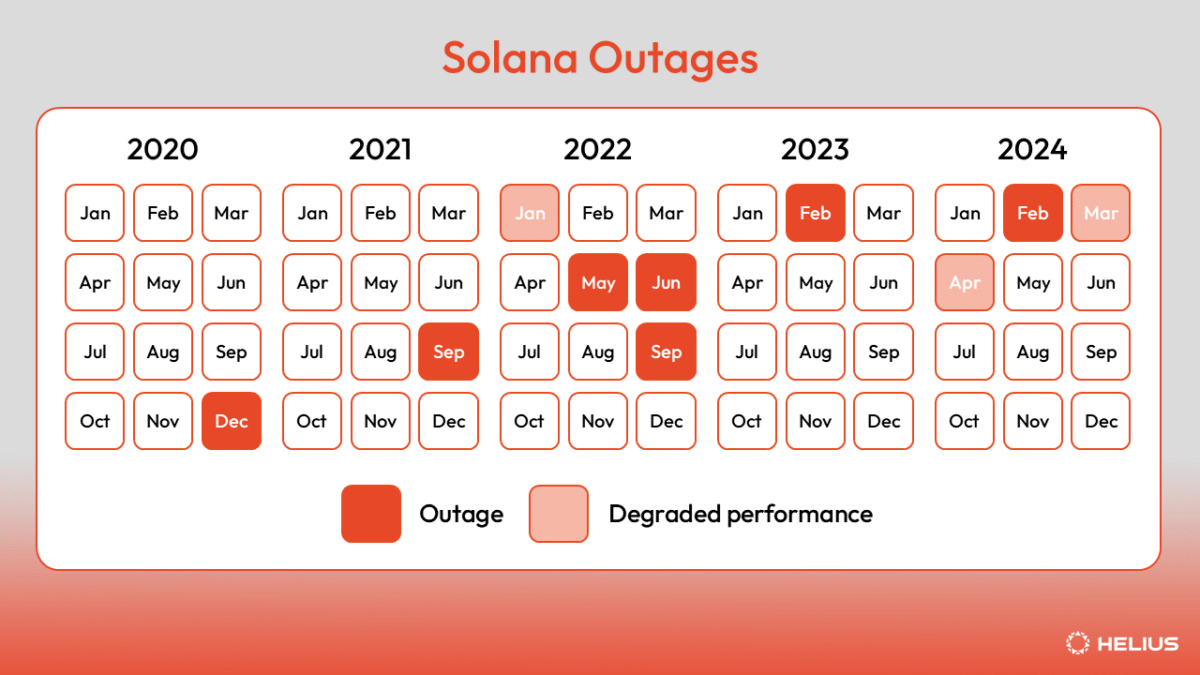
No assessment of Solana’s six-year journey is complete without confronting the network’s most persistent criticism: downtime. Between September 2021 and February 2024, Solana experienced at least seven officially acknowledged outages and numerous periods of degraded performance. These incidents eroded trust, hammered the SOL price during an already brutal bear market, and gave Ethereum maximalists a ready-made talking point.
| Date | Duration | Cause | Impact |
|---|---|---|---|
| Sep 14, 2021 | ~17 hours | Bot-driven transaction flood (~400K TPS) during Grape Protocol IDO overwhelmed validators, causing consensus loss | Full network halt |
| Jan 6–12, 2022 | ~6 days (degraded) | High-compute transactions overwhelmed network capacity; reduced throughput | Severe congestion |
| Apr 30, 2022 | ~7 hours | NFT minting bots (Candy Machine) generated 4M TPS, crashing validators | Full network halt |
| Jun 1, 2022 | ~4.5 hours | Durable nonce transaction bug caused validators to disagree on network state | Consensus failure |
| Oct 2022 | ~6 hours | Misconfigured validator produced conflicting blocks; fork selection bug prevented recovery | Full network halt |
| Feb 25, 2023 | Several hours | Validator broadcast an unusually large block, overwhelming Turbine protocol | Degraded performance |
| Feb 6, 2024 | ~5 hours | Bug in Loaded Programs function halted block production; validators deployed patched software | Full network halt |
The pattern is notable: Solana’s most turbulent period was 2021–2022, when the network lacked key congestion-management mechanisms such as priority fees and local fee markets. Early versions essentially incentivized spam over legitimate traffic. Since the February 2024 incident, however, there have been no officially acknowledged full outages—a streak of over 13 months.
Defenders of the network point to Solana’s dramatically improved response times (the February 2024 restart took under five hours, compared to 17 hours in September 2021) and the introduction of the QUIC networking protocol, priority fees, and local fee markets as evidence that the worst is behind it. Critics counter that unofficial service disruptions detected by third-party monitors continued into early 2025, even if Solana’s own status page did not acknowledge them.
Security incidents and exploits
Beyond network outages, Solana’s ecosystem has weathered several significant security incidents that tested community confidence.
The Wormhole bridge exploit (February 2022)
In February 2022, an attacker exploited a vulnerability in the Wormhole cross-chain bridge’s signature verification, minting 120,000 wETH on Solana without backing collateral. The $320 million loss was the largest DeFi exploit at the time. Jump Crypto stepped in within 24 hours to replace the stolen ETH and restore bridge integrity. Roughly $225 million was later recovered in February 2023 through a counter-exploit of the hacker’s Oasis vault.
The Slope wallet hack (August 2022)
On August 3, 2022, approximately 9,231 Solana wallets were compromised, resulting in losses of roughly $8 million. The Solana Foundation quickly identified the root cause: Slope Finance’s wallet software had been logging users’ private keys in plain text on a centralized server. The core Solana protocol itself was not breached, but the incident damaged user confidence during an already challenging period.
Broader DeFi exploit landscape
According to security analyses, total recorded losses from Solana-based exploits between 2020 and early 2025 exceeded $530 million, with the overwhelming majority stemming from application-layer DeFi hacks (Wormhole, Mango Markets, Cashio, and Crema Finance) rather than core protocol failures. Notably, several incidents saw partial fund recoveries through negotiations, reflecting a maturing ecosystem response to security threats.
Also Read: The First 24 Hours After a Crypto Hack: A Minute-by-Minute Breakdown
Major upgrades: building a more resilient Solana
Solana’s development team has not been idle in the face of these challenges. The network’s technical roadmap reads as a direct response to the outages, exploits, and scalability bottlenecks that defined its early years.
| Upgrade | Timeline | What It Does |
|---|---|---|
| QUIC Protocol | 2022–2023 | Replaced UDP with QUIC for transaction forwarding; adds flow control and receipt acknowledgments to prevent spam flooding |
| Priority Fees & Local Fee Markets | 2023 | Introduced dynamic fee pricing so users can prioritise urgent transactions and different applications can compete for block space independently |
| Frankendancer (Hybrid Client) | 2024 | Hybrid client mixing Firedancer’s networking stack with existing execution layer; 26%+ of validators adopted it by late 2025 |
| Firedancer (Full Client) | Dec 2025 | Complete C/C++ validator rewrite by Jump Crypto; demonstrated 1M+ TPS on commodity hardware; adds critical client diversity to reduce single-point-of-failure risk |
| Alpenglow Consensus | Q1 2026 (est.) | Largest protocol upgrade in Solana’s history; replaces PoH+Tower BFT with a simpler consensus framework; targets 150 ms finality (100x faster than current) |
| SIMD-0266 (P-Tokens) | 2026 | Approved upgrade introducing lower fees and preparing for confidential transfer capabilities |
The Firedancer launch in December 2025 is arguably the single most important infrastructure milestone since genesis. By introducing an entirely independent validator client written from scratch, Solana now has a second engine: if one client encounters a bug, the other can keep the network running. This directly addresses the root cause of multiple past outages, where a single software bug could cascade across all validators simultaneously.
Alpenglow, expected to activate on mainnet in Q1 2026, promises to be even more transformative. By replacing Proof of History and Tower BFT with a simpler consensus protocol based on local clocks and skip votes, it aims to reduce finality from the current ~12.8 seconds to just 150 milliseconds—making Solana potentially faster than Sui’s 400 ms finality and approaching the responsiveness of traditional web services.
Solana vs Ethereum 2026
While Solana dominates in terms of volume and retail activity, Ethereum is doubling down on what it does best: attracting institutional capital. The launch of BlackRock’s staked ETH ETF (ticker: ETHB) has marked the beginning of what some analysts are calling Ethereum’s “Yield Era.”
The yield magnet
Ethereum’s new generation of staked ETFs is attracting an entirely different class of investor. Pension funds and long-term allocators are beginning to view ETH not as a speculative cryptocurrency but as an “Internet Bond” offering a steady annualized yield of approximately 3.5%. This framing—familiar to traditional finance participants—is proving far more persuasive than any technical throughput benchmark.
Staking dominance and supply crunch
Over 35.5 million ETH—nearly 29% of the total supply—is now locked in staking contracts. This creates a significant supply crunch, reducing liquid ETH available on exchanges just as institutional demand via ETFs is accelerating. The combination of shrinking supply and growing demand forms a powerful long-term price support structure.
The scaling roadmap
Ethereum’s Glamsterdam upgrade, expected in H1 2026, aims to scale its Layer 2 ecosystem to a combined throughput of 200,000 TPS through a framework called “Lean Execution.” While Solana ships Firedancer for base-layer throughput, Ethereum is betting that its modular L2 approach—bolstered by rollups like Arbitrum, Optimism, and Base—can match or exceed aggregate throughput without sacrificing decentralization.
Consumer layer vs settlement layer
The Solana-vs-Ethereum narrative has matured beyond a simple speed comparison. In 2026, the two networks are increasingly serving distinct roles in the broader crypto ecosystem.
| Solana: The Consumer Layer | Ethereum: The Settlement Layer | |
|---|---|---|
| Core Strength | HFT, AI agents, micropayments | $100B+ ETFs, institutional tokenization |
| User Base | Retail, meme communities, real-time DApps | Pension funds, banks, enterprise |
| 2026 Upgrade | Firedancer + Alpenglow (1,200+ base TPS; 150 ms finality) | Glamsterdam (200,000 L2 TPS via Lean Execution) |
| Fee Model | ~$0.00025 per transaction | Variable; L2s < $0.01 |
| Key Risk | Outage history; validator centralization concerns | L2 fragmentation; slower base-layer speed |
Solana’s trajectory as the go-to “consumer layer” is well-established. Its sub-cent fees and sub-second finality make it the natural home for high-frequency DeFi, gaming, memecoin culture, and the emerging wave of AI-agent transactions. Ethereum, by contrast, is cementing its role as the “settlement layer”—the blockchain where the world’s largest institutions tokenize assets, park treasury capital, and access yield.
What lies ahead for Solana’s seventh year
Several catalysts could define Solana’s next chapter. The Alpenglow consensus upgrade, set for Q1 2026, promises 150-millisecond finality. Combined with Firedancer’s throughput improvements and the proposed removal of the block compute cap (SIMD-0370), Solana could soon offer a technical stack that few competitors can match.
The growing real-world asset tokenization market—including partnerships with Visa, PayPal, Mastercard, and Western Union—suggests the network’s utility is expanding well beyond speculative trading. Galaxy Digital and Superstate’s tokenization of SEC-registered Class A Common Stock directly on Solana in September 2025 marked the first time a major public company moved its legal equity records onto a public ledger.
If ETF inflows accelerate and the Alpenglow upgrade delivers on its promise, SOL could find a new price floor well above its current trading range. But the risks remain real: FTX estate token unlocks continue to create periodic selling pressure, regulatory uncertainty persists, and the competition from alternative Layer 1s like Sui, Aptos, and TON is intensifying.
Six years in, Solana is no longer trying to prove it can scale. The question now is whether it can hold its ground as the institutional giants come knocking—on Ethereum’s door.
What Wall Street analysts are saying about Solana
Institutional coverage of Solana has matured significantly over the past year. Here is how leading analysts are positioning their outlook as the network enters its seventh year:
1. STANDARD CHARTERED—Geoffrey Kendrick, Global Head of Digital Assets Research
Kendrick trimmed his end-2026 SOL target from $310 to $250 in February 2026, citing the time required for micropayment adoption to scale. However, he simultaneously raised his long-term trajectory to $400 (2027), $700 (2028), $1,200 (2029), and $2,000 (2030). He describes Solana as evolving from a memecoin-dominated network into a backbone for stablecoin-based micropayments, noting that stablecoin turnover on Solana is two to three times higher than on Ethereum.
2. BERNSTEIN—Gautam Chhugani, Lead Digital Assets Analyst
While Bernstein’s primary focus has been Bitcoin (with a $150,000 target for 2026), Chhugani has described the broader crypto downturn as a “crisis of confidence” rather than a structural break, adding that institutional buying patterns suggest an “elongated bull cycle.” Spot Solana ETFs attracted $63 million in net inflows in January 2026, remaining in the black since their October 2025 debut.
3. PANTERA CAPITAL—Cosmo Jiang, General Partner
Jiang has suggested that Solana ETF approval and continued network growth could drive SOL toward $1,000 in a bull scenario, making it one of the most bullish institutional forecasts on the asset.
The divergence between near-term caution and long-term optimism is a recurring theme. Standard Chartered explicitly expects Solana to underperform Ethereum through 2026–2027, before gradually catching up as its micropayment narrative matures and outperforms Bitcoin’s growth rate between 2027 and 2030.
Frequently asked questions
Is Solana better than Ethereum in 2026?
It depends on the use case. Solana is faster and cheaper for high-frequency trading, micropayments, and retail DeFi activity, processing 148 million non-vote transactions daily at fees of roughly $0.00025. Ethereum, on the other hand, is the preferred settlement layer for institutional capital, with over 35.5 million ETH staked (29% of supply) and the launch of staked ETFs like BlackRock’s ETHB are attracting pension funds. In 2026, the two networks increasingly serve complementary roles rather than competing directly for the same users.
What is the Firedancer upgrade on Solana?
Firedancer is an entirely new validator client for Solana, built from scratch in C/C++ by Jump Crypto over three years. It went live on mainnet in December 2025 after producing over 50,000 blocks on testnet without major incidents. In controlled tests, Firedancer has demonstrated throughput exceeding one million transactions per second.
Will Solana have another network outage?
No blockchain can guarantee 100% uptime, but Solana’s outage risk has been significantly reduced. Since February 2024, there have been no officially acknowledged full network halts—a streak exceeding 13 months. The introduction of the QUIC protocol, priority fees, local fee markets, and the Firedancer multi-client architecture have addressed the specific technical vulnerabilities that caused past failures.
What is the SOL price prediction for 2026?
Analyst forecasts for SOL in 2026 vary widely. Standard Chartered’s Geoffrey Kendrick targets $250 by year-end, while prediction markets on Kalshi imply a 48% chance SOL exceeds $150 and a 68% chance it dips below $60 at some point during the year. The wide spread reflects genuine uncertainty: SOL currently trades at approximately $92–$94 (as of March 16, 2026), down roughly 69% from its January 2025 all-time high of ~$295.
Disclaimer:
Some elements of this content may have been enhanced with the help of our artificial intelligence (AI) assistants for purposes such as basic refinement, review, image generation, and translation to deliver high-quality news in a shorter time frame. However, all AI-assisted content is reviewed and approved by our team to ensure accuracy, fairness, and editorial integrity.