
Key Highlights
- The first 24 hours after a crypto hack follow a predictable sequence from exploit detection to exchange alerts and bounty offers.
- In 2026, at least $112.53 million was lost to crypto hacks in the first 2 months alone across major DeFi incidents.
- Security analysts say exchanges often have only 10 to 15 minutes to freeze stolen funds once they reach trading platforms.
When a crypto hack happens, the headlines write themselves. Protocol X loses $40 million. Token crashes 90%. Users scramble. But what you almost never see is the granular, hour-by-hour reality of what happens inside the first 24 hours after an exploit is detected.
Having closely followed every major DeFi breach in 2026 so far, and having studied the patterns of dozens of incidents before them, I can tell you this: the first day after a hack is not chaos. It is a sequence. A disturbingly predictable one.
The attack vector might differ. The chain might change. The dollar amount might vary. But the playbook that unfolds in those first 24 hours follows a pattern so consistent that it now constitutes a genre of its own in crypto security.
This piece breaks down that timeline using real incidents from January and February 2026, including the Step Finance treasury drain, the IoTeX bridge exploit, the YieldBlox oracle manipulation, and the CrossCurve validation breach. These are not hypotheticals. These are reconstructions built from on-chain data, official post-mortems, and security firm reporting.
The numbers so far: 2026’s hack landscape
Before getting into the timeline, it is worth understanding just how active the threat landscape has been in the opening months of this year.
According to PeckShield, January 2026 saw 16 major hacks resulting in $86.01 million in total losses. That figure was a slight 1.42% decrease year-over-year compared to January 2025’s $87.25 million, but it represented a 13.25% increase over December 2025.
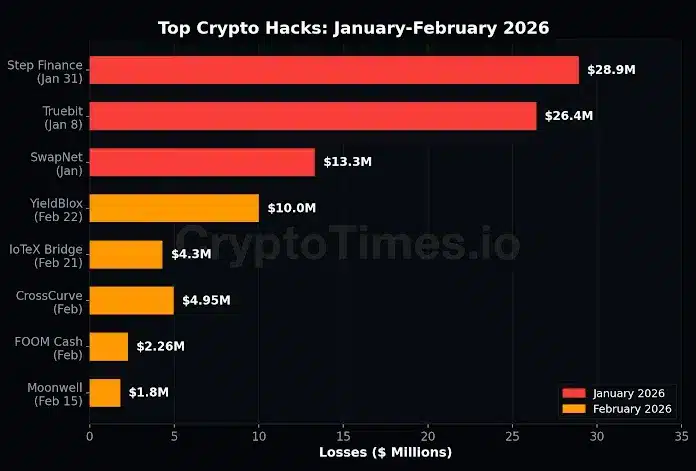
The top three incidents, Step Finance ($28.9 million), Truebit ($26.4 million), and SwapNet ($13.3 million), accounted for the overwhelming majority of losses.
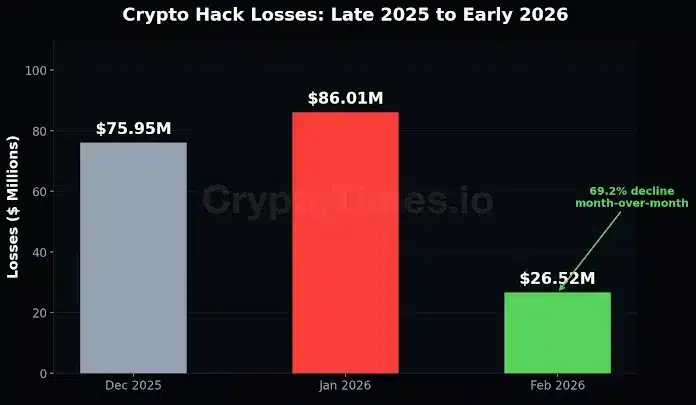
February brought a sharp pullback. PeckShield data shows 15 hacks totaling $26.52 million, a 69.2% decline from January and a staggering 98.2% year-over-year drop, though that comparison is skewed by the $1.4 billion Bybit exploit in February 2025.
The top incidents in February included the YieldBlox oracle attack ($10 million), the IoTeX bridge compromise ($4.3-8.8 million depending on how minted tokens are valued), and the CrossCurve bridge exploit ($4.95 million).
Combined, the first two months of the year produced $112.53 million in confirmed losses. CertiK’s broader tally, which includes phishing and smaller incidents, places the January figure alone closer to $370 million.
What stands out is not just the money. It is the shift in how these attacks are happening.
The shift: From code exploits to human failures
If 2024 was about smart contract bugs, 2026 is about people.
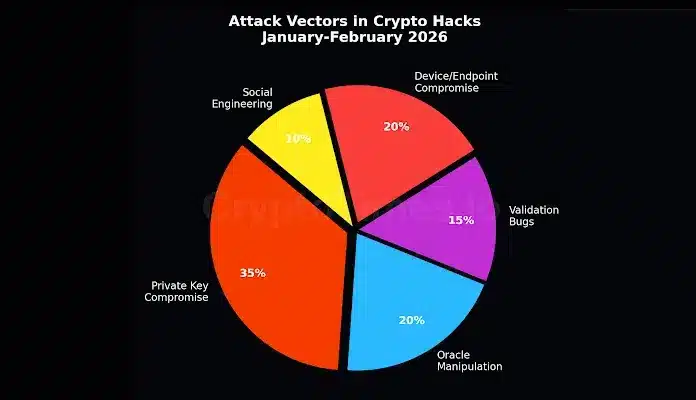
Mitchell Amador, CEO of on-chain security platform Immunefi, described the shift in an interview in January: the worst hacks are no longer stemming from on-chain code vulnerabilities. They are coming from Web2-style operational failures, including stolen passwords, compromised devices, and social engineering.
The data backs this up. Chainalysis’ 2026 Crypto Crime report shows that impersonation scams surged 1,400% year-over-year in 2025, while AI-enabled scams proved 450% more profitable than traditional methods.
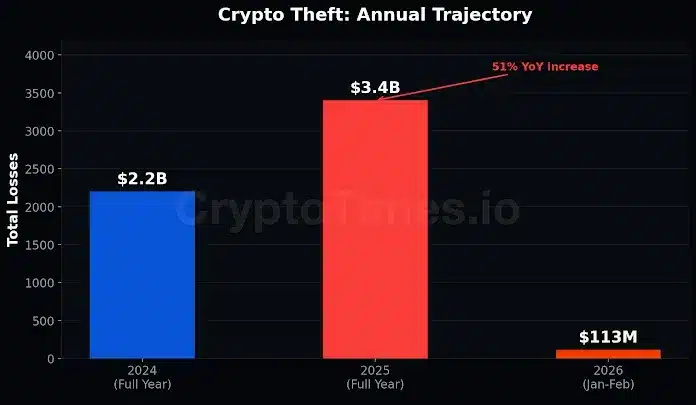
TRM Labs’ separate analysis recorded $2.87 billion stolen across nearly 150 hacks in 2025, with the Bybit breach alone accounting for 51% of the total.
In 2026, this trend has continued. The Step Finance hack on January 31 was caused by compromised executive devices, not a smart contract flaw. The IoTeX bridge exploit on February 21 was enabled by a single compromised private key. Neither incident involved any on-chain code vulnerability.
As Amador put it, the human factor is now the weak link. And when the weak link snaps, what follows is a 24-hour sequence that has become almost ritualistic in its predictability.
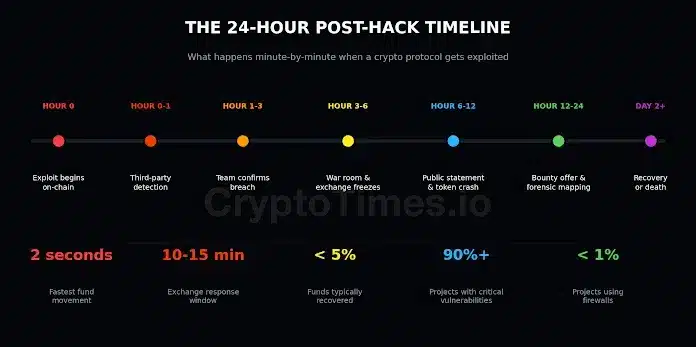
Hour zero to hour one: The silent alarm
The first hour is the most critical and the most chaotic. It is when the exploit is still unfolding, when the affected team may not yet know what is happening, and when the window for intercepting stolen funds is at its widest. What happens in these 60 minutes often determines whether any recovery is possible at all.
The on-chain anomaly
Most crypto hacks are not discovered by the team that got hacked. They are flagged by third parties.
When the IoTeX bridge was exploited on February 21, on-chain analyst Specter was among the first to identify suspicious transactions tied to the project’s treasury.
PeckShield flagged the exploit independently, reporting that funds were being swapped to ETH and bridged to Bitcoin via THORChain. IoTeX did not issue its own acknowledgment until approximately 10:30 AM UTC, roughly two to three hours after the attack began between 7 and 9 AM UTC.
The same pattern played out with Step Finance. CertiK initially flagged the withdrawal of approximately 261,854 SOL from the platform’s treasury wallets on January 31, during APAC trading hours. The Step team followed with its own disclosure through social media posts, but by then the tokens had already been unstaked and moved.
This gap, between the moment stolen funds begin moving and the moment the affected team confirms what happened, is where the story really begins. For security firms, it is the window where early action can make or break the recovery. For users, it is the window where panic starts.
The internal discovery
Inside the affected project, the first hour is defined by confusion. Teams often learn about the exploit from external alerts, from a frantic DM on Telegram, from a PeckShield tweet, or from a community member posting suspicious transaction hashes.
For Step Finance, the initial disclosure described the attack as leveraging “a well known attack vector,” but details were sparse. The team activated emergency protocols and reached out to cybersecurity firms.
It was only through later investigation that the root cause was identified: attackers had compromised executive devices, likely gaining access to private keys or installing malware that corrupted the transaction approval process.
For IoTeX, co-founder Raullen Chai acknowledged the breach himself, initially claiming that actual losses were “significantly lower” than the figures circulating on social media.
The team’s first public response came via a carefully worded statement on X, confirming the breach was isolated to the Ethereum-side bridge contracts and that the Layer 1 chain itself was unaffected.
Hour one to hour six: The scramble
Once the breach is confirmed internally, a parallel race begins. On one side, the project team is trying to contain the damage, contact exchanges, and figure out how the attacker got in. On the other side, the attacker is laundering as fast as the blockchain will let them. These five hours are where the outcome is largely decided.
War room formation
Within the first few hours, every hacked project follows roughly the same operational playbook. A war room is formed. External security firms are engaged. Communications with exchanges begin. Legal counsel is looped in.
IoTeX moved quickly to coordinate with major exchanges, requesting that deposits from flagged addresses be frozen. Binance suspended IoTeX-related transactions as a precautionary measure.
South Korea’s Upbit placed IOTX on its trading alert list and paused deposits and withdrawals. These actions, taken within hours, are critical because once stolen tokens hit a centralized exchange and are sold, recovery becomes exponentially harder.
Step Finance similarly notified authorities and “implemented immediate remediation steps while working with top security professionals around the clock,” according to its public statements.
The attacker’s laundering race
While the project scrambles, the attacker is moving fast in the opposite direction.
In the IoTeX case, stolen tokens were swapped into ETH on Uniswap, consolidated into a few wallets, and then bridged to the Bitcoin network through THORChain. IoTeX later identified four Bitcoin wallets holding approximately 66.6 BTC (worth roughly $4.3 million).
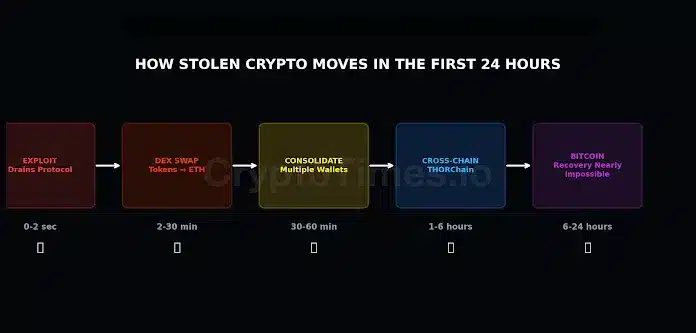
But as security analysts have repeatedly warned, once assets are routed through THORChain, recovery becomes extremely difficult. The protocol operates without KYC and processes swaps between chains without intermediaries. There is no central entity to issue a freeze order.
In the YieldBlox attack on February 22, the attacker followed a different but equally rapid path. After manipulating the USTRY/USDC oracle on Stellar’s DEX to inflate the token price from roughly $1 to $106, they used the inflated collateral to borrow over 1 million USDC and 61.2 million XLM. The stolen funds were then bridged across Base, BSC, and Ethereum using Allbridge, Across, and Relay.
Global Ledger’s research found that in the fastest cases during 2025, stolen funds moved within just 2 seconds of the exploit. The typical response window for exchanges once funds arrive on their platform is 10 to 15 minutes. Miss that window, and the money is likely gone.
Hour six to hour twelve: The public response
By the time six hours have passed, the initial forensic picture is beginning to take shape. The team now has a rough estimate of losses, a partial map of where funds have moved, and a growing list of exchanges and partners who have been notified.
This is when the project shifts from containment mode to communication mode, and the way it handles this transition can determine whether the community rallies behind it or abandons it entirely.
The first official statement
By the six-hour mark, most projects have issued at least one public statement. These initial communications follow a remarkably consistent template: confirm a breach occurred, downplay the severity where possible, assure users that the team is working around the clock, and emphasize that core protocol infrastructure was not compromised.
IoTeX’s early messaging is a textbook example. The team stated that “initial estimates indicate the potential loss is significantly lower than circulating rumors suggest” and emphasized that the Layer 1 blockchain and smart contracts were unaffected. PeckShield, however, had already reported losses exceeding $8 million when accounting for minted tokens.
Step Finance described the attack as exploiting “a well known attack vector” without initially specifying what that vector was. The vagueness was not unusual.
In the immediate aftermath, teams are often still conducting their own forensic analysis and are reluctant to share details that could expose additional vulnerabilities or complicate law enforcement investigations.
Token price collapse
The market’s reaction is rarely subtle. Step Finance’s native STEP token crashed over 90% within 24 hours of the hack disclosure. It eventually lost nearly 97% of its value before the project announced its shutdown on February 23.
IoTeX’s IOTX token dropped approximately 22%, falling from $0.0054 to $0.0042 in the immediate aftermath. Trading volume spiked over 500% as panic sellers rushed for the exits while opportunistic traders moved in.
The YieldBlox incident caused a sharp but temporary drop in Stellar’s XLM, which fully recovered shortly afterward since the exploit was isolated to a single community-managed pool.
Also Read: What are Flash Loan Attacks in Crypto?
Hour twelve to hour twenty-four: The bounty and the reckoning
As the first half of the day closes, the situation has typically crystallized into a grim but clear picture. The team knows roughly how much was taken. They know where most of the funds have moved. And they know that the traditional path of waiting for law enforcement to act is far too slow for blockchain timelines.
This is the phase where strategy replaces panic, and where projects must decide: do they chase the attacker through courts and code, or do they try to buy the funds back?
The 10% bounty offer
At some point during the first day, many projects reach the same conclusion: the fastest path to fund recovery is negotiation, not prosecution.
IoTeX CEO Raullen Chai sent an on-chain message to the attacker offering a 10% white-hat bounty, approximately $440,000, if the remaining funds were returned within 48 hours.
The message made clear that all fund movements across Ethereum, IoTeX, and Bitcoin had been fully traced, that exchange deposits had been flagged and frozen, and that the project would not pursue legal action if the funds were returned.
YieldBlox’s Security Council followed a similar approach, sending an on-chain message to the hacker’s Ethereum address offering a 10% bounty along with instructions for returning the 48 million XLM held in frozen addresses.
These bounty offers have become standard practice. Some work. Many do not. IoTeX’s 48-hour deadline passed without a response. The KyberSwap hack from 2023 remains a cautionary tale: the attacker rejected the bounty and instead demanded full control of the protocol.
The forensic trail deepens
By the end of the first 24 hours, blockchain security firms have typically built a comprehensive map of fund movements. On-chain analysts linked the IoTeX attacker’s wallet to the $49 million Infini stablecoin platform hack from February 2025, raising the possibility of a repeat offender.
For Step Finance, the forensic investigation revealed that the breach extended beyond Step’s own operations, impacting connected platforms including Remora Markets and SolanaFloor.
CertiK’s comprehensive January 2026 security report placed the month’s total confirmed losses at approximately $370.3 million across all exploit types, a number that includes phishing, rug pulls, and smaller incidents that rarely make crypto hack headlines.
Day two and beyond: Recovery or collapse
The 24-hour mark is not an endpoint. It is a fork in the road.
Step Finance took the path of collapse. After exploring every recovery option, including emergency financing rounds and potential acquisition deals, the team announced on February 23 that it would shut down operations immediately. The $40 million loss was simply too large for the platform to absorb.
STEP holders were offered a buyback program based on a pre-hack snapshot, and Remora Markets rToken holders could redeem their tokens at a 1:1 ratio, but the platform that had served as a core analytics and portfolio hub for Solana since 2021 was done.
IoTeX took a different path. The team deployed a mainnet upgrade (v2.3.4) on February 24, permanently blacklisting 29 hacker addresses and freezing approximately 45 million IOTX tokens. The IoTeX Foundation committed to full compensation for all affected users, regardless of whether stolen assets were recovered.
Binance, Coinbase, and other exchanges gradually restored services. IOTX surged over 29% when Binance reopened trading.
YieldBlox found itself somewhere in between. Script3, the developer behind the protocol, confirmed that all depositors in the affected pool would be fully compensated for bad debt losses. The incident was contained to a single pool, and no other Blend pools on Stellar were affected.
But the exploit exposed a fundamental design weakness: the protocol’s reliance on a VWAP oracle fed by a market with near-zero liquidity and no circuit breakers.
The uncomfortable pattern
Every hack in 2026 has reinforced a pattern that the industry keeps learning and keeps forgetting.
First, the weakest link is almost never the smart contract anymore. Step Finance was compromised through executive devices. IoTeX fell to a single private key. YieldBlox was undone by an illiquid market feeding a naive oracle.
CrossCurve lost $4.95 million to a validation bug that let attackers spoof messages appearing to come from Axelar. In none of these cases was the core protocol logic fundamentally broken. The vulnerabilities were operational, architectural, or economic.
Second, the response window is vanishingly small. The Global Ledger research found that in the fastest cases, funds move within seconds. The 10-to-15-minute window once stolen assets hit an exchange is the realistic limit for intervention.
After that, the funds are likely bridged, mixed, or converted into Bitcoin through THORChain and effectively out of reach.
Third, recovery is the exception. CertiK’s data shows that less than 2-5% of stolen funds from January 2026 incidents had been recovered as of early February. IoTeX managed to freeze the majority of minted tokens, but the real-value assets, the USDC, USDT, and WBTC that were swapped to ETH and bridged to Bitcoin, remain in the attacker’s hands.
Fourth, the human cost is real and rarely discussed. Step Finance did not just lose money. It lost its entire operation. Its media outlet SolanaFloor went dark. Its RWA platform Remora Markets shut down. A project that had been part of the Solana ecosystem since 2021 and had recently hit $110 million in cumulative volume on Remora ceased to exist in less than a month.
What needs to change
Immunefi’s Amador noted in January that over 90% of projects still harbor critical, exploitable vulnerabilities, and fewer than 1% use firewalls. Less than 10% employ AI detection tools. These numbers are damning for an industry managing hundreds of billions in value.
The solution is not more smart contract audits, though those remain necessary. The solution is operational security at the level that traditional financial institutions have practiced for decades: hardware-enforced key management, mandatory multi-signature schemes, time-locked administrative functions, endpoint security on every device with signing privileges, and real-time monitoring systems that can pause operations within seconds of anomalous activity.
Bridges, which accounted for two of the four largest February 2026 hacks, remain the industry’s most persistent vulnerability. The architectural reality is that cross-chain bridges create complex attack surfaces spanning multiple networks, and the human controls protecting them, usually a handful of validator keys, are often far weaker than the cryptographic infrastructure they secure.
Until the industry treats operational security with the same rigor it applies to consensus mechanisms and tokenomics, the 24-hour post-hack playbook described in this article will keep repeating. The attacker will drain funds. The security firms will flag it. The team will scramble. The bounty will be offered. And the money, more often than not, will be gone.
The bottom line
The first 24 hours after a major crypto hack are not random. They are a sequence. A war fought in real time across blockchains, Telegram groups, exchange compliance desks, and hastily assembled war rooms.
Every major incident in 2026 has followed this arc: silent exploit, external detection, internal panic, public downplay, token crash, fund tracing, bounty offer, and finally, either recovery or death.
The industry’s smartest builders and best-funded protocols are not immune. Step Finance had been operating for four years. IoTeX had a team of over 36 validators. YieldBlox was audited and DAO-managed. None of that mattered when the operational layer failed.
If you work in crypto, if you build in crypto, if you invest in crypto, understanding this 24-hour cycle is no longer optional. It is the minimum literacy for operating in a space where $112 million can vanish in a couple of months and the response window between loss and recovery is measured in minutes, not days.
Also Read: Digital Arrest Crypto Scam: What It Is, How It Works, and How to Protect Yourself
Disclaimer:
Some elements of this content may have been enhanced with the help of our artificial intelligence (AI) assistants for purposes such as basic refinement, review, image generation, and translation to deliver high-quality news in a shorter time frame. However, all AI-assisted content is reviewed and approved by our team to ensure accuracy, fairness, and editorial integrity.