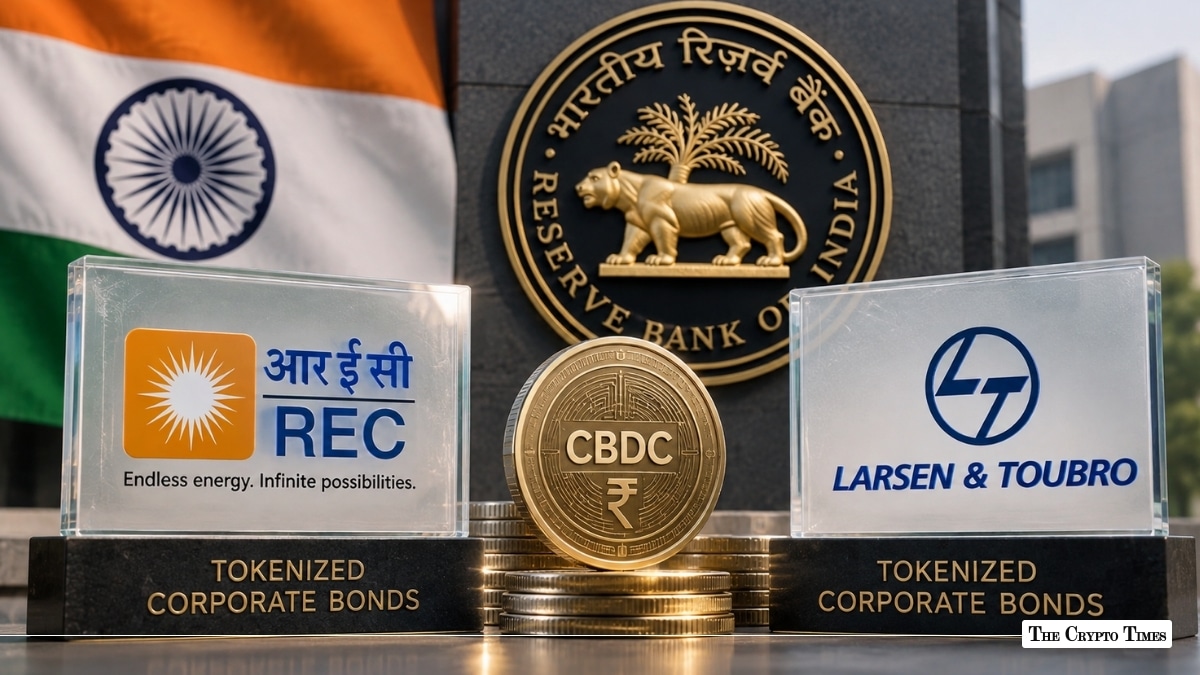
Three Indian corporate bond issues moved onto blockchain-based rails inside a single working week, marking the first time the country has settled ordinary rupee corporate debt on a permissioned distributed ledger against central-bank digital cash.
The paper itself remains conventional corporate debt with unchanged credit risk, tenor structure and coupon obligations. What has changed is the plumbing: the record of ownership, the settlement asset, and the timeline from bidding to listing. Retail access has not been opened, and the notes are not available on any cryptocurrency exchange.
REC opens the pilot with a ₹500 crore issue
State-owned power sector financier REC Limited, a Maharatna Central Public Sector Enterprise (CPSE) under the Ministry of Power, completed the first pilot issuance on Monday, September 7, under the Securities and Exchange Board of India’s (SEBI) Regulatory Sandbox Framework. The company accepted ₹500 crore at a 7.30% annual coupon for a tenor of one year and nine months, with maturity in May 2028, according to REC’s official statement carried by ANI.
The structure comprised a base issue of ₹100 crore with a green-shoe option of ₹400 crore. Book building drew bids of about ₹796 crore, which REC described as an oversubscription of roughly eight times against the ₹100 crore base. Measured against the ₹500 crore actually accepted, the cover works out to about 1.6 times, a nuance the headline “8x” number does not immediately capture.
Bidding took place on the National Stock Exchange’s (NSE) Electronic Bidding Platform (EBP), and the notes are listed on both NSE and BSE Limited, with pay-in, allotment and listing completed the same day.
The pilot picks up from the framework The Crypto Times reported when SEBI first announced it in May 2026 and from the planned September sale that surfaced in August through Reuters reporting.
L&T becomes the first private issuer, IIFL Finance the first non-PSU NBFC
Two days later, on Wednesday, September 9, Larsen & Toubro (L&T) became the first private-sector corporate in India to sell a tokenized bond. According to L&T’s regulatory filing lodged with BSE Limited, the company raised ₹500 crore for a three-year tenor at what corporate filings and market reports put at a 7.40% coupon.
The offering comprised 50,000 unsecured, listed, rated and redeemable non-convertible debentures (NCDs) of ₹1 lakh face value each, allotted on September 9, 2026 and maturing on September 9, 2029, with interest paid annually.
Trade press coverage identified NSDL’s distributed-ledger platform as the underlying tokenisation infrastructure. L&T described its issuance as taking place under SEBI’s “newly introduced blockchain-based tokenisation framework,” language that reads slightly broader than REC’s sandbox framing but sits under the same regulatory umbrella.
On the same day, IIFL Finance, a non-banking financial company (NBFC), raised ₹25 crore at a 9.10% coupon for a two-year tenor through a tokenized issue arranged by Trust Investment Advisors, as reported by Business Standard. It is the first tokenized bond sale by a non-PSU NBFC. Taken together, the three deals put a little over ₹1,025 crore of Indian corporate debt onto tokenized rails in a single week.
How the settlement plumbing actually works
Bidding continued to run on NSE’s existing Electronic Bidding Platform, the same channel used for ordinary private placements. What changed sat downstream. Allotted holdings did not enter a standard demat account but were recorded on Demat 2.0, a permissioned distributed-ledger securities wallet being built by NSDL and CDSL.
The payment leg moved through wholesale Central Bank Digital Currency (CBDC) wallets held by participating banks, using the institutional digital rupee (e₹-W) rather than the retail digital rupee application or any private stablecoin.
The bond leg and the cash leg were designed to transfer together in what market infrastructure terminology calls atomic Delivery-versus-Payment (DvP): the security only changes hands if the money does, and both happen on a shared ledger in the same event.
Each participating investor needed both a wholesale CBDC wallet and a securities wallet under Demat 2.0 to bid. This permissioned architecture is why the notes cannot circulate to retail investors or cryptocurrency exchanges, however “on-chain” the record may look.
Who bought, and what remains reported rather than official
About 20 institutions took the REC notes, according to people familiar with the allocation quoted by Bloomberg and Moneycontrol. Named subscribers reported by these sources include HDFC Bank, ICICI Bank, Axis Bank, Yes Bank, AK Capital Services, ICICI Securities Primary Dealership, Taurus Group and Trust Investment Advisors, along with other banks, mutual funds and corporates.
The nuances matter. HDFC Bank confirmed it served as one of the arrangers of the REC issue but did not confirm that it invested in the notes. Taurus Group confirmed it both invested in and helped arrange the offering, while AK Capital confirmed participating. Axis Bank, ICICI Bank, ICICI Securities Primary, REC, Trust Investment and Yes Bank did not immediately respond to requests for comment. This means the buyer roster is a reported book, not the official allotment register.
What is genuinely new, and what quietly is not
The credit risk on these notes has not moved onto the blockchain. REC still owes the coupon and principal on its bonds, L&T still owes its noteholders, and IIFL Finance’s tokenized paper carries the same NBFC risk profile as its conventional debt. Bidding continued to run through NSE’s Electronic Bidding Platform. The bonds are still ordinary corporate paper for regulatory, accounting and taxation purposes.
Two things did change materially. First, the back-office settlement collapsed from a multi-day cycle to a same-day process for these deals. Second, the cash and security legs cleared on connected digital infrastructure, cutting the settlement gap that a T+1 or T+2 process leaves open.
REC officials said at a Zee Business bond tokenisation event this week that the pilot completed in about two hours, following a 20-day mapping exercise involving 20 institutional investors, of whom 18 received allotments almost immediately. Those operational figures come from the issuer’s own account and from conference remarks and have not been independently audited in public.
The missing piece: a market to trade in
The gap that most coverage has glossed over is the secondary market. REC’s bonds are listed on NSE and BSE, but Business Standard reported this week that a mechanism to trade tokenized bonds does not yet exist, and that the REC paper was priced in line with rates on the issuer’s existing bonds trading in the market. In other words, the pilot has not yet unlocked a pricing benefit from tokenisation.
Sources cited by Reuters in August had indicated an initial three-month lock-in on the tokenized notes and said exchanges were expected to build a trading venue by December 2026. Listing on an exchange and having a live two-way market on that exchange are not the same thing.
Retail access remains outside the perimeter. Only investors holding both a Demat 2.0 securities wallet and a wholesale CBDC wallet can participate at issuance or, once it exists, in secondary trading. That closed loop is by design for a sandbox pilot, but it also means the ₹1,025 crore that has moved onto tokenized rails so far represents a controlled experiment rather than a functioning tokenized bond market.
RBI signals ambition, and hedges it with warnings
The deals landed during Global Fintech Fest (GFF) 2026 in Mumbai, held between September 8 and September 11 at the Jio World Centre. On September 9, RBI Executive Director P. Vasudevan said the central bank hopes to add more asset classes to its Unified Markets Interface (UMI), the digital market infrastructure that pairs tokenized financial instruments with wholesale CBDC settlement. He disclosed that the UMI has already handled about 248 tokenized certificate of deposit (CD) transactions worth roughly ₹17,000 crore, with about two-thirds of that volume in the secondary market.
In the same fireside chat, Vasudevan flagged legal certainty, data privacy, consent management, interoperability and the risk of platform concentration as open issues, along with the financial-stability implications of money moving faster than existing safeguards are designed to handle, as The Crypto Times reported separately. Those cautions are the official counterweight to the enthusiasm around this week’s bond issues.
The wider context and what to watch next
The tokenized bond pilot is not the only strand of India’s tokenisation experiment. SEBI’s Annual Report for 2025-26 kept the corporate bond tokenisation pilot on its stated forward priorities for 2026-27, as The Crypto Times reported in August.
Separately, Maharashtra Chief Minister Devendra Fadnavis said this week at GFF 2026 that a draft law to enable tokenisation of land is under expert review. That is a different asset class and a different legal problem, but it shows the direction of official travel.
For the corporate bond track specifically, the questions that matter now are narrow rather than broad. Whether a secondary market opens after the reported lock-in period, and at what spread against ordinary REC and L&T paper, will show whether tokenisation carries any pricing benefit.
Whether more private issuers copy L&T, or whether the book stays with a small circle of CBDC-ready institutions, will show whether the framework scales. Whether SEBI moves the pilot into standing regulations or keeps it in the sandbox will decide the legal weight of these instruments. And whether RBI keeps wholesale CBDC as the only cash token, or eventually admits other settlement assets, will decide how open the plumbing becomes.
Until those answers arrive, the accurate description is straightforward. India has started settling ordinary corporate bonds on a permissioned distributed ledger against central-bank digital cash. The bonds are live. The market around them is not.
Also Read: India Favors Bilateral CBDC Payments Over a Unified BRICS Payment System