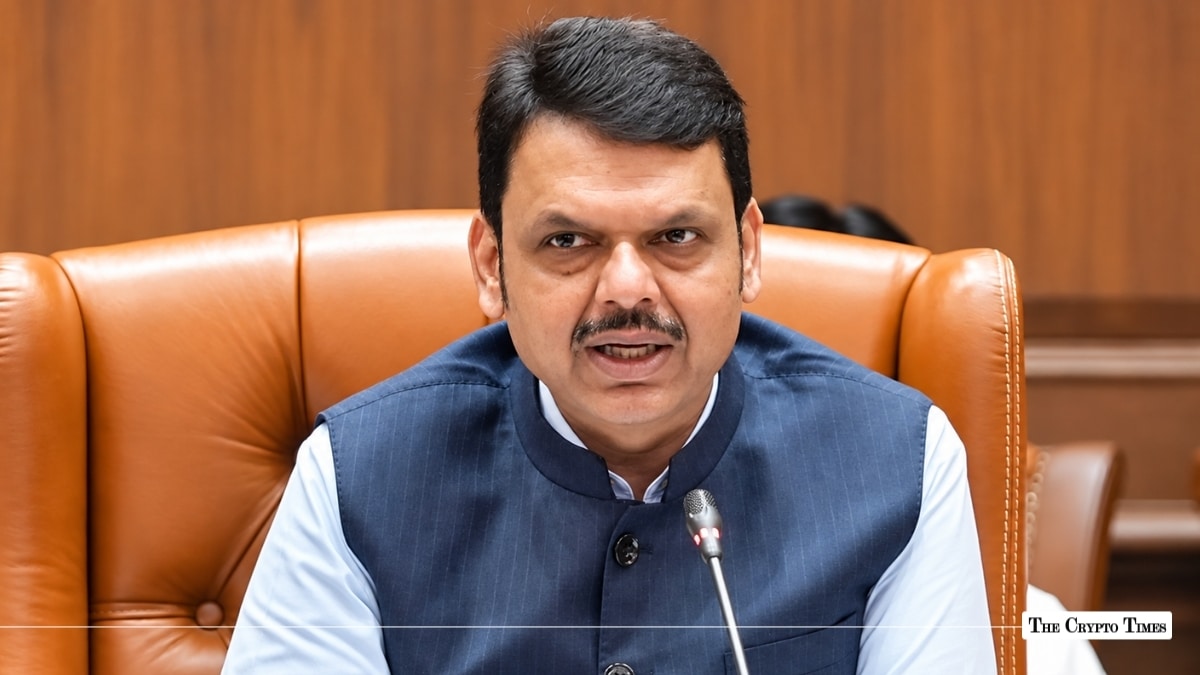
Maharashtra Chief Minister Devendra Fadnavis said on Wednesday that the state has prepared a draft of the Maharashtra Digitisation and Exchange of Land Token Asset Act, known as the DELTA Act, and formed a review committee to examine it.
The proposed law seeks to create India’s first legal framework for blockchain-based tokenization of land and other immovable assets, though the Bill has not been enacted and no tokens have been issued so far.
Fadnavis announced during his address at the Global Fintech Fest (GFF) 2026, a four-day event being held at Mumbai’s Jio World Centre from September 8 to 11. He said the state is putting in place “the architecture of the Maharashtra Digitisation and Exchange of Land Token Asset Act” and that a committee has been formed “to undertake a complete review of the Act.”
In a separate interview with NDTV Profit published the same day, the Chief Minister said the recommendations had already reached the executive committee and that the proposed legislation was expected “within the next four to five months.”
The Chief Minister traced the initiative to a commitment he said he made at last year’s edition of the fintech festival, recalling a conversation with entrepreneur Kunal Shah in which he said Maharashtra would work toward becoming “India’s first tokenized state.” He pegged the latent value locked in land and real estate in the state at “as large as 50 lakh crore rupees,” a figure attributed to a government estimate rather than any market valuation.
Expertise From SEBI, BSE And NSE
In his GFF 2026 address, and in a later readout carried by The Economic Times, Fadnavis said the state is drawing in expertise from the Securities and Exchange Board of India (SEBI), the Bombay Stock Exchange (BSE), the National Stock Exchange (NSE), industry, technology, law, and academia to shape the draft.
He added that “innovation at this scale must be accompanied by legal certainty, consumer protection and regulatory trust,” and that operationalizing the Act would require coordination among the Government of India, market institutions and the Maharashtra government.
Speaking to reporters at the venue, the Chief Minister said that once the law is enacted, ordinary citizens should be able to realize value from land and other assets and create liquidity from them. He framed the effort as part of a wider ambition to position Maharashtra as a fintech testbed, telling delegates, “Don’t look at Maharashtra only as your market, but as your laboratory.”
Fadnavis also separated the project from speculative trading. In remarks reported from the same event, he said tokenization, for the state, is about unlocking productive capital, improving liquidity, and converting dormant property value into economic use, and not about speculation.
No specific blockchain network, token standard, issuance platform, custody model, or secondary-market design was named on Wednesday.
Groundwork Laid Earlier In 2026
The GFF announcement builds on earlier work inside the state government. On July 20, 2026, Fadnavis chaired a meeting on the DELTA Act draft at Sahyadri Guest House in Mumbai, and the Chief Minister’s Office posted the meeting note the same afternoon.
In that post, Fadnavis said officials had been directed to propose the Act to unlock “latent value embedded in immovable properties,” to form an expert committee that would include representatives from SEBI, BSE, and NSE, and to study global laws so Maharashtra could be the first in India with legislation of this kind.
Wednesday’s comments therefore mark progress on a draft already inside government channels rather than the sudden launch of a token market.
What Tokenisation Would Mean For Land
Tokenization, in the sense used by the Chief Minister, refers to representing legal interests in land or other immovable property as digital units recorded on a distributed ledger. In theory, that can make title checks faster, support fractional interests and make it easier to use property as collateral.
In practice, Indian land is difficult to fractionalize cleanly because title, mutation, stamp duty, registration, tenancy, and mortgage rules still sit inside older statutes.
That distinction matters. India already has a well-developed payments stack. It does not yet have a state law that treats tokenized land as a defined legal object. Fadnavis’s pitch is that Maharashtra wants to write that law first.
The project also sits alongside other Indian tokenization work that remains limited and closely supervised. SEBI has kept a corporate-bond tokenization pilot on its 2026-27 agenda after Chairman Tuhin Kanta Pandey described the effort in May.
Separately, Reuters reported in August that state-owned power sector lender REC Limited was preparing a small tokenized bond sale, with the notes to be held in a distributed-ledger securities wallet still being built.
Read: India’s First Tokenized Bond Set for September as REC Plans Sub-$57M Sale
Both experiments concern financial instruments and, in the REC Limited case, central bank digital currency settlement. Neither is a template for village land records.
Prime Minister Narendra Modi, who inaugurated GFF 2026 on Tuesday, September 8, placed tokenization in the same basket as agentic artificial intelligence (AI) and quantum technology, saying the test was converting those ideas into “real impact.” Fadnavis’s Wednesday speech was the state-level attempt to demonstrate one such conversion path.
Two Tracks: Fraud Law And Asset Law
The DELTA draft should not be read as a broader state embrace of retail crypto trading. In July 2026, Maharashtra moved to bring virtual digital assets under the Maharashtra Protection of Interests of Depositors (MPID) framework, treating crypto holdings linked to fraudulent schemes as recoverable property. Fadnavis had told the state Assembly that 10,505 cyber financial fraud cases were registered in Maharashtra between January 2025 and May 2026, with 2,379 arrests, and that Mumbai alone reported losses above ₹1,031 crore.
The policy pattern is closer to “blockchain for records and collateral, enforcement for unregulated crypto schemes” than to a state-issued coin.
That split is also visible at the national level. New Delhi has funded non-crypto blockchain projects while leaving a comprehensive virtual digital asset (VDA) statute unfinished. A parliamentary finance panel in July asked for clearer rules on tokenized products and an interim self-regulatory organization (SRO) model for virtual digital assets.
Aam Aadmi Party Member of Parliament Raghav Chadha had earlier floated an Asset Tokenization Bill in Parliament. None of those national moves is a substitute for a state land statute, and none of them makes DELTA law.
What Still Has To Be Settled
Several facts are still open. The text of the Bill has not been published as an enacted statute, and a committee review can change definitions, investor access and the line between a land record and a tradable security.
Land tokenization also works only if the token maps to a legally recognized interest. If the ledger is only a parallel copy of existing records, it is digitization with extra steps. If the token is meant to be pledged, sold in fractions or used in lending, it will need to sit within the Registration Act, the Transfer of Property Act, stamp duty rules, the Real Estate (Regulation and Development) Act (RERA), banking charge-creation rules and, depending on design, SEBI’s securities perimeter.
Fadnavis himself said operationalizing the Act would need the Union government as well as state institutions. Land is largely a state subject in India, while capital markets, banking settlement and cross-border distribution are not. Consumer protection, meanwhile, will remain a statement of intent until the draft specifies who holds the keys, who updates title after a court order, who is liable for a wrong mutation, and what happens in foreclosure.
Real-World Asset Context
Global tokenized finance is growing from a small base. Tokenized stocks, according to Token Terminal data reported on September 6, 2026, had touched an onchain market capitalization of about $3.1 billion, still small next to listed equity, and not land.
Land is the harder case. In an August interview with The Crypto Times, Binance APAC head SB Seker had called legal certainty around land, agriculture and similar assets “absolutely critical” if India wants to sit in the real-world asset (RWA) value chain rather than only supply the underlying property. Maharashtra’s draft is an attempt to supply that certainty at the state level. Whether it does so will be clear only when the Bill text, the registrar design, and the first supervised issuance are made public.
Until then, the position on record is this. On September 9, 2026, Maharashtra’s Chief Minister said the DELTA Act has been prepared, is under committee review, and is intended to become India’s first legal framework for blockchain tokenization of land and immovable assets. The tokens themselves are not here yet.
Also Read: India’s Crypto Law Nears Turning Point With Sept. 16 Finance Ministry Hearing