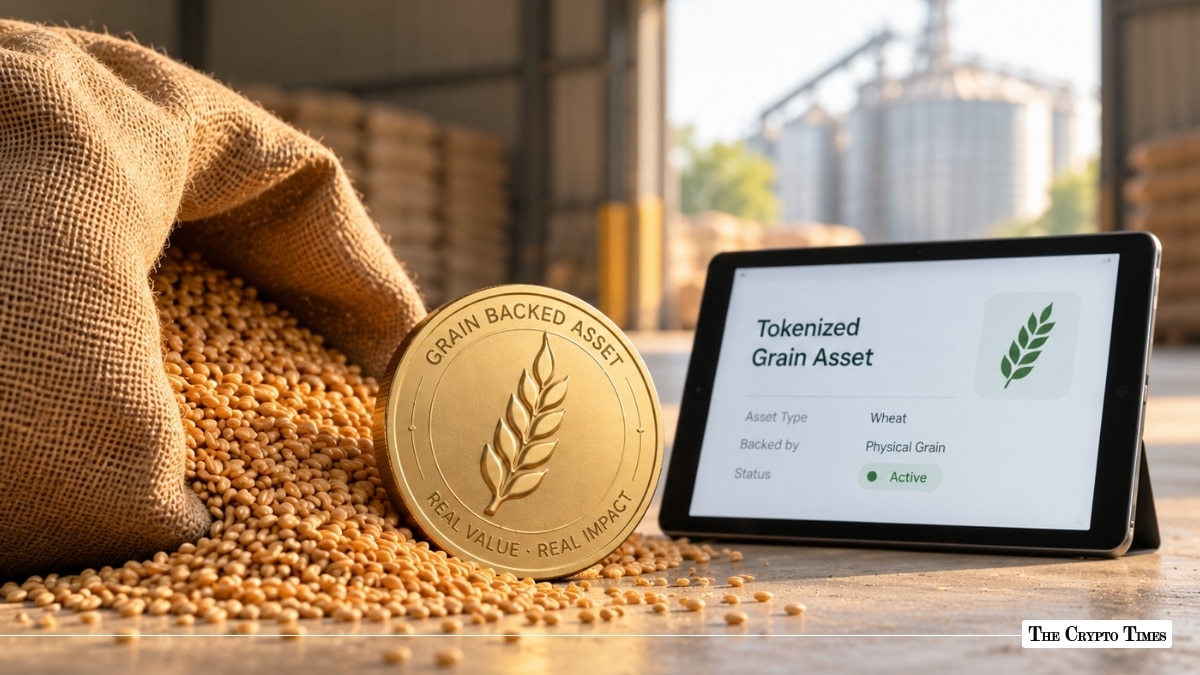
India’s largest agricultural warehousing business is putting its grain records on a blockchain. How much of its business moves there, and when, has not been said.
Arya.ag holds around $2 billion of crops across its warehouses and facilitates roughly $1.3 billion in loans a year. The companies have not disclosed how much of that the initial deployment covers.
Nandan Nilekani announced the initiative on Thursday during his keynote at the Global Fintech Festival in Mumbai.
What Is Being Tokenized
The system tokenizes electronic negotiable warehouse receipts, or e-NWRs— Instruments that already exist and are legally recognized in India for securing bank loans against stored crops.
Devika Mittal, head of India at Ava Labs, said that testing is under way and that each tokenized receipt represents ownership of the stored commodity. The aim is to connect grain deposits, warehouse receipts, collateral commitments, and loan status in a single record.
Arya.ag’s samplers collect information about stored grain and enter it into the company’s portal. Finternet then combines farmer, commodity, warehouse, and insurance information into what he called a composite token that banks can use when assessing collateral risk.
The Verification Problem
When a farmer stores grain rather than selling it at harvest, they can borrow against it. The obstacle is that the records showing what is stored, whether it has already been pledged, and how much is still owed typically sit in separate systems.
That makes it slower for a lender to confirm the collateral exists and is unencumbered before approving a loan. A shared ledger that the warehouse, the lender, and other permitted parties can read at the same time is intended to remove that step.
A Chain Arya Runs Itself
The network is a dedicated layer-1 built with technology from Avalanche, the blockchain created by Ava Labs, and operated by Arya.ag rather than by Ava Labs.
Mittal said the deployment is dedicated for now but will scale to support other warehouse companies, that any bank can join, and that three major banks are already doing so. Neither company named them.
Some lending comes from Arya’s own non-bank finance company, Arya Dhan, which issues about $230 million directly each year. The rest comes from banks and financial institutions lending against crops in Arya’s warehouses after checking its records.
Where the $2 Billion Figure Comes From
The $2 billion refers to the value of crops Arya.ag holds across its warehouses, not to loans moving onto the chain. No figure has been given for the amount of grain or lending covered by the initial deployment, and the financial terms of the arrangement with Ava Labs were not disclosed.
The number has been in circulation since February, when Finternet Labs and Avalanche announced a partnership to build tokenized financial infrastructure in India, beginning with a pilot on lending against farm assets and referencing roughly $2 billion of Indian agricultural assets as the addressable pool.
Finternet Labs was co-created by Pramod Varma, an architect of India’s Aadhaar identity system, with Siddharth Shetty as chief executive. The broader Finternet concept was proposed by Nilekani alongside Agustín Carstens, the former general manager of the Bank for International Settlements and former governor of the Bank of Mexico, and is set out in a BIS working paper.
The Credit Gap It Targets
Farmers make up roughly 40% of India’s population, but only around 15% can access formal credit, with most borrowing running through informal and often expensive channels.
Warehouse-backed lending is intended to narrow that gap and has legal backing already, yet remains lightly used, particularly among smaller farmers. Whether shared records change is the question the deployment will answer.
Also Read: Robinhood CEO Defends Stock Tokens After AMC Criticism