Key Highlights
- Former SEC and CFTC officials warned that overlapping derivatives requirements could make U.S. markets less competitive.
- Kalshi estimates offshore perpetual futures trading exceeded $90 trillion in 2025.
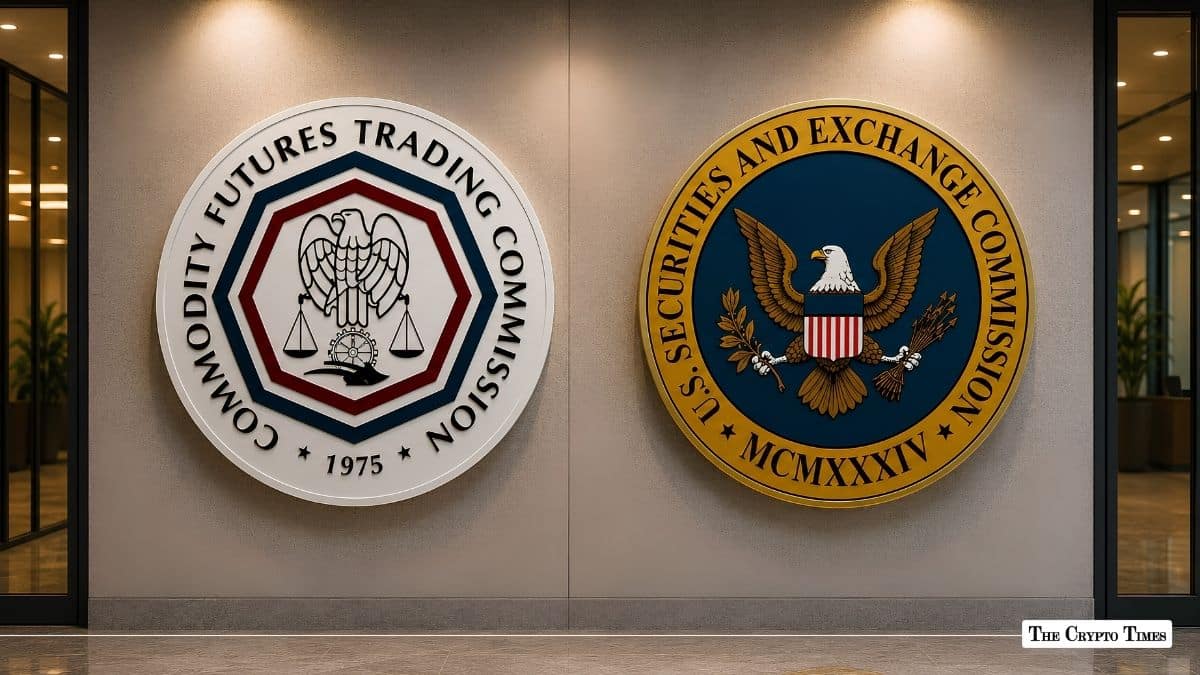
- The SEC and CFTC are reviewing the regulatory treatment of derivatives and emerging financial products.
A group of former U.S. securities and derivatives regulators is calling for a risk-based approach to crypto market regulation as the Securities and Exchange Commission (SEC) and Commodity Futures Trading Commission (CFTC) review rules covering derivatives and other digital asset products.
According to a Crypto In America report by journalist Eleanor Terrett on August 31, the former officials argue that regulators should avoid imposing overlapping requirements on products with similar risk profiles.
Their comments come as a large share of cryptocurrency perpetual futures trading continues on platforms outside the U.S. regulatory system.
Former regulators question current derivatives approach
The group includes former CFTC Chairman Chris Giancarlo, former CFTC Commissioners Brian Quintenz and Sharon Brown-Hruska, former SEC Commissioner Steven Wallman, and former SEC Chief Economist Chester Spatt.
In a recent comment letter, the former officials argued that regulatory requirements should be based on a product’s risks rather than creating separate rules for products that perform similar functions.
The letter follows a June request for public input from the SEC and CFTC on the definitions of swaps, security-based swaps and emerging financial products, as well as the division of regulatory responsibilities between the two agencies.
The former officials said uncertainty or overlapping requirements could affect the ability of U.S. venues to compete with offshore markets.
Former CFTC Chairman Giancarlo told Crypto In America that the size of the offshore perpetual market shows continued demand for the product.
“The $90 trillion offshore perpetual market isn’t a mystery to solve; it’s a market waiting for a sensible U.S. rulebook.”
He argued that delays in establishing clearer rules could make it more difficult for U.S. platforms to attract some of that trading activity.
Offshore perpetuals trading tops $90 Trillion.
Perpetual futures have become a major part of the cryptocurrency derivatives market, particularly on offshore exchanges.
According to figures cited by Kalshi, offshore perpetual futures trading exceeded $90 trillion in 2025, compared with approximately $28 trillion in 2023.
The contracts allow traders to maintain leveraged positions without a traditional expiration date and are widely used across global crypto markets.
U.S. regulators have been examining whether more of this activity can operate through domestic, regulated venues.
Earlier this month, President Donald Trump said CFTC Chairman Michael Selig was working to bring offshore perpetuals platform Hyperliquid into the United States.
Separately, the Hyperliquid Policy Center has asked the CFTC to continue its phased review of perpetual futures while examining their potential use in markets beyond cryptocurrencies.
The developments come as U.S. regulators assess the classification, oversight and potential domestic availability of perpetual futures, while a large portion of existing trading remains outside the U.S. regulatory system.
Kalshi helped prepare the comment letter
The former officials’ letter was prepared with assistance from Kalshi, which retained law firm Bellementis PLLC to help with the drafting.
The signatories said they were not compensated by Kalshi and that the company did not control the contents of the submission.
Kalshi has its own interest in the regulatory debate. The prediction market operator has expanded into cryptocurrency derivatives and began offering crypto perpetual futures earlier this year.
Its involvement is therefore relevant when assessing the letter’s arguments, even though the recommendations were presented by the former regulators who signed it.
SEC also revisits digital asset custody
The derivatives discussion is taking place alongside a separate SEC review of custody requirements.
Last week, the SEC sent a proposed rewrite of its investment adviser custody rules to the White House Office of Information and Regulatory Affairs (OIRA) for review.
The proposal could affect how investment advisers and investment companies hold digital assets and the requirements applicable to custodians.
The details of the proposal have not yet been made public, leaving questions about which firms could qualify as crypto custodians and what standards they would have to meet.
SEC continues separate crypto rulemaking
The SEC is also moving forward with its “Reg Crypto” proposal, which has been published in the Federal Register and is open for public comment through October 20.
The initiative is separate from the custody review but forms part of the agency’s broader effort to establish rules for digital assets under its existing authority.
The parallel rulemaking efforts come while Congress continues to debate legislation that could establish a broader division of responsibilities between the SEC and CFTC.
Prediction markets add another regulatory question
The regulatory debate also extends to prediction markets.
A federal appeals court recently ruled that Kalshi cannot prevent Nevada from regulating its sports event contracts, adding to the ongoing dispute over whether states can apply their gaming laws to products offered through federally regulated prediction markets.
Prediction market operators generally argue that their contracts are derivatives subject to federal commodities regulation, while state regulators have argued that some sports-related contracts fall within state gambling laws.
The CFTC has also taken enforcement action involving prediction-market trading based on advance access to information.
In one recent case, the agency ordered a former White House teleprompter operator to pay more than $172,000 after finding that he used advance access to President Trump’s speeches to trade Kalshi contracts.
These cases raise separate questions about federal jurisdiction, state authority, consumer protection, and the use of non-public information in event-based markets.
U.S. crypto regulation faces several open questions
The latest developments show that U.S. crypto regulation is being addressed through several channels at once.
The SEC and CFTC are reviewing derivatives rules, the SEC is considering changes to custody requirements, and prediction-market operators continue facing disputes with state regulators.
The former regulators’ argument is that the design of those rules could influence where crypto derivatives trading takes place.
Whether more activity ultimately moves onto U.S.-regulated platforms will depend on the rules adopted by regulators, the outcome of congressional legislation, and how exchanges and traders respond to the resulting compliance requirements.
For now, the $90 trillion offshore perpetual market remains an important reference point in the debate over how the United States approaches crypto derivatives.
Also Read: Grayscale Warns AI Could Raise Demand for Crypto Privacy