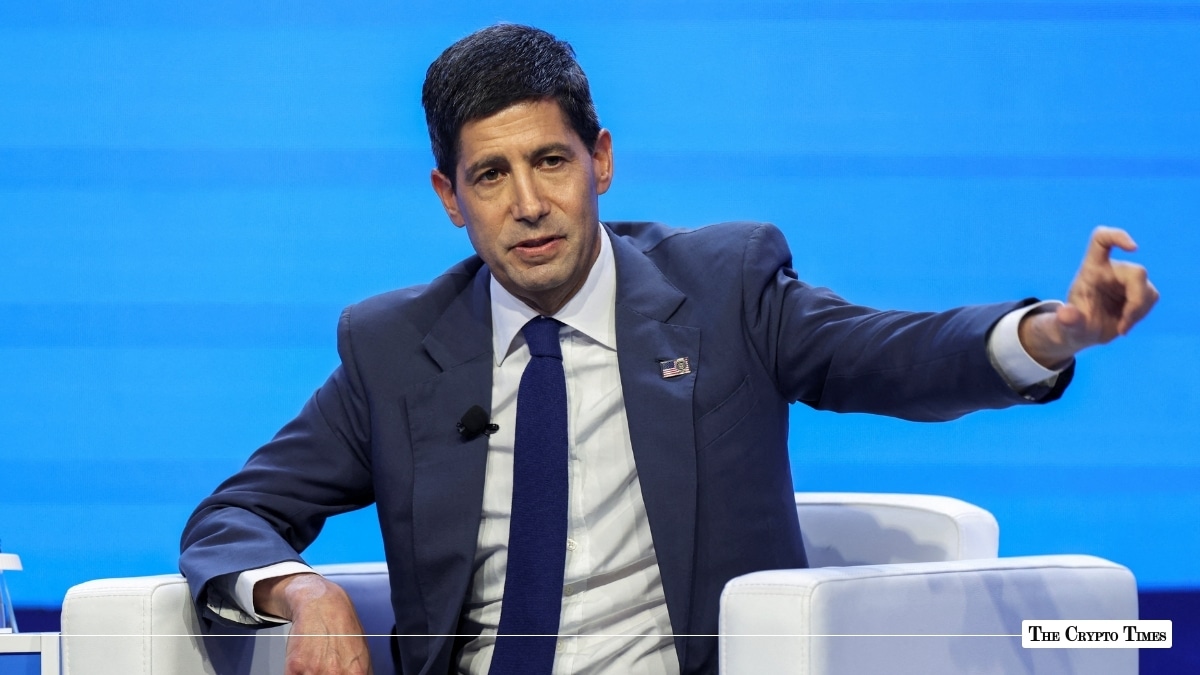
Federal Reserve Chair Kevin Warsh declined to signal whether the central bank would raise or hold interest rates at its October meeting, saying, “I don’t prejudge meetings,” during a fireside chat with International Monetary Fund Managing Director Kristalina Georgieva in Bangkok on October 15.
The discussion, held during the IMF and World Bank annual meetings, covered monetary policy, economic resilience and artificial intelligence’s potential effects on productivity, employment and inflation. Warsh defended the Fed’s September rate increase but offered no advance commitment on the next decision.
Warsh’s comments came after the US reported another monthly increase in consumer prices. They also raised a broader policy question: whether the investment required to build AI infrastructure could add to demand and price pressures before productivity improvements help expand supply. For crypto markets, both interest-rate expectations and the outlook for AI-linked investments remain relevant, although neither factor alone explains daily price movements.
No Signals, and No Apology for September
Warsh’s central message was that he would not use public remarks to preview the Federal Open Market Committee’s next decision. Asked about the October 27–28 meeting, he said, “I don’t prejudge meetings,” and indicated that the Fed would not routinely telegraph its decisions in advance.
The distinction matters because the Fed’s next move remains undecided. Warsh’s refusal to offer guidance should not itself be read as confirmation that policymakers will hold rates steady. The Federal Reserve’s October calendar lists the two-day FOMC meeting for October 27–28.
Warsh also defended the Fed’s September decision to raise rates by 25 basis points, bringing the federal funds target range to 3.75%–4%. The FOMC’s September meeting minutes record the decision and the new target range. Warsh framed the move as part of a broader effort to bring inflation under control, describing a “synchronous tightening in monetary policy” by central banks worldwide.
The economic backdrop remains challenging. The US Bureau of Labor Statistics reported that the Consumer Price Index rose 0.6% in September on a seasonally adjusted basis, following a 0.4% increase in August. Headline CPI was up 3.7% over the 12 months through September. The report showed that inflation remained elevated, but it does not by itself establish how the Fed will respond. Interest-rate expectations reflect policymakers’ assessments of inflation, employment and broader economic conditions, alongside incoming data.
Markets were already weighing the possibility of an October pause. Even without guidance, markets drew their own conclusion. By the time Warsh spoke, CME FedWatch showed traders pricing an 87.3% chance that the Fed holds rates steady in October, with any further move more likely in December. In other words, a known hawk declining to push for back-to-back hikes, days after a hotter-than-expected inflation report, reinforced the view that the Fed will pause this month.
The AI Inflation Warning
Warsh also described artificial intelligence as a major economic shift, while cautioning that the transition could be uneven. He called AI “probably the most consequential change to the U.S. and the global economy in my lifetime” and said it could increase productivity and wealth over time, even as the adjustment period proves “very bumpy.”
His inflation concern centers on the timing of investment and productivity gains. Building AI infrastructure requires substantial capital spending, while the productivity improvements expected from AI may take longer to materialize. If investment boosts demand before the technology meaningfully expands productive capacity, it could add to price pressures. This is a potential economic mechanism, not proof that AI investment is currently responsible for a measurable share of US inflation.
Warsh also discussed uncertainty around AI’s effects on employment over the next 12 to 18 months. He said a Fed task force studying AI’s effects on productivity and jobs would hold a field hearing in the San Francisco Bay Area on November 16.
The implications for monetary policy are not one-directional. If AI investment adds to demand and inflation, it could complicate the case for easing policy. If AI eventually delivers substantial productivity gains, it could also expand economic capacity and help moderate costs. The timing and scale of those effects remain uncertain.
Notably, Warsh did not discuss cryptocurrencies, stablecoins, or digital assets in the session.
What It Means for Crypto
For digital assets, the significance runs along two tracks. The first is the familiar rate channel. The fear Warsh helped cool is the same one that drove crypto lower this week: as The Crypto Times reported, Bitcoin slid below $81,000 as the hotter September CPI revived October rate-hike odds, and Ethereum fell 6.2% as long liquidations hit $265 million after the print. A near-certain October pause removes the immediate catalyst that had been weighing on a rate-sensitive market; though, as Macquarie economists have framed it, a “hawkish hold” leaves a year-end hike in play, and the inflation data itself has not improved.
The market steadied on Friday. The total crypto market capitalization rose about 2.5% to roughly $2.867 trillion, with Bitcoin near $82,148 (up 0.9% on the day, after dipping below $81,000 earlier in the week), Ether up 3.3% to about $2,453, and Solana and XRP higher by 3.5% and 2.3%, according to CoinGecko data as of roughly 09:12 UTC. The rebound is consistent with easing rate-hike fears, but crypto responds to many forces at once, and a single session does not establish the cause.
The second connection is the relationship between crypto and AI-linked investments. Crypto and the AI trade have become increasingly intertwined, from AI-linked token narratives to the pre-IPO markets now tracking companies like Anthropic and OpenAI. The Crypto Times has recently covered the launch of the 21Shares Anthropic pre-IPO ETP tied to Binance perpetual futures and the market debate around Anthropic’s potential $2 trillion valuation.
Warsh’s argument that AI investment is stoking inflation cuts against the idea that the AI boom is an unambiguous tailwind: if the capital pouring into AI keeps prices elevated, it strengthens the case for tighter policy, which is a headwind for the same risk assets the AI story is supposed to lift.
What to Watch
The next scheduled FOMC meeting is October 27–28. The committee’s decision will establish whether policymakers hold rates at the current target range or tighten further. The November 16 AI field hearing may provide more detail on how the Fed is examining the technology’s effects on productivity and employment, while the December 8–9 meeting will be another opportunity for policymakers to reassess the economic outlook.
For crypto markets, the key questions are whether inflation continues to put pressure on the Fed’s outlook, how policymakers assess the balance between demand and productivity growth, and whether changing rate expectations coincide with shifts in risk appetite. A pause would not by itself guarantee a sustained recovery, just as concerns about AI-related inflation would not determine the direction of crypto prices on their own.
The Crypto Times will continue to track the Fed’s decisions and their potential implications for digital assets without treating market expectations as confirmed policy outcomes or presenting price movements as proof of a single cause.
Also Read: Will Tesla Stock Price Go Up Today? Elon Musk Unveils Flying Car Roadster