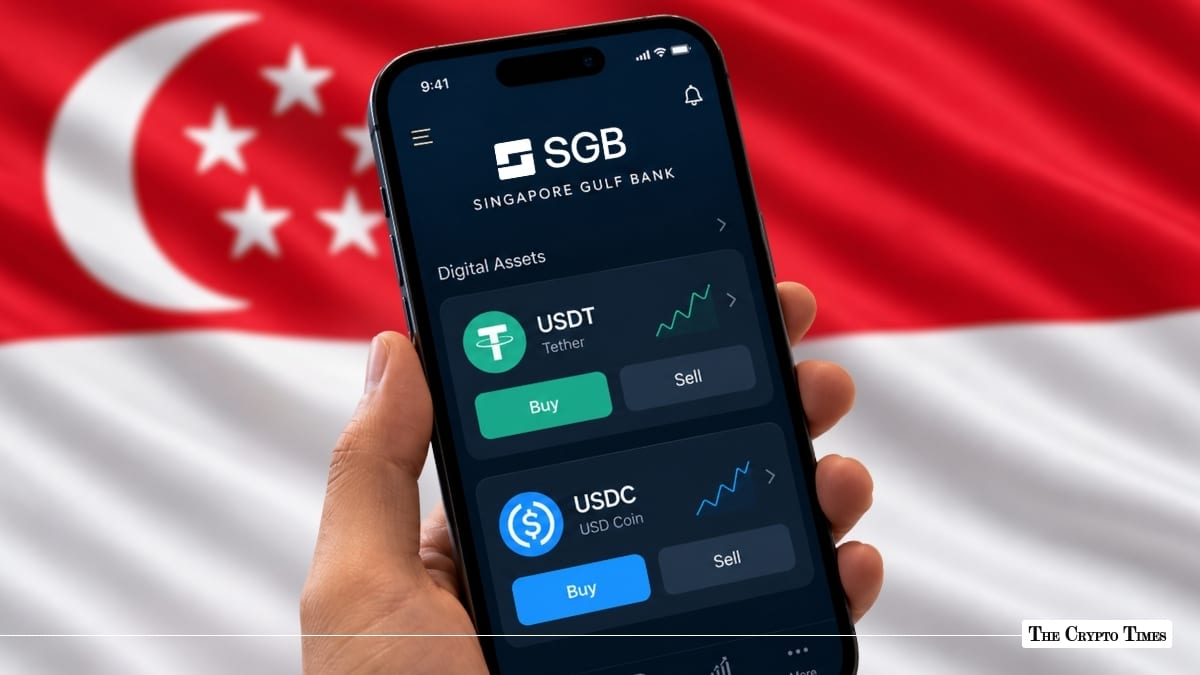
Singapore Gulf Bank (SGB), a Bahrain-regulated digital bank backed by Singapore’s Whampoa Group and Bahrain’s sovereign wealth fund Mumtalakat, has enabled retail customers to convert bidirectionally between U.S. dollars and the stablecoins USDT or USDC directly inside its mobile banking app.
Users can hold the stablecoins alongside fiat balances in the same account and move them to self-custody or custodial wallets without first routing funds through a crypto exchange.
What SGB Launched
SGB announced the feature on its official X account on October 14, 2026. The service supports two-way conversion between USD and USDT or USDC, is available 24 hours a day from Monday to Friday, and allows deposits and withdrawals to external wallets. The bank’s messaging emphasizes the removal of the traditional “runaround” between a bank account and an exchange.
This retail rollout follows earlier institutional offerings. In April 2026, SGB launched a USDC mint-and-redeem service on Solana (initially for higher-value clients, with temporary fee waivers) and signaled plans to add USDT and other stablecoins. The Crypto Times previously covered that institutional launch as well as the bank’s more recent partnership with BNY for 24/7 USD payments.
SGB operates under a banking license from the Central Bank of Bahrain and positions itself as a bridge between traditional finance and digital assets, with remote onboarding aimed at clients in Asia, the Gulf, and beyond.
How It Affects Users and the Broader Market
For retail clients, the practical effect is a reduction in friction and counterparty steps. Instead of transferring USD to an exchange, converting, and withdrawing stablecoins (with associated fees, delays, and exchange risk), users can convert inside a licensed bank and hold the result in the same account. This is especially relevant for people who already use USDT or USDC for payments, trading, or remittances and want to keep fiat and stablecoin balances under one regulated roof.
On a wider scale, the move is another data point in the gradual embedding of major stablecoins into licensed banking infrastructure. USDT and USDC already dominate on-chain settlement volumes; bringing direct bank-level conversion to retail accounts lowers the barrier for everyday use and reduces reliance on pure crypto-native on-ramps.
It also fits a pattern of regulated institutions in progressive jurisdictions (Bahrain has had a digital-asset framework since 2019) offering fiat-stablecoin rails while traditional correspondent banking remains constrained by hours and cut-off times.
SGB’s recent infrastructure steps reinforce this direction. Its SGB Net clearing network has grown rapidly, it has integrated with BNY for weekend and holiday USD transfers, and it previously partnered with Payward (Kraken’s parent) for institutional USD settlement. Adding retail stablecoin conversion extends the same logic—faster movement between dollars and dollar-pegged tokens—to individual clients.
How Things Are Likely to Unfold
In the near term, adoption will depend on account eligibility, any volume or geographic limits, conversion spreads or fees (not detailed in the public announcement), and how smoothly withdrawals to external wallets function in practice. Because the service is limited to weekdays (24 hours Monday–Friday), it is not yet fully continuous, though it already improves on traditional banking hours.
Over the medium term, several developments are plausible:
- Expansion of supported assets or chains, building on the earlier Solana USDC work and the bank’s stated interest in additional stablecoins.
- Deeper integration with SGB’s existing 24/7 USD payment capabilities, potentially allowing more seamless stablecoin ↔ fiat movement outside standard windows.
- Competitive pressure on other banks and fintechs in the region (and among digital-asset-friendly institutions elsewhere) to offer similar in-app conversion, especially as stablecoin volumes continue to grow.
- Regulatory and compliance scrutiny remaining a constant constraint. Because SGB is fully licensed in Bahrain, the service operates inside an existing supervisory perimeter, but any material scale-up will still need to satisfy anti-money-laundering, sanctions, and customer-protection rules.
For the stablecoin market itself, each additional licensed banking on-ramp increases the practical utility of USDT and USDC as settlement and treasury tools rather than purely trading instruments. It does not change the underlying reserve or regulatory status of those tokens, but it does expand the set of regulated venues where users can enter and exit them without touching an exchange.
SGB’s trajectory—from institutional mint/redeem to 24/7 dollar rails via BNY and Payward to this retail conversion feature—shows a deliberate step-by-step integration of stablecoins into a licensed banking stack. Whether that model scales widely or remains a specialized offering for clients comfortable with Bahrain-regulated digital banking will become clearer as usage data and any further product expansions emerge.
Also Read: Mastercard and BVNK Launch Platform for Fiat and Stablecoin Payments