
Capital Group—one of the world’s largest traditional asset managers with roughly $3.3 trillion in assets under management—has significantly expanded its position in Metaplanet Inc., becoming the Japanese company’s largest shareholder.
According to an official disclosure filed today with Japanese regulators, Capital Research and Management Company, a key unit of Capital Group, now holds 136,059,120 common shares in Metaplanet (TSE: 3350), equivalent to 10.63% of voting rights.
The stake was built by adding approximately 17.4 million shares since its previous reported level of 9.32%, with the change effective as of July 13, 2026.
The move places a premier value-oriented giant squarely behind Metaplanet, a former hotel operator that has reinvented itself as one of Asia’s most aggressive corporate Bitcoin accumulators. This development is being closely watched by Bitcoin observers as evidence that sophisticated capital is increasingly comfortable allocating to BTC via publicly listed treasury vehicles.
A Major Institutional Bet on Bitcoin’s Corporate Treasury Strategy
Metaplanet has aggressively pursued a “Bitcoin-first” treasury policy since 2024, raising capital through equity offerings, bonds, and other instruments specifically to purchase Bitcoin as a hedge against yen weakness and long-term fiat depreciation.
The company currently holds 43,000 BTC, valued near $2.9 billion at prevailing price of $66,200 per coin, positioning it as the third-largest corporate Bitcoin holder globally behind Strategy and Twenty One Capital.
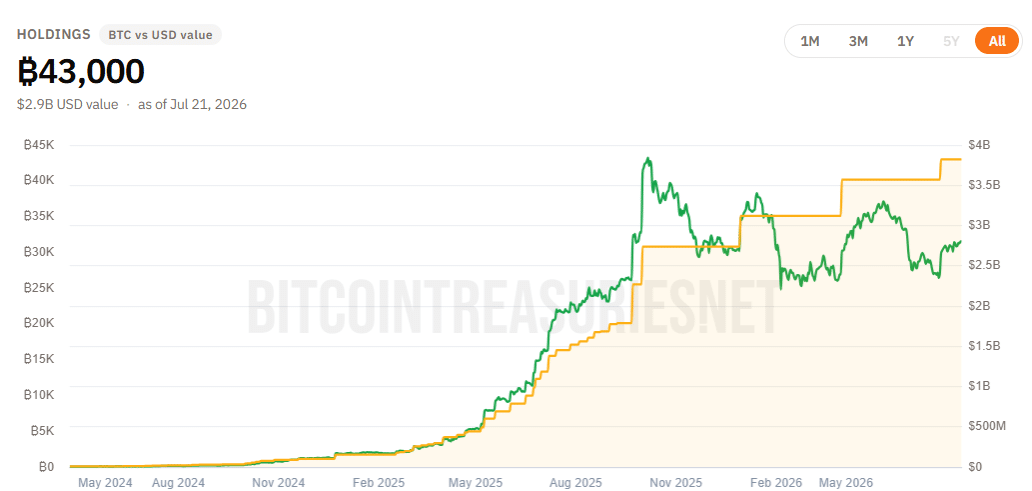
Capital Group’s increased ownership — now worth roughly $203 million — represents more than just another line item in a vast portfolio. It signals validation of the entire corporate Bitcoin treasury model pioneered by Michael Saylor’s Strategy and refined by Metaplanet in the Asian context.
For traditional asset managers bound by mandates that limit direct crypto exposure, equity stakes in dedicated Bitcoin treasury companies offer a regulated, equity-market gateway.
Capital Group, renowned for its long-term fundamental approach and flagship funds, has now doubled down on this thesis. The firm already maintains a notable position in Strategy; today’s filing extends that conviction to Japan’s leading Bitcoin proxy.
By consistently deploying raised capital into Bitcoin rather than speculative ventures, Metaplanet has built a balance sheet that increasingly resembles a leveraged Bitcoin holding company trading on the Tokyo Stock Exchange.
What is more noteworthy is that the timing adds weight. Metaplanet has faced share-price volatility amid broader market swings and repeated equity dilution to fund purchases. Yet Capital Group chose to buy more, suggesting the manager views current levels as attractive relative to the underlying Bitcoin holdings and the company’s growth runway.
What This Means for Bitcoin’s Institutional Adoption Trajectory
This transaction carries implications that extend well beyond one Japanese stock. It reinforces Bitcoin’s gradual migration from fringe asset to legitimate corporate reserve instrument — a narrative that has gained traction as inflation, currency debasement concerns, and sovereign debt levels remain elevated in many jurisdictions.
For Bitcoin itself, every major institutional entry point matters. When a $3.3 trillion manager like Capital Group allocates capital to a pure-play Bitcoin treasury company, it normalizes the idea that BTC belongs in sophisticated portfolios, even indirectly. This can lower perceived risk for other institutions still on the sidelines and encourage further capital formation around similar vehicles.
Read: The Bitcoin Treasury Blueprint: What Stress Testing on Strategy Inc.’s MSTR-STRC Reveals
Metaplanet’s model demonstrates how Bitcoin can function as a treasury asset in practice: raise cheap capital, deploy into BTC, hold long-term, and potentially develop ancillary financial products (the company has explored tokenized Bitcoin-backed instruments and securities licensing). Success here could inspire other Asian and European firms facing similar monetary pressures.
From a broader market perspective, the filing highlights maturing liquidity channels. Traditional managers no longer need to wrestle with custody, ETF mechanics, or direct spot exposure if they can achieve desired economic exposure through listed equities. This hybrid approach may accelerate adoption without requiring immediate regulatory shifts in every jurisdiction.
Also read: New Bitcoin Multisig Proposal Removes Need for Off-Chain Coordination