Key Highlights
- ARK Invest researcher Lorenzo Valente said confirmed Robinhood Wallet activity accounted for less than 1% of transactions in his analysis.
- Valente estimated the Robinhood-linked share could reach about 5% when unidentified contracts are included.
- Valente attributed much of the remaining identifiable activity to trading terminals including GMGN, Axiom and OKX.
Robinhood Chain has recorded substantial trading activity since launch. Still, an analysis posted on X by ARK Invest Director of Research Lorenzo Valente on September 5 has raised questions about how much of that activity represents new users entering crypto through Robinhood.
Valente examined smart-contract activity on the network and compared identifiable transactions with routes associated with Robinhood Wallet. His analysis found that confirmed Robinhood Wallet activity represented less than 1% of the transactions he examined.
The finding does not provide a count of Robinhood Chain users. Instead, it raises a narrower question about whether the network’s early activity is being driven primarily by Robinhood customers or by traders already active elsewhere in crypto.
Robinhood wallet activity accounts for less than 1%
Valente identified the 0x Settler contract, which Robinhood Wallet uses to route swaps, as the clearest onchain indicator of transactions associated with the wallet.
Transactions through that route represented less than 1% of the activity in his analysis.
Valente estimated that Robinhood-linked activity could rise to around 5% if some unidentified contracts were included. He described that figure as a generous upper estimate because the unidentified activity could also have originated from outside platforms.
The distinction matters because blockchain data generally does not show whether a wallet belongs to a first-time crypto user, an existing trader or a customer of a particular financial platform.
Valente summarized his interpretation of the data as “same degens, new chain,” referring to his view that much of the activity resembles trading behavior already present elsewhere in crypto.
Third-party platforms complicate user attribution
Much of the identifiable activity outside the Robinhood Wallet route came through trading terminals including GMGN, Axiom and OKX, according to Valente’s analysis.
Those platforms can connect users to onchain markets without requiring them to use Robinhood Wallet or maintain a Robinhood brokerage account.
That does not mean every trader using those services is an existing crypto user. A person new to crypto could also access Robinhood Chain through a third-party application.
The limitation is therefore with the available data: contract activity can show where transactions were routed, but it cannot reliably establish the identity or experience of the person behind each wallet.
Robinhood chain records significant onchain activity
Separate network data shows that Robinhood Chain is being used across several parts of the crypto market.
According to DeFiLlama data, the network had approximately $890.1 million in DeFi TVL, $951.88 million in stablecoin market capitalization, and $251.24 million in RWA active market capitalization.
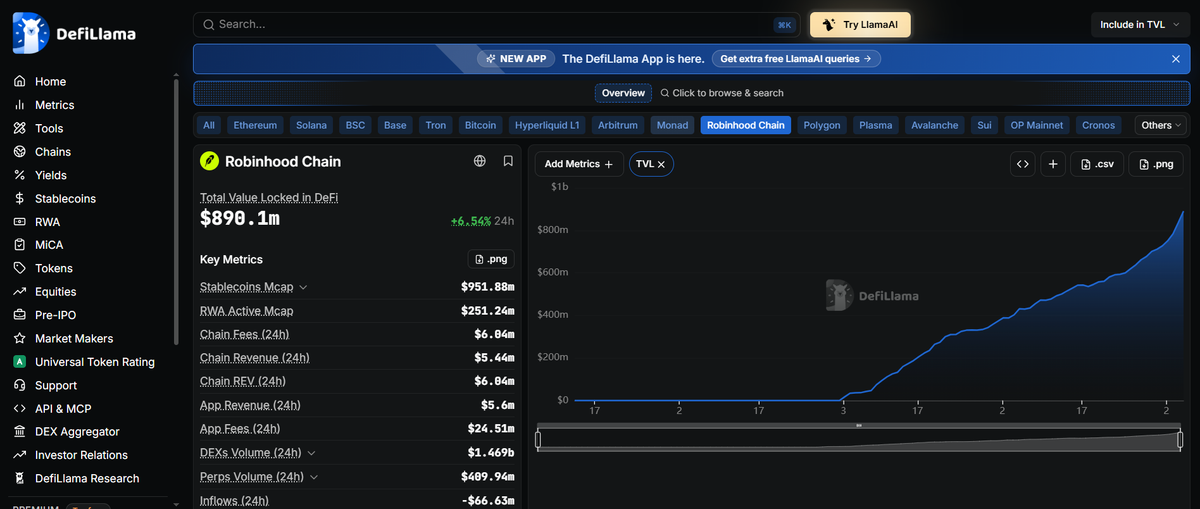
Robinhood Chain of September 5 | Source: DeFiLlama
The chain also recorded about $1.47 billion in 24-hour DEX volume and $409.94 million in perpetual futures volume. Its 24-hour chain revenue stood at approximately $5.44 million, while chain fees were around $6.04 million. Bridged TVL was about $3.30 billion.
The most active protocols include Uniswap, Pons, GMGN, and Morpho Blue, spanning decentralized trading, token launches, and lending.
These figures establish the level of activity on the network, but they do not indicate how many users are new to crypto or how many are Robinhood customers.
Trading activity does not establish new-user growth
High transaction and trading volumes show that a network is being used, but they do not by themselves measure first-time crypto adoption.
Activity can rise when existing traders move strategies from another blockchain, interact with multiple applications, or increase their trading frequency.
This makes transaction counts, DEX volume, and TVL useful measures of network activity, but less reliable as standalone measures of new-user acquisition.
For Robinhood Chain, the distinction is particularly relevant because the network is open to external wallets and applications rather than being limited to Robinhood customers.
Robinhood has a large existing customer base
Robinhood’s existing customer base gives the company a separate potential source of onchain users.
The company reported 28.4 million funded customers at the end of the second quarter, alongside approximately $369 billion in platform assets.
However, the size of that brokerage customer base cannot be directly translated into Robinhood Chain adoption.
The network is permissionless, allowing compatible wallets and applications to interact with it without requiring a Robinhood brokerage account.
That makes it difficult to determine how much of the chain’s activity is coming from existing Robinhood customers and how much is coming from users already active in crypto.
ARK Invest’s Robinhood buying adds context
The discussion comes shortly after ARK Invest increased its exposure to Robinhood.
The firm purchased additional Robinhood shares on September 4, according to earlier reporting, while also adding to a Solana-focused ETF.
The investment activity and Valente’s analysis address different questions. His research examined the composition of current onchain activity, while ARK’s portfolio decisions reflect the firm’s broader view of Robinhood as an investment.
As a result, the firm’s purchases do not establish that Robinhood Chain is or is not successfully acquiring new users.
Cathie Wood offers a different interpretation
Cathie Wood offered a more optimistic interpretation, saying that “net new users” would help build Robinhood’s liquidity and increase its credibility in crypto.
The difference highlights the difficulty of determining user acquisition from public blockchain data.
A wallet can be traced to an application or smart contract, but the transaction history generally does not reveal whether its owner is a first-time crypto user, an experienced trader, or a Robinhood customer.
That leaves room for different interpretations of the same onchain activity.
Whether Robinhood customers move onchain
Robinhood Chain’s early data shows that the network is attracting trading activity and capital. What remains less clear is the source of those users.
Valente’s analysis points to a relatively small share of transactions that can be directly associated with Robinhood Wallet, while much of the identifiable activity comes through external trading infrastructure.
That does not rule out new-user growth, but it means current blockchain data cannot provide a definitive measure of how many existing Robinhood customers have moved into onchain markets.
For now, Robinhood Chain’s activity is easier to measure than its user acquisition. Whether the network can convert Robinhood’s existing customer base into active onchain participants will become clearer as more user-level data becomes available.
Also Read: AMC–Robinhood Feud Fuels $MEME Token Past $100 Million in Hours