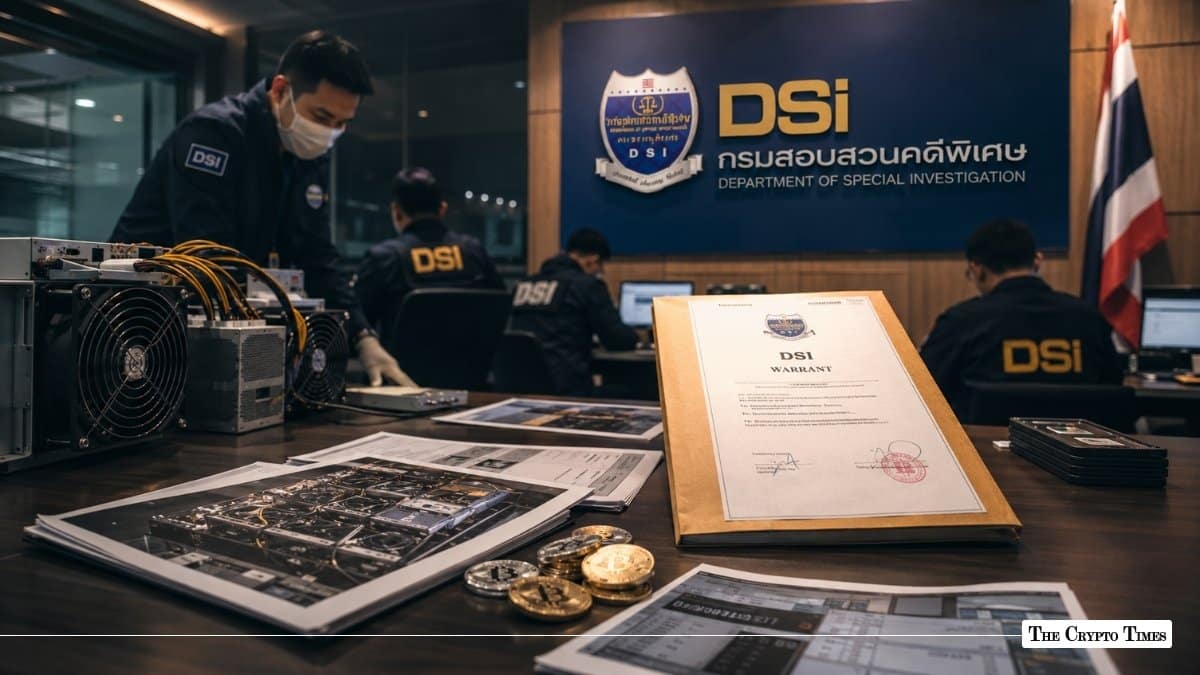
Thai authorities have escalated their crackdown on transnational cybercrime by issuing an arrest warrant for prominent Chinese businessman Wang Yicheng. Investigators accuse Wang of orchestrating a complex web of unauthorized cryptocurrency mining hubs used to launder funds generated by online gambling and international scam networks.
According to Thailand’s Department of Special Investigation (DSI), Wang is believed to have already fled the country. Thai law enforcement officials are currently coordinating with international police counterparts to track his movements across Southeast Asia.
Police Major Woranan Srilam, a spokesperson for the DSI, confirmed that Wang was charged in November with theft and violations of the Computer Crimes Act, which specifically penalizes unauthorized interference with state digital systems and utilities. Authorities allege he was linked to a group of Chinese investors involved in illegal cryptocurrency mining operations.
Investigation links mining network to scam funds
The DSI said it uncovered the network while investigating illegal cryptocurrency mining operations that allegedly consumed about $28 million worth of electricity. Authorities described the case as one of Thailand’s largest illegal crypto mining investigations in recent years.
According to the agency, investigators widened their probe after examining whether the mining operation was linked to online scams and other forms of financial crime. The DSI said criminal groups can use illegal mining activities to generate revenue and move illicit funds.
The allegations add to findings from a 2023 Reuters investigation, which reported that a cryptocurrency wallet registered in Wang’s name received at least $9.1 million from accounts linked to so-called “pig-butchering” scams. The schemes typically involve fraudsters building trust with victims online before persuading them to invest in fake cryptocurrency opportunities.
Reuters reported that investigators were unable to determine whether Wang controlled the wallet or whether someone else had used his identity.
The DSI also said U.S. authorities previously identified Wang as a suspect in a separate digital asset fraud investigation. In June 2023, U.S. officials seized about $500,000 in cryptocurrency from an account bearing his name after tracing funds allegedly stolen from a victim in Massachusetts.
Thailand tightens crypto oversight
The hunt for Wang underscores Thailand’s dual-track approach to Web3: expanding the regulated institutional digital marketplace while aggressively squeezing out shadow operators.
Earlier this year, Thai SEC outlined plans to support cryptocurrency exchange-traded funds, futures trading, and tokenized investment products. Concurrently, authorities also introduced new anti-money laundering measures. In March, officials said they froze more than 10,000 suspicious cryptocurrency accounts using the “Speed Bump” monitoring system. The tool temporarily delays large transfers and is designed to identify mule accounts often used to move illicit funds.
Thailand has also taken action against several crypto-related projects. In November last year, regulators ordered the suspension of a nationwide iris-scanning program that offered digital tokens to participants and directed the deletion of about 1.2 million biometric records over privacy concerns.
By pursuing high-profile figures like Wang Yicheng, the Thai government is sending a clear message to international cartels: the Grand Duchy will not allow its sovereign energy grid or its local financial architecture to serve as an unmonitored off-ramp for global cyber-fraud.
Also Read: How Chen Zhi’s Prince Group Allegedly Targeted Americans in a $15 Billion Crypto Scam Network