Crypto Times Logo Black
Google News Follow Banner
  • News
    • Market
    • Bitcoin
    • Ethereum
    • Altcoins
    • Regulations & Policies
    • DeFi News
    • Blockchain News
    • Industry
  • Exclusive
    ExclusiveShow More
    Litecoin Summit Day 2 LitVM's $50M Bet and BasicSwapDEX's Bold Vision
    Litecoin Summit Day 2: LitVM’s $50M Bet and BasicSwapDEX’s Bold Vision
    Litecoin Summit Day 1 Quantum Warnings, Privacy Coin Breakthroughs, & MiCA's Looming Deadline
    Litecoin Summit Day 1: Quantum Warnings, Privacy Coin Breakthroughs, & MiCA’s Looming Deadline
    Inside the High-Stakes Corporate War Over the GENIUS Act
    Inside the High-Stakes Corporate War Over the GENIUS Act
    From Demonetization to Digital Rupee India's Decade-Long Blockchain Journey
    From Demonetization to Digital Rupee: India’s Decade-Long Blockchain Journey
    The 7% Premium Trap Exposed How India Makes Crypto More Expensive Than Dollars
    The 7% Premium Trap Exposed: How India Makes Crypto More Expensive Than Dollars
  • Opinion
    OpinionShow More
    Why Wall Street is Divided Michael Saylor’s Scarcity vs. Tom Lee’s Staking Empire
    Why Wall Street is Divided: Michael Saylor’s Scarcity vs. Tom Lee’s Staking Empire
    The Arthur Hayes Paradox Macro Prophet or Market Opportunist
    The Arthur Hayes Paradox: Macro Prophet or Market Opportunist?
    RBI Denies Gold Sale Amid Oil Crisis: Could It Speed Up India's Digital Rupee Push?
    RBI Denies Gold Sale Amid Oil Crisis: Could It Speed Up India’s Digital Rupee Push?
    The CLARITY Act War Starts Jamie Dimon Vs Armstrong
    The CLARITY Act War Starts: Jamie Dimon Vs Armstrong
    Is Crypto Dying, or Is Pump.fun Turning It Into an Attention Casino
    Is Crypto Dying, or Is Pump.fun Turning It Into an Attention Casino?
  • Learn
    • Explained
    • How To
    • Insights
  • Videos
  • More
    • About Us
    • Our Authors
    • Contact Us
    • Editorial Policy
The Crypto TimesThe Crypto Times
  • All News
  • Market
  • Bitcoin
  • Ethereum
  • Altcoins
  • Regulations & Policies
  • Blockchain
  • DeFi
  • Industry
  • Exclusive
  • Opinion
Search
  • News
    • Market
    • Bitcoin
    • Ethereum
    • Altcoins
    • Regulations & Policies
    • Blockchain
    • DeFi
    • Industry
    • Exclusive
    • Opinion
  • Learn
    • Explained
    • How To
    • Insights
  • Quick Links
    • About Us
    • Our Authors
    • Contact Us
    • Editorial Policy
    • AI Policy
    • Sponsored & Advertorial Policy
  • Videos
  • Glossary
Follow US
© 2026 By Crypto Times. All Rights Reserved.
DeFi News

DLMC Token on BNB Chain Loses Approximately $222,600 in Flash Loan Exploit

The root cause is a self-referential pricing flaw — the contract priced redemptions off treasury reserves divided only by externally circulating supply.

Written By Dhara Chavda Dhara Chavda
Edited by Divya Mistry Divya Mistry
Published 2 hours ago·Updated 12 seconds ago
Make The Crypto Times preferred on GoogleGoogle
Last updated: 12 seconds ago
Published 2 hours ago
Share
Last updated: 12 seconds ago
Published 2 hours ago
DLMC Token on BNB Chain Loses Approximately $222,600 in Flash Loan Exploit
Show AI Summary
DLMC token protocol suffered a $222,560 treasury drain due to flash loan manipulation, highlighting DeFi project risks
Attack exploited internal price calculation and referral reward distribution, inflating token price and draining USDT reserves
Incident underscores need for robust economic security measures, such as external oracles and sell cooldowns, in decentralized financial ecosystems

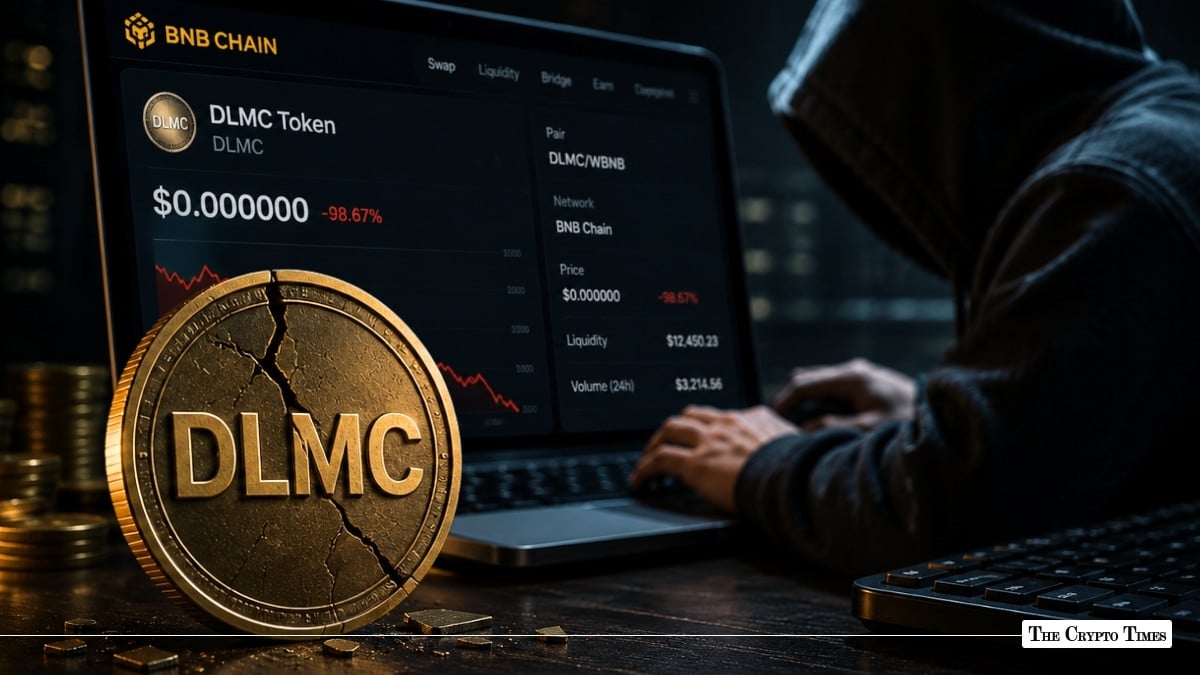
The DLMC (Decentralized Legacy Management Corporation) token protocol on BNB Chain suffered a treasury drain of roughly $222,560 in USDT on June 24, 2026, according to multiple on-chain security monitoring services and independent researchers.

The incident, which unfolded at approximately 11:15 UTC in block 106091607, highlights persistent risks in DeFi projects that rely on internally calculated token prices without robust safeguards against flash loan manipulation.

🚨TenArmor Security Alert🚨

Our system has detected a suspicious attack involving #DLMC on #BSC, resulting in an approximately loss of $222.6K.

Attack transaction: https://t.co/Xv6AsO63fQ

With TenArmor’s TenMonitor, you get early detection and automated response to on-chain… pic.twitter.com/4UccmcQ0ka

— TenArmorAlert (@TenArmorAlert) June 25, 2026

The attack was first flagged publicly by security-focused accounts on X, including @Defi_Nerd_sec, @DefimonAlerts, and @TenArmorAlert. TenArmorAlert reported the loss at around $222.6K and linked the primary transaction on BscScan.

What is DLMC?

DLMC positions itself as a decentralized financial ecosystem focused on transparent, community-driven digital asset management powered by smart contracts. Marketed as the “world’s first AI-powered intelligent DeFi ecosystem,” the protocol emphasizes full automation, no central authority, and dynamic tokenomics where tokens are minted on buys and burned on sells.

Its website (dlmc.io) describes a system where the token price is calculated dynamically, reportedly using liquidity reserves divided by total supply. The smart contract is CertiK-verified, ownership has been renounced, and liquidity is claimed to be locked. The project promotes accessibility with low entry deposits and community governance.

Prior to the exploit, the project’s official X account had shared updates highlighting growth and the mint-burn model. The token operates on BNB Chain (BSC), leveraging its low fees and EVM compatibility, which is popular for DeFi experiments.

How the Attack Unfolded

According to detailed technical breakdowns from DeFi security researchers, the attacker exploited a combination of flash loan mechanics, the protocol’s internal “livePrice” calculation, and referral/DAO reward distribution.

The attacker began by flash-swapping approximately 1.42 million USDT from a PancakeSwap liquidity pair. Using helper contracts (registered under affiliate/referral accounts), they executed large buy transactions into the DLMC contract:

  • One helper bought ~420,000 USDT worth of DLMC.
  • A second helper, registered under the first, bought an additional ~1 million USDT worth.

These buys deposited substantial USDT into the DLMC contract’s reserves. Critically, the protocol’s buy function mints the majority of new DLMC tokens directly to the contract address itself (address(this)), rather than immediately circulating them externally.

The protocol’s _updatePrice() function then recalculates the livePrice as USDT reserves divided by the externally circulating DLMC supply (excluding tokens held by the contract and certain pre-mined or LP balances). This created a rapid inflation of the internal price—from roughly $0.41 USDT to nearly $25 USDT—because the numerator (reserves) surged while the denominator (circulating supply) did not increase proportionally.

The attacker then sold referral/DAO reward DLMC tokens (approximately 65,908 DLMC received by one helper) back into the contract at this artificially inflated price, draining nearly the entire USDT treasury (~1.646 million USDT extracted). After repaying the flash loan (~1.423 million USDT), the attacker retained a net profit of about $222,560 USDT, which was sent to a designated receiver address.

Key addresses identified include the attacker’s EOA (0x74c4a756933d0f713facb1dea325ef511646c3b1), the profit receiver (0x701bb7b460ae231dbbcfa3d87f0ab5b458429699), and the vulnerable DLMC contract (0xf2ca2a3572b26ae7c479dc7ae36d922113b1bdf2).

Root Cause: A Self-Referential Pricing Trap

The core vulnerability stems from the protocol’s design for self-pricing redemptions and rewards. By tying price directly to contract reserves while excluding freshly minted (but contract-held) tokens from the circulating supply denominator, flash-funded deposits could disproportionately influence the price upward. Referral rewards, which appear to be minted and immediately sellable, provided an efficient way to extract value at the manipulated price without needing to hold or sell large positions acquired at market rates.

This is a classic example of a bonding-curve or reserve-based pricing mechanism being gamed when combined with flash loans and reward systems that lack sufficient cooldowns, caps, or oracle-independent safeguards. Even though the contract was audited (CertiK verified), the specific interaction between deposit mechanics, price updates, and referral logic created an exploitable edge case.

Researchers emphasized in their analysis that protocols cannot safely price redemptions or rewards from treasury reserves if flash-funded actions can move the numerator while newly created liabilities remain excluded from the denominator.

Impact and Context in DeFi Security

The absolute loss of ~$222,600 is relatively modest compared to multi-million or billion-dollar exploits seen in 2026 (such as larger bridge or protocol drains earlier in the year). However, it underscores that even smaller or mid-tier projects with audited contracts remain targets when economic incentives align for attackers.

The project’s decentralized nature (renounced ownership) may complicate rapid response or patching, though the community-driven model could allow governance proposals if active.

This incident adds to a long list of DeFi exploits involving flash loans, price oracle manipulation (or self-oracles), and reward farming mechanics. It serves as a reminder that technical audits alone are insufficient without rigorous economic modeling and stress-testing against adversarial scenarios like flash loans.

Broader Implications

For users and the broader ecosystem, such events erode trust in innovative but complex tokenomic designs. Projects emphasizing “dynamic pricing,” mint-burn models, and referral incentives must implement additional protections—such as time-weighted average prices (TWAP), external oracles for key valuations, sell cooldowns on rewards, or caps on single-transaction impacts.

Investors and participants in similar protocols are advised to review smart contract code (where possible), monitor on-chain activity via tools like BscScan or security dashboards, and diversify exposure. As DeFi evolves toward more sophisticated mechanisms, the DLMC incident is a timely case study in the importance of aligning technical implementation with robust economic security principles. The crypto community will be watching for any updates from the DLMC project and whether similar vulnerabilities exist in other reserve-driven or referral-heavy protocols.

Also Read: DeFi’s $45B Wipeout: Hacks and Market Crash Drive TVL Lower

Disclaimer: The information researched and reported by The Crypto Times is for informational purposes only and is not a substitute for professional financial advice. Investing in crypto assets involves significant risk due to market volatility. Always Do Your Own Research (DYOR) and consult with a qualified Financial Advisor before making any investment decisions.

Follow The Crypto Times on Google News to Stay Updated!      Google News
Google News Banner

TAGGED:BinanceCrypto Hack
Share This Article
Whatsapp Whatsapp LinkedIn Telegram Copy Link
Dhara Chavda
By Dhara Chavda
Follow:
Dhara Chavda is a Research Analyst at The Crypto Times. She covers U.S. crypto regulation — including the CLARITY Act and GENIUS Act — DeFi security and major protocol exploits, and investigations into crypto fraud and enforcement actions. Her work emphasizes primary sourcing and on-chain verification over secondary commentary. Dhara joined The Crypto Times in 2020 and has followed every major market cycle since — the 2021 bull run, the 2022 Terra and FTX collapses, the 2023 banking turmoil, the 2024 spot Bitcoin ETF launch, and the 2025–2026 regulatory cycle — first assigning and reviewing the desk's coverage, and now writing it herself. Her reporting has been cited by international outlets including TheStreet and Argentina's La Nación. She holds a Bachelor of Engineering in Computer Engineering from Gujarat Technological University (GTU), which informs her technical reporting on on-chain data, smart contract analysis, and protocol architecture.
Divya Mistry
By Divya Mistry
Follow:
Divya Mistry is the Senior Editor at The Crypto Times. She leads the central editorial desk, overseeing the review and publication of policy analyses, investigative reports, exchange coverage, and protocol exploit stories. Her editorial remit spans digital asset markets, global exchange operations, cross-border digital asset settlements, regulatory developments, and other key developments shaping the cryptocurrency industry. Divya brings more than a decade of experience in editorial strategy, content development, public relations, marketing communications, and research. Before joining The Crypto Times, she worked across multiple sectors, including finance, technology, education, healthcare, real estate, entertainment, lifestyle, and vertical transport, contributing to both digital and print publications. Her research and content work has been featured on platforms including DNA India, Zee, Forbes, and Elevator World India. She holds a Master's degree in English Literature from the University of Mumbai. Drawing on her background in long-form publishing, research, and editorial leadership, she reviews and refines complex stories to ensure accuracy, clarity, and strong editorial standards before publication.

Latest News

$1B Liquidated as Bitcoin Breaks $60K Support Ahead of $10B Expiry
Thailand Hunts Chinese Businessman Over $28M Illegal Crypto Mining Ring
MIM Plunges 36% as Abracadabra Launches Emergency Measures_
MIM Plunges 36% as Abracadabra Launches Emergency Measures
GTA 6 ‘Early Access’ Sites Drain Gamers’ Crypto Ahead of June 25 Pre-Orders
CoinEx Became Iran's Crypto Exit Ramp as Binance Pulled Back
CoinEx Became Iran’s Crypto Exit Ramp as Binance Pulled Back

Find Us on Socials

You may also like

Coinbase Taps 450M Users With Luxembourg MiCA Hub as Binance Loses EU Bid

Coinbase Taps 450M Users With Luxembourg MiCA Hub as Binance Loses EU Bid

Taiko to Fully Restore Bridge Backing After $1.7M Hack

Taiko to Fully Restore Bridge Backing After $1.7M Hack

DeFi’s $45B Wipeout Hacks and Market Crash Drive TVL Lower

DeFi’s $45B Wipeout: Hacks and Market Crash Drive TVL Lower

Binance Withdraws Greece Bid—But Its MiCA Plans Aren’t Dead

Binance Withdraws Greece Bid—But Its MiCA Plans Aren’t Dead

The Crypto Times Logo PNG

Providing real-time, accurate Crypto reporting. Your trusted source for Crypto News and Research.

Stay Updated

All News
Exclusive
Opinions
Learn
Videos
Glossary

Company

About Us
Our Authors
Editorial Policy
AI Policy
Advertorial Policy

Get In Touch

Contact Us
Career

Find Us on Socials

X-twitter Linkedin Telegram Youtube Instagram

© 2026 The Crypto Times | A BITROCK TECHNOLOGIES L.L.C. Company.

DMCA.com Protection Status
  • Terms and Conditions
  • Disclaimer
  • Privacy Policy
  • Cookie policy
Do Not Sell or Share My Personal Information