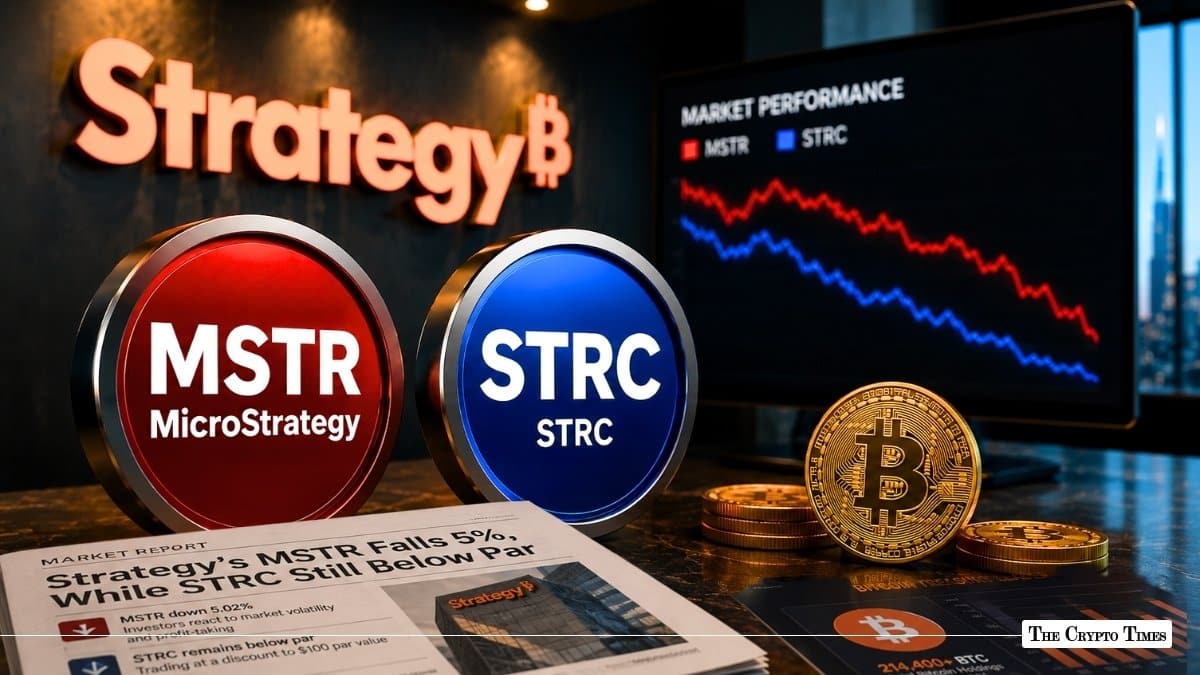
Strategy Inc., the company formerly known as MicroStrategy and now rebranded to emphasize its Bitcoin treasury focus, finds itself at a critical juncture. Its common shares have plummeted nearly 80% from their all-time highs, trading perilously close to the $100 mark.
At the same time, Strategy’s flagship preferred stock, the Variable Rate Series A Perpetual Stretch Preferred Stock (NASDAQ: STRC), is navigating volatility in an attempt to return to its $100 par value through its unique adjustable dividend mechanism.
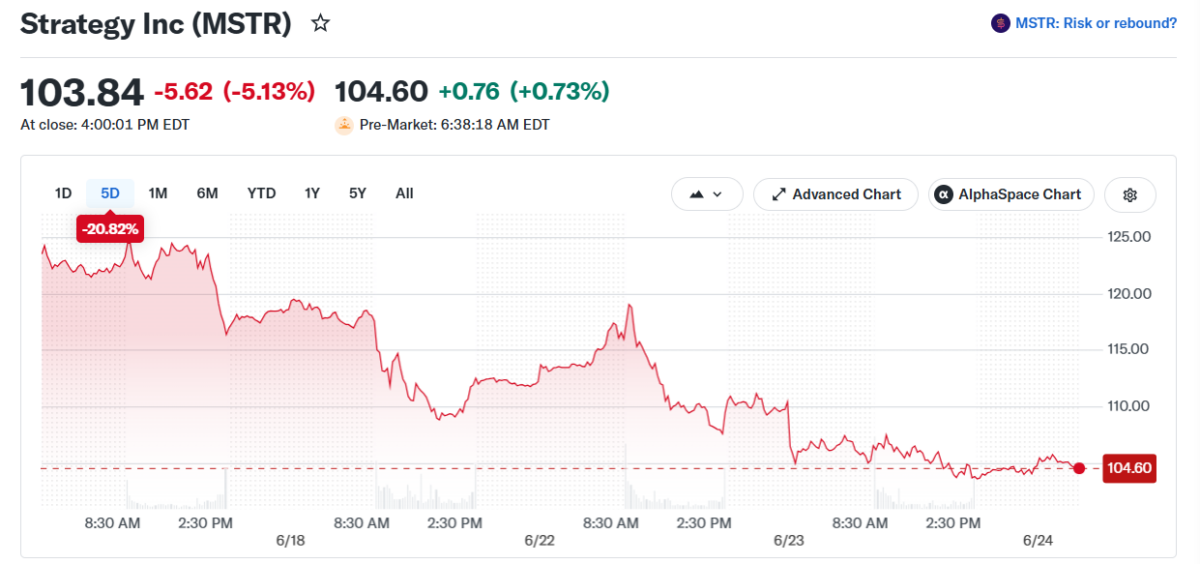
As of the close on June 23, 2026, MSTR shares settled at $103.84, down over 5% that session and hovering near 52-week lows around $104. This marks a stark contrast to its peak closing price of approximately $474 in late 2024. The decline reflects broader pressures in the cryptocurrency market, where Bitcoin (BTC) has traded around $62,000 amid fluctuating sentiment.
MSTR’s Dramatic Fall from Grace
MSTR’s trajectory over the past year and a half has been nothing short of turbulent. From euphoric highs fueled by aggressive Bitcoin accumulation and bullish crypto narratives in 2025, the stock has shed the majority of its value.
The company, led by Executive Chairman Michael Saylor’s vision of Bitcoin as a superior treasury asset, has continued its buying spree even as prices corrected. Recent filings show Strategy holding 847,363 BTC as of June 22, 2026, with additional purchases including 520 BTC for about $35 million on June 22 and 1,587 BTC for $100 million earlier in the month. Yet these acquisitions have not shielded the common stock from selling pressure.
The roughly 78% drop from peak levels (with some measures approaching or exceeding 80% depending on exact intraday highs) has erased tens of billions in market capitalization.
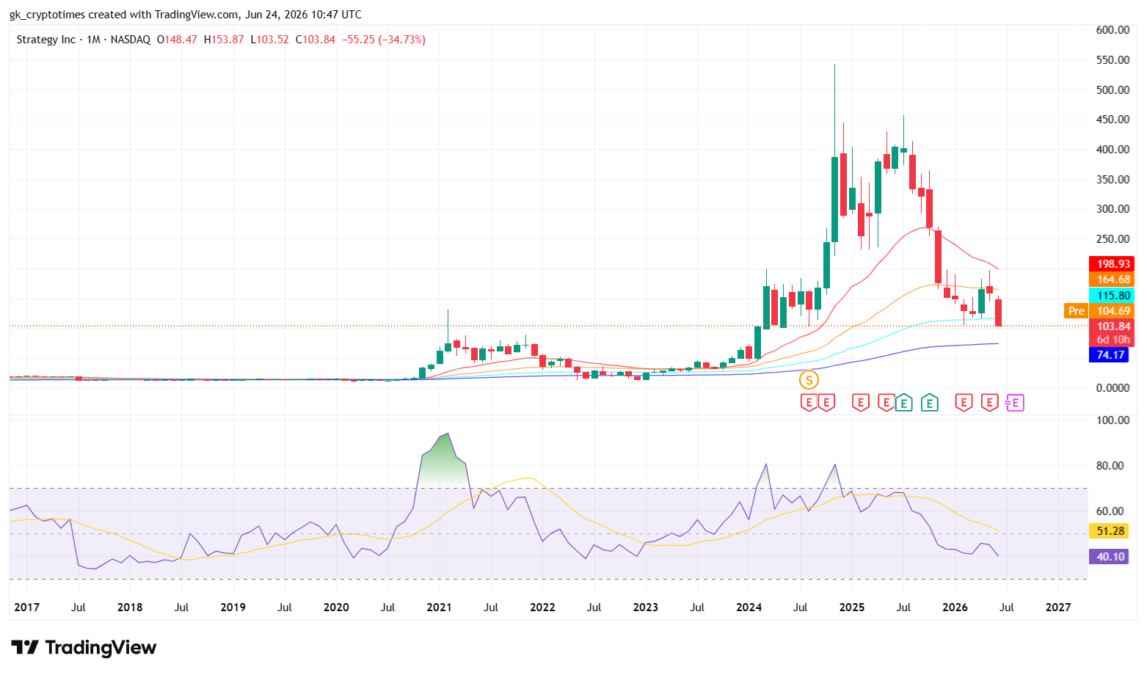
For the downfall in MSTR price, market spectators are point to several factors. One of the primary reasons is Bitcoin’s own consolidation below previous highs, while concerns over share dilution from ongoing capital raises, unrealized losses on the Bitcoin treasury relative to its average cost basis (around $75,000–$76,000 per BTC), and broader risk-off sentiment in tech and growth stocks also played a vital role.
The Bitcoin Treasury Connection
Strategy’s core identity remains its massive Bitcoin holdings, representing a significant portion of the total supply. The company’s strategy of converting raised capital into BTC has created a highly leveraged play on Bitcoin’s price movements. When BTC rises, MSTR has historically amplified gains; the reverse has proven equally true during downturns.
With Bitcoin trading near $62,000, the market value of Strategy’s treasury sits around $53 billion, creating a gap versus the higher cost basis and pressuring the equity valuation. The stock has recently traded close to or at modest premiums to its Bitcoin net asset value (mNAV), a departure from the substantial premiums seen in prior bull phases.
This dynamic underscores the double-edged nature of Strategy’s model: relentless accumulation builds long-term conviction among Bitcoin maximalists but exposes shareholders to sharp drawdowns when crypto sentiment sours.
STRC: The Preferred Play Seeking Stability at Par
In parallel, Strategy’s innovative preferred stock vehicle, STRC (often called “Stretch”), has faced its own challenges while attempting to stabilize around its $100 par value. Launched in 2025, STRC features a variable dividend rate, currently around 11.5% annualized, paid semi-monthly, that adjusts monthly based on trading price to encourage equilibrium near par.
Recent trading has seen STRC dip to record lows near or below $87–$89, well under par. This de-anchoring has triggered dividend adjustments upward in an effort to attract buyers and support the price. The mechanism is designed to strip away some duration risk and provide a high-yield credit-like exposure backed by the same Bitcoin treasury that underpins MSTR.
However, when STRC trades materially below par, it complicates Strategy’s ability to issue new shares at or above par through at-the-market programs, which have been a key funding source for further Bitcoin purchases.
STRC offers income-focused investors a different risk-reward profile compared to MSTR common shares, higher yield potential with seniority in the capital structure, but still exposed to the company’s overall Bitcoin strategy and execution risks.
Funding Dynamics, Dilution, and Recent Developments
Strategy has historically funded its Bitcoin buys through a combination of common equity raises, convertible notes, and preferred issuances like STRC. The current environment has tested this flywheel. Reports indicate pauses in certain above-par preferred sales and even a small Bitcoin disposal (the first in years) to help cover dividend obligations in recent weeks.
The company’s cash reserves have also fluctuated, with efforts to bolster liquidity for ongoing dividend payments on the preferred stack. Critics highlight potential dilution for common shareholders when raises occur at depressed valuations, while supporters emphasize the long-term Bitcoin-per-share growth and the self-adjusting nature of the preferred instruments.
These developments have fueled debate about the sustainability of the “Bitcoin yield” narrative that Strategy promotes, where capital raised is deployed into BTC to benefit common equity holders over time.
Market Sentiment and Analyst Views
Wall Street remains divided but largely constructive on the long-term thesis. Many analysts maintain Strong Buy ratings on MSTR with price targets significantly above current levels (averages in the $300+ range in some forecasts), betting on eventual Bitcoin recovery and continued accumulation.
Short-term sentiment, however, reflects caution. Options activity has shown mixed-to-bearish flows at times, and the stock’s proximity to $100 carries psychological weight.
For STRC, the focus is on whether the dividend adjustments can successfully anchor the price back toward par without excessive strain on the company’s resources.
Broader crypto market conditions, regulatory developments, and macroeconomic factors (interest rates, risk appetite) will likely dictate near-term moves for both securities.
Outlook: A Test of Conviction
Strategy Inc. stands at an inflection point. MSTR’s slide toward $100 tests investor resolve in the leveraged Bitcoin play, while STRC’s efforts to regain par highlight the innovative yet complex capital structure the company has built.
For Bitcoin bulls, these instruments represent unique ways to gain exposure, amplified upside via common shares or yield with relative seniority via preferred. For others, the volatility, dilution risks, and dependence on crypto price action represent significant hurdles.
As Bitcoin consolidates and Strategy continues its accumulation, the coming weeks and months will reveal whether these securities can stabilize and rebound or if further pressure lies ahead. Investors are advised to monitor Bitcoin price action closely, along with Strategy’s regular Bitcoin purchase disclosures and any updates on preferred dividend rates or capital raises.
Also read: Mow Says STRC Needs No Help; Strategy Boosts Cash Reserve Anyway