
The cryptocurrency market currently finds itself firmly under Bitcoin’s influence. While the leading digital asset consolidates following its earlier peaks, most alternative cryptocurrencies continue to struggle for attention and capital.
This familiar pattern, frequently described by traders as Bitcoin sucking liquidity from altcoins, manifests through sustained high Bitcoin dominance and subdued performance across the broader ecosystem.
In the current scenario, investors appear to be channeling fresh funds and existing holdings primarily into Bitcoin, leaving altcoins with thinner order books and slower recoveries during market movements.
CoinMarketCap data shows that BTC is recovering gradually from its latest dip while major altcoins, including ETH, BNB, XRP, SOL, and HYPE, are lagging behind and showing capital exodus.
The Rise of Bitcoin Dominance
Bitcoin dominance, the metric that tracks Bitcoin’s share of the total cryptocurrency market capitalization, currently stands at approximately 58.5%. This level has held relatively steady in recent weeks after climbing from lower points earlier in the year.
With the overall crypto market capitalization hovering near $2.15 trillion and Bitcoin itself commanding roughly $1.25 trillion dollars in market value, the dominance figure underscores a market where more than half of all value concentrates in a single asset.
When dominance remains elevated in this range, it signals that incoming capital tends to favor Bitcoin over riskier alternatives. New investors, particularly through institutional channels like spot Bitcoin ETFs, often prefer the perceived safety and liquidity of the original cryptocurrency.
As a result, altcoins experience reduced trading volumes and limited upward momentum even when Bitcoin shows signs of stabilization. This concentration effect has become a defining characteristic of the current market phase, reinforcing Bitcoin’s role as the primary anchor for the entire sector.
Measuring the Altcoin Drought Through the Altcoin Season Index
Another key indicator highlighting this liquidity shift is the Altcoin Season Index, which currently registers around 46 out of 100. This score places the market squarely in Bitcoin Season territory, meaning the majority of leading altcoins have underperformed Bitcoin over the past 90 days.
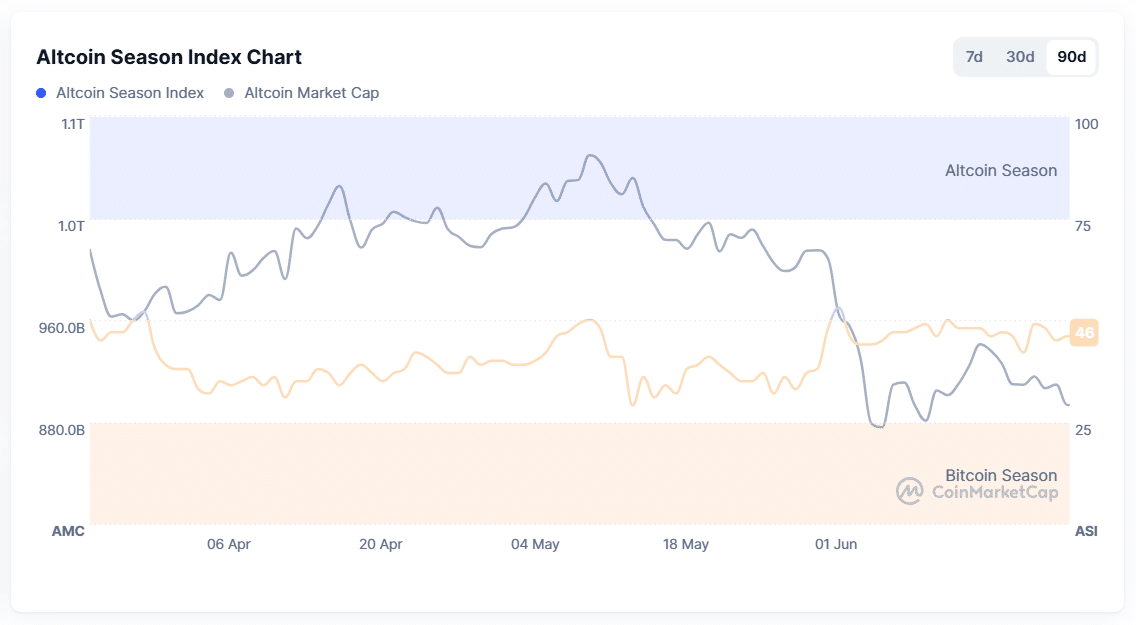
The index evaluates how many of the top cryptocurrencies excluding Bitcoin have delivered stronger returns relative to the flagship asset. Readings below 75, and especially those in the 30 to 50 range, consistently point to an environment where altcoins face challenges in attracting meaningful capital flows.
This underperformance appears across various segments of the market. Many mid-cap and small-cap tokens have recorded steeper percentage declines during recent corrections compared to Bitcoin, while their recoveries remain muted.
Trading activity in these assets has stayed subdued, reflecting a broader hesitation among participants to venture beyond established names. The index has shown only modest fluctuations lately, suggesting that any short-term rallies in specific altcoin narratives have failed to translate into widespread strength.
Underlying Factors Driving Liquidity Toward Bitcoin
The ongoing concentration of liquidity in Bitcoin is contributed by several structural and behavioral elements. Institutional investors continue to view Bitcoin as the most accessible and regulated entry point into cryptocurrency through exchange-traded funds and corporate treasury allocations.
These vehicles provide straightforward exposure without the additional complexities associated with altcoin projects, which often carry higher execution risks and governance uncertainties. Macroeconomic caution also plays a significant role.
In periods of uncertainty regarding interest rates, geopolitical tensions, or traditional market volatility, participants gravitate toward assets perceived as digital gold.
Bitcoin benefits from its established network effects, brand recognition, and growing mainstream acceptance, which further draws capital away from more speculative ventures. Historical cycle patterns reinforce this behavior, as Bitcoin frequently absorbs available liquidity during consolidation phases before any potential rotation occurs.
Moreover, the maturation of the crypto industry has amplified these dynamics. With millions of tokens now competing for attention, the fragmentation makes it harder for broad-based rallies to sustain momentum. Liquidity pools remain shallower in altcoin markets, leading to amplified volatility and quicker exhaustion of buying pressure whenever enthusiasm wanes.
Effects on Altcoin Projects and Market Participants
The consequences of this Bitcoin-led environment extend throughout the ecosystem. Developers and teams behind altcoin initiatives often face difficulties in securing funding or maintaining community engagement when investor focus narrows.
Trading volumes for many tokens have declined notably from previous cycle highs, resulting in reduced market depth and heightened sensitivity to large orders. For individual investors holding diversified portfolios, this phase has proven testing. Allocations heavy in altcoins have generally lagged behind simpler Bitcoin-focused strategies over recent months. Leverage positions in altcoin markets have been particularly vulnerable, experiencing faster liquidations during downturns.
Even projects with strong fundamentals or innovative use cases have struggled to break out meaningfully without broader market participation. Isolated pockets of strength do emerge from time to time, such as in memecoins or specific technological narratives, but these tend to be short-lived and fail to ignite sustained sector-wide momentum. This selective activity further highlights the uneven distribution of liquidity in the current cycle.
Lessons from Previous Market Cycles
Such periods of Bitcoin dominance are not unusual in cryptocurrency history. Past bull markets have shown similar patterns where dominance climbs during the accumulation and early expansion stages before eventually declining as capital rotates outward. Peaks near or above 60% have often preceded eventual altcoin outperformance, though the timing and triggers vary.
In the current environment, dominance has moderated slightly from its recent highs but remains well above levels typically associated with full altseason transitions.
Analysts monitoring these shifts note that meaningful rotation usually requires Bitcoin to enter a stable consolidation or mild correction phase, allowing speculative capital to seek higher-risk opportunities. Without a clear drop in dominance toward the 50% area or lower, broad altcoin participation tends to stay limited.
Looking Ahead for Signs of Rotation
Market observers are closely tracking several potential catalysts that could signal a shift away from the current dynamic. A sustained decline in Bitcoin dominance, perhaps breaking below key technical supports around 55 to 57, would represent an important early indicator.
Similarly, the Altcoin Season Index climbing toward or above 75 would confirm increasing participation from alternative assets. Additional factors such as renewed institutional interest in Ethereum or other major protocols, positive regulatory developments, or technological upgrades across ecosystems could accelerate capital rotation.
However, given the structural preference for Bitcoin in the maturing market, some experts suggest that future altseasons may prove shorter or more selective than in previous cycles. For now, the consensus points to continued Bitcoin leadership in the near term.
A Bitcoin-Dominated Market Persists
As June 2026 draws to a close, the cryptocurrency sector demonstrates a classic consolidation phase dominated by Bitcoin. With dominance holding near 58.5% and the Altcoin Season Index reflecting limited altcoin strength, liquidity continues to gravitate toward the market leader.
This environment rewards those positioned primarily in Bitcoin while challenging altcoin holders and builders to navigate thinner conditions. History indicates that capital rotations eventually materialize once Bitcoin stabilizes sufficiently, yet the precise timing remains uncertain.
Until clearer signals emerge, the market’s focus stays squarely on Bitcoin, underscoring its enduring role as the foundational asset in the cryptocurrency space. Investors and projects alike must adapt to these realities while preparing for potential shifts in the months ahead.
Also read: ADA Price Slides Despite Cardano’s Biggest Scaling Test Yet