Key Highlights
- Cardano’s ADA declined more than 5% in 24 hours, trading near $0.150.
- The drop came despite the launch of Cardano’s scaling testnet, Ouroboros Leios.
- The “Musashi Dojo” testnet aims to improve Cardano’s transaction throughput.
Cardano (ADA) continued its downward trajectory this week, trading near multi-year lows around $0.1502, despite the launch of its most ambitious scaling test to date.
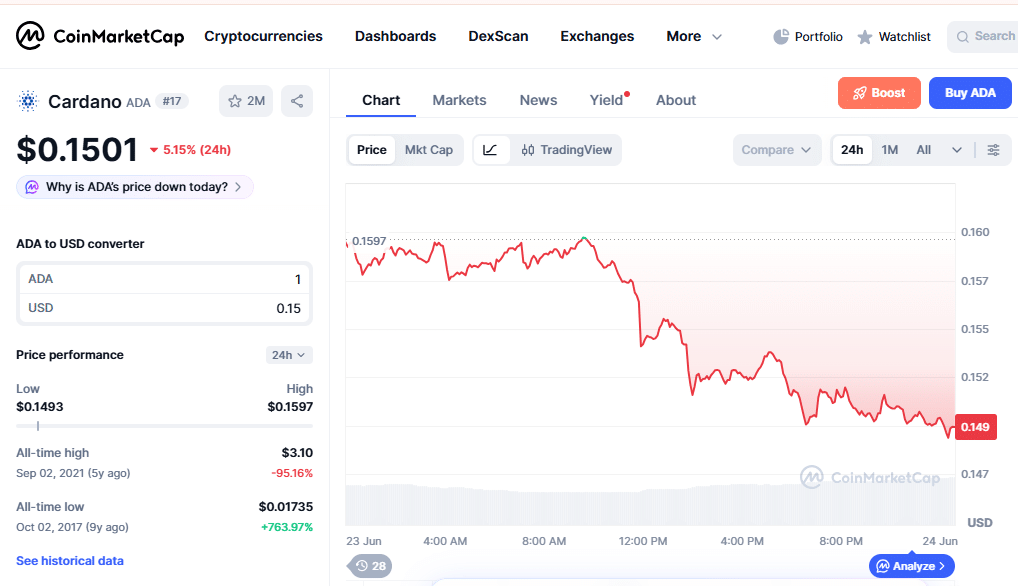
At the time of this writing, ADA was trading at $0.1501, down 5.15% in the last 24 hours, according to CoinMarketCap. The token continues its prolonged bearish trend, hovering near multi-year lows and showing consistent downward pressure throughout the day.
The 24-hour chart shows sharp selling activity, with ADA breaking below $0.152 support and testing $0.1493. Despite the launch of Leios scaling testnet, market sentiment remains weak amid broader altcoin weakness and low trading momentum.
Ouroboros Leios testnet launches
The rollout of the Ouroboros Leios testnet, dubbed “Musashi Dojo,” marks a technical step aimed at boosting Cardano’s throughput and addressing long-standing concerns about scalability.
Launched on Tuesday, the Leios testnet introduces a parallel block production mechanism as an overlay to the existing Ouroboros Praos consensus. It bundles transactions more efficiently by utilizing idle block time through endorser blocks.
Early targets suggest throughput could increase from roughly 4.5 KB/s to as much as 200 KB/s, representing a potential 10x to 65x improvement. If successfully deployed on mainnet, currently targeted for late 2026, the upgrade could raise transaction capacity from roughly 10 transactions per second to more than 1,000, making Cardano more competitive among Layer-1 networks.
Testnet follows structured rollout phases
The testnet will progress through five structured phases inspired by Miyamoto Musashi’s Book of Five Rings: Earth, Water, Fire, Wind, and Void. These stages are designed to allow developers and the community to stress-test the protocol under various conditions before governance approval for mainnet deployment.
Despite this development, ADA failed to gain an upward trend. The token has fallen sharply in recent weeks, hitting levels not seen since late 2020. Market observers attribute the weakness to broader altcoin sell-offs, thin liquidity, and profit-taking across the sector. Cardano’s market cap has slipped below $6 billion, with ADA down significantly from its all-time high near $3.10.
Cardano Foundation CEO Frederik Gregaard and founder Charles Hoskinson have urged the community to focus on long-term fundamentals rather than short-term price action. Hoskinson recently highlighted ongoing ecosystem challenges while emphasizing Cardano’s steady progress in governance and infrastructure.
The Leios upgrade is part of a broader 2026 roadmap that includes the Van Rossem hard fork (Protocol Version 11), expected to be enacted soon. This fork enhances Plutus smart contract efficiency and ledger coherence. Additional initiatives like Midnight (a data protection sidechain) and Hydra (layer-2 scaling) are also advancing, though adoption metrics and developer activity have yet to show explosive growth.
Cardano community shifts focus away from X
In a separate development, Cardano founder Charles Hoskinson announced plans to guide a large part of the Cardano community away from X to dedicated Discord servers. In collaboration with Phillip Pon, CEO of EMURGO, Hoskinson is establishing a new, well-moderated Discord space for the “great migration.”
The initiative aims to create positive, constructive environments focused on meaningful discussions, development, and tangible progress. Hoskinson emphasized moving away from the platform’s toxicity, drama, and negativity toward healthier channels that support real community building and innovation.
Critics question adoption progress
Critics argue that while Cardano has maintained a strong reputation for research-driven development and security, it has lagged in user growth and DeFi TVL compared to faster-moving competitors like Solana. The gap between strong technical progress and price performance underscores persistent market sentiment challenges.
As the Leios testnet progresses, attention will be on performance metrics and community feedback. A successful testing phase could strengthen confidence ahead of a planned mainnet rollout and potentially attract additional developers and institutional participants.
Also Read: Prince Group Hit With U.S. Sanctions in Crypto Fraud Crackdown