Welcome to this week’s cryptocurrency market update. If last week was about Bitcoin crashing 50% from its all-time high, Zcash’s emergency fork after a critical counterfeiting bug, and Strategy selling BTC for the first time in its history, this week the action shifted from damage control to new battlegrounds.
SpaceX listed on Nasdaq at $135 per share in the largest IPO in Wall Street history, and crypto exchanges from Hyperliquid to Binance turned it into a full-blown pre-IPO trading frenzy with SPCX perps surging past $180; the U.S. Court of Appeals upheld Sam Bankman-Fried’s 25-year sentence for the $8 billion FTX fraud, ending his legal fight; Humanity Protocol was hit by a $36 million exploit traced to a North Korean phishing campaign; Strategy bought 1,550 BTC while Saylor walked back his “never sell” stance at BTC Prague; and Zcash staged a dramatic 80% rebound after its emergency fork. Let’s get into it.
Top headlines for this week
Below are the major headlines, giving an overview of what happened in the crypto market this week.
SpaceX IPO goes live and crypto exchanges race to front-run Wall Street
The biggest story of the week, and arguably the biggest financial event of 2026 so far, was SpaceX’s Nasdaq debut. The company listed under the SPCX ticker on June 12 at $135 per share, raising $75 billion at an implied valuation of roughly $1.77 trillion. Shares opened at $150, jumped 19% on day one, and closed at $160.95. It is now the largest IPO in stock market history, surpassing Saudi Aramco’s 2019 record.
But the crypto angle was just as significant. Before SpaceX even began trading on Nasdaq, crypto exchanges had already built an entire parallel market around it. SPCX perpetual contracts hit $180+ on Hyperliquid and Binance ahead of the official listing. Bybit launched tokenized SpaceX offerings, though investors were quick to note they would not own actual equity in SpaceX.
The frenzy was real, but so were the risks. Reuters flagged concerns that the SpaceX IPO could drain liquidity from crypto markets, as traders rotated capital into pre-IPO speculation and away from tokens. The timing is brutal for a market still reeling from weeks of ETF outflows and the AI rotation thesis that Michael Saylor laid out last week. SpaceX joining the Nasdaq alongside upcoming Anthropic and OpenAI listings means institutional capital has more high-conviction destinations to park money, and none of them are Bitcoin.
Sam Bankman-Fried loses appeal, 25-year sentence stands
The legal saga of FTX’s collapse reached its final chapter this week. The U.S. Court of Appeals upheld Sam Bankman-Fried’s conviction and 25-year prison sentence for defrauding billions in customer funds. SBF’s legal team had challenged the trial process, the sentencing guidelines, and the judge’s application of loss calculations. The appellate court rejected every argument.
The ruling closes the book on the biggest criminal fraud case in crypto history. SBF has no further appeals available through the standard federal court system. The $8 billion fraud that collapsed FTX in November 2022 has now produced a final, unappealable conviction, and the man who was once the poster child of crypto’s institutional ambitions will spend the next two decades in federal prison.
For the industry, the SBF verdict carries symbolic weight beyond the legal outcome. It confirms that the post-FTX enforcement apparatus works, at least in the most egregious cases. Whether that deters future bad actors or simply forces them to be more careful is another question entirely.
Humanity Protocol hacked for $36 million, DPRK links confirmed
Humanity Protocol suffered the most high-profile exploit of the week when a key breach drained approximately $36 million worth of $H tokens. The H token crashed over 80% in the immediate aftermath. ZachXBT raised questions about whether the hack was possibly staged, adding a layer of controversy to an already damaging incident.
The situation escalated further when Quantstamp’s post-mortem revealed that the exploit originated from a phishing email that compromised a developer laptop, leading to stolen private keys and unauthorized token minting on BNB Chain. The forensic trail pointed to DPRK-linked actors, making this the latest in a growing list of North Korean state-sponsored crypto heists targeting private key infrastructure rather than smart contract vulnerabilities.
In a surprising twist, the H token bounced 43% later in the week as the team released its recovery plan. The bounce does not erase the fundamental problem: a single phishing email took down a multisig setup and cost the protocol $36 million. The security failure was human, not technical, and that makes it harder to fix with code.
Michael Saylor rewrites his own rules at BTC Prague
If last week’s story was Strategy selling 32 BTC for the first time, this week was about Saylor explaining why that sale does not contradict anything he has ever said. Speaking at BTC Prague, Saylor told the crowd that his famous “never sell Bitcoin” mantra was always directed at retail holders, not at Strategy as a corporation with fiduciary obligations.
The reaction was exactly what you would expect. Critics called it a goalpost shift. Supporters argued the corporate treasury context is genuinely different from individual hodling. The truth is probably somewhere between, but the damage to Saylor’s narrative credibility is real. When you spend years building an identity around one phrase, the moment you add an asterisk, the asterisk becomes the story.
Strategy did move to reinforce its Bitcoin commitment the same week. The company acquired a fresh 1,550 BTC, and Peter Schiff took jabs at the purchase, calling it damage control. Whether the 1,550 BTC buy was conviction or optics depends on which narrative you believed before Saylor rewrote his own playbook.
Zcash stages an 80% rebound after emergency fork
After last week’s 50% crash following the Orchard vulnerability disclosure, Zcash had a very different week. The Ironwood network upgrade and swift fork deployment rescued ZEC from what looked like a terminal price collapse. The token bounced roughly 80% from its post-crash lows as the market began pricing in the successful fix and the absence of any evidence of prior exploitation.
The 50-hour race to save Orchard was detailed in a comprehensive post-mortem this week, and the engineering response was widely praised. The question that remains unanswered, and the one that can never be answered because of Orchard’s privacy architecture, is whether the bug was ever exploited during its four-year window.
The turnstile mechanism confirmed total supply remained intact, but the cryptographic impossibility of full verification will hang over ZEC until confidence rebuilds organically.
Crypto founders draw a line on the CLARITY Act
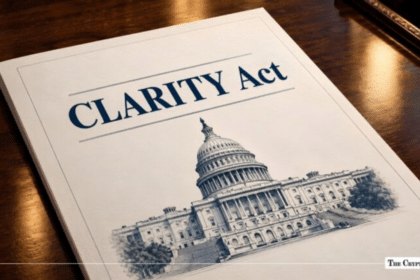
The CLARITY Act fight entered a new phase this week as crypto’s biggest founders publicly pushed back against key provisions in the bill. The collective statement from founders across DeFi, infrastructure, and exchange sectors represents the first coordinated industry response to specific legislative language, rather than the general lobbying that has defined the bill’s journey through Congress.
Peter Schiff separately rejected JPMorgan CEO Jamie Dimon’s push for stricter crypto rules, creating an unusual alliance between a gold bug and the crypto industry against Wall Street banks. The stablecoin yield provision remains the single biggest fault line in the legislation, and with the July 4 signing deadline approaching, the next few weeks will determine whether the bill survives in its current form.
DeFi exploits keep piling up
The exploit cycle rolled on without pause. Ambient Finance, an Ethereum DeFi protocol, suffered a $110K drain. Stake DAO filed a criminal complaint after a $91K Arbitrum exploit that minted trillions of tokens. And the TOP token lost $1.58 million in an alleged governance attack where a single vote drained the treasury.
The governance attack on TOP is particularly worth watching. Unlike bridge exploits or smart contract bugs, governance attacks exploit the democratic mechanisms that protocols build as features, not flaws. When one vote can move $1.58 million, the question is not whether the attacker broke the rules. The question is whether the rules were ever fit for purpose.
BitMine doubles down on Ethereum despite unrealized losses
BitMine continued its aggressive Ethereum accumulation this week, adding $41 million in ETH despite sitting on unrealized losses. The company had already expanded its Ethereum bet earlier in the week with a separate purchase during the market pullback.
The BitMine strategy is the Ethereum equivalent of what Strategy did with Bitcoin, but with a critical difference. Strategy’s Bitcoin thesis was built during a bull market and tested during drawdowns. BitMine is building its Ethereum position during the drawdown itself. If ETH recovers, the timing will look prescient. If it does not, the unrealized loss column will become the headline.
News you might have missed
- Nakamoto refinances to 2027: The Bitcoin treasury company cut rates and added a buyback program, restructuring its debt in a move that signals confidence in Bitcoin’s medium-term trajectory even as short-term price action remains ugly.
- TON Strategy earns $5.6M in staking: The TON ecosystem’s staking play generated $5.6 million in yield as network upgrades went live, positioning TON as one of the higher-yielding proof-of-stake chains in 2026.
- ZachXBT slams UK HTX sanctions: The on-chain investigator criticized UK sanctions on HTX as FixedFloat suspended Huobi-linked funds, exposing continued compliance confusion around sanctioned exchanges and their successor entities.
- Arthur Hayes accused of pump and dump: A detailed investigation claimed Hayes shilled tokens to his followers and then dumped on them, raising fresh questions about influencer ethics in crypto.
- Crypto scammers hit matrimonial platforms in India: A report detailed how crypto scammers are exploiting matrimonial platforms to lure victims, using fake marriage proposals to push people toward fraudulent Bitcoin investments.
Buzz of the Week
The buzz this week belongs to SpaceX, and not just because it pulled off the largest IPO in history.
What made the SpaceX listing a defining crypto moment is how fast the industry built a parallel market around it. Before SPCX shares even opened on Nasdaq, perpetual contracts were already trading at premiums north of 30% on Hyperliquid and Binance. Bybit launched tokenized exposure products. Kraken, Coinbase, and others scrambled to offer their own versions. Crypto did not wait for Wall Street’s permission. It front-ran the entire event.
That speed and ambition are exactly what make crypto compelling. It is also exactly what raises the red flags. Bybit’s tokenized SpaceX product came with a critical caveat that most retail traders probably glossed over: you do not own actual SpaceX shares. You own a synthetic exposure product issued by an exchange.
The distinction matters enormously in a market where counterparty risk has already destroyed billions in value through FTX, and where the man behind that destruction just had his 25-year sentence confirmed this very same week.
The SBF appeal ruling landing in the same week as the SpaceX crypto frenzy is almost poetic. One story is about the consequences of running a fake exchange with fake balances. The other is about a new generation of exchanges offering synthetic exposure to the hottest IPO in history.
The products are different, the regulation is (slightly) better, and the exchanges are (mostly) more legitimate. But the fundamental tension between financial innovation and investor protection has not changed one bit since November 2022.
Meanwhile, Saylor at BTC Prague delivered what might be the most memed moment of the year in crypto. The idea that “never sell” was always a retail instruction and never a corporate commitment is technically defensible but narratively devastating. Strategy’s 1,550 BTC purchase the same week reads as an attempt to bury the story under fresh buying activity. Whether the market accepts the reframe or treats it as a permanent credibility hit will play out over the coming months.
The Humanity Protocol hack, with its DPRK attribution, reinforces a pattern that the industry has been slow to fully internalize. North Korean state actors are not going after smart contracts. They are going after people. Phishing emails, compromised laptops, stolen private keys. The attack surface is not code. It is operational security, and most crypto teams are still running multisig setups that would not survive a determined social engineering campaign.
And Zcash’s 80% rebound is the week’s redemption story. The protocol went from existential crisis to one of the best-performing assets in crypto in the span of seven days. The Ironwood upgrade and swift fork execution proved the team can ship under extreme pressure. The question is whether that technical competence is enough to overcome the trust deficit that a four-year-old undiscovered bug creates in a privacy coin, where the whole point is that you cannot verify what happened.
What to expect for next week?
Next week has several critical watch points.
First, the SpaceX aftermarket is the single most important variable for crypto liquidity. If SPCX continues to rally on the Nasdaq, the synthetic contracts on crypto exchanges will draw more capital and more attention. If retail traders get burned on poorly understood tokenized products, the regulatory backlash will be swift. Either outcome matters for how crypto’s relationship with traditional IPO markets evolves.
Second, the CLARITY Act deadline pressure intensifies. With crypto founders publicly opposing specific provisions and the July 4 target approaching, expect more lobbying activity, more public statements, and potentially more amendments. The stablecoin yield clause remains the fulcrum.
Third, the Humanity Protocol recovery plan will face its first real test. The $H token bounced 43% on recovery optimism, but the DPRK attribution adds geopolitical weight to what is otherwise a protocol-level incident. Watch for further forensic disclosures and whether the team can credibly rebuild trust after a basic phishing attack took down their key infrastructure.
Fourth, Bitcoin’s response to the SpaceX capital rotation will tell us whether the AI-and-IPO liquidity-drain thesis has legs. If BTC holds current levels despite the mega-IPO wave, the worst of the outflow cycle may be behind us. If it slips further, the $60K support level becomes the next line in the sand.
And keep watching the DeFi governance attack vector. The TOP token exploit, which used a single vote to drain $1.58 million, is a template that will be repeated. Any protocol with low voter participation and meaningful treasury balances is now a target.
Also Read: Crypto Tax Overhaul: What Congress’s New Framework Means for 60M Americans