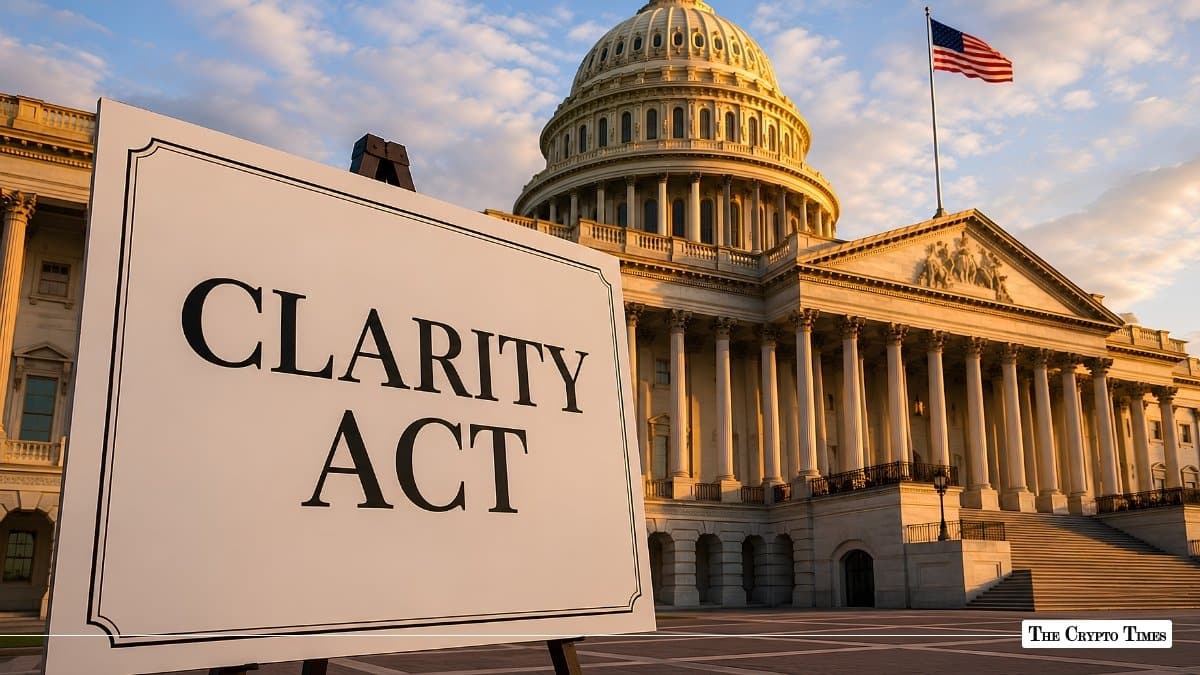
Crypto industry leaders are pressing the U.S. Senate to preserve key developer protections in the CLARITY Act, arguing that the legislation’s treatment of software developers has become a defining issue as lawmakers debate the future of digital asset regulation.
In a June 9 letter addressed to Senate Majority Leader John Thune and Minority Leader Chuck Schumer, more than 60 founders, CEOs, and investors from across the crypto industry urged lawmakers to pass the CLARITY Act with the Blockchain Regulatory Certainty Act (BRCA) provisions approved by the Senate Banking Committee intact.
The signatories include leaders from Coinbase, a16z Crypto, Solana Labs, Uniswap, Kraken, Block, Circle-backed ecosystem participants, Anchorage Digital, Fireblocks, BitGo, Galaxy, Paradigm, and numerous other crypto firms and venture funds.
Developer protections become central issue
Rather than focusing on exchanges, stablecoins, or token classifications, the letter centers on legal protections for software developers and infrastructure providers. The group argued that the BRCA would align federal criminal law with existing approaches used by regulators administering the Bank Secrecy Act by clarifying that non-controlling software developers are not automatically treated as financial intermediaries.
According to the signatories, developers working on blockchain infrastructure, decentralized finance protocols, and open-source software need clear legal standards defining when regulatory obligations apply. They warned that removing or weakening those provisions could leave uncertainty around the legal status of developers who build or maintain decentralized networks.
Calls for boundaries between software and financial intermediaries
The letter highlighted other sections of pending legislation that supporters believe are necessary to distinguish software development from regulated financial activity. Specifically, the group called for preserving Section 601 of the CLARITY Act and Section 207 of the Senate Agriculture Committee’s Digital Commodity Intermediaries Act.
The executives argued that these provisions establish clearer lines between decentralized protocols and traditional financial intermediaries, helping developers determine when securities, commodities, and financial compliance requirements apply.
According to the letter, clear distinctions would strengthen enforcement efforts by allowing regulators and law enforcement agencies to focus on actors engaged in illicit or non-compliant conduct rather than software creators.
Major industry names unite behind Senate push
The list of signatories spans nearly every segment of the digital asset industry. Among those signing were Brian Armstrong, Jack Dorsey, Chris Dixon, Barry Silbert, Mike Novogratz, Anatoly Yakovenko, Hayden Adams, and Anthony Scaramucci.
Executives from infrastructure firms, venture capital groups, custody providers, DeFi projects, and blockchain foundations also joined the effort, reflecting broad industry alignment around the developer provisions.
Moreover, Avery Ching, CEO of Aptos Labs, commented on the development in a statement to The Crypto Times, stating, “There is still work ahead to get the details right, but real momentum toward thoughtful, well-designed matters for our shared goal of keeping American blockchain innovation growing here at home.
I had the privilege of testifying before the House Agriculture Committee last June on the need for clear market structure rules, and I was honored to have that perspective included in the committee’s official report on the Clarity Act. Builder input is necessary to create the very best framework for digital assets, and I am grateful to the lawmakers engaged with our industry for the opportunity to keep contributing to this conversation.
The next generation of financial infrastructure is already being built. The question is whether America creates the environment for that innovation to scale responsibly here. At Aptos, we are building toward a future powered by secure, scalable systems that can support global markets and next-generation internet applications, and I am committed to engaging constructively with policymakers as the path forward gets refined.”
White House signals progress as industry pressure mounts
The push from crypto founders comes as negotiations around the CLARITY Act appear to be entering a critical phase in Washington. White House crypto adviser Patrick Witt said this week that discussions following the Senate Banking Committee markup have narrowed key disagreements surrounding the legislation.
“Big week ahead for Clarity,” Witt wrote on X. “The work has continued in earnest behind the scenes since the Banking markup. The issue set has narrowed, and good faith offers are being put forward to close the gap. But time is of the essence.”
His comments coincided with a broader lobbying effort from across the digital asset industry. More than 200 companies, trade associations, and advocacy organizations recently urged Senate leaders to bring the CLARITY Act to the floor for a vote.
The coalition, organized by Stand With Crypto alongside Blockchain Association, Crypto Council for Innovation, and The Digital Chamber, included firms such as Coinbase, Ripple, Kraken, Circle, Binance US, and Andreessen Horowitz.
Senate faces pressure as CLARITY Act advances
The letter arrives as momentum builds around the CLARITY Act following its advancement through the Senate Banking Committee. Supporters view the legislation as a framework for defining regulatory responsibilities across digital asset markets, while industry participants continue lobbying lawmakers over specific provisions before a potential Senate floor vote.
For the signatories, the message was clear: market structure legislation should include explicit protections for non-custodial software developers. They argued that legal certainty for builders is necessary if blockchain development and digital asset innovation are to remain in the United States.
The letter concluded by urging Senate leaders to preserve the Banking Committee’s bipartisan language and advance the CLARITY Act without weakening the developer protections included in the current version of the bill.
Also Read: White House Hosts Law Enforcement Meeting on CLARITY Act as Senate Vote Nears