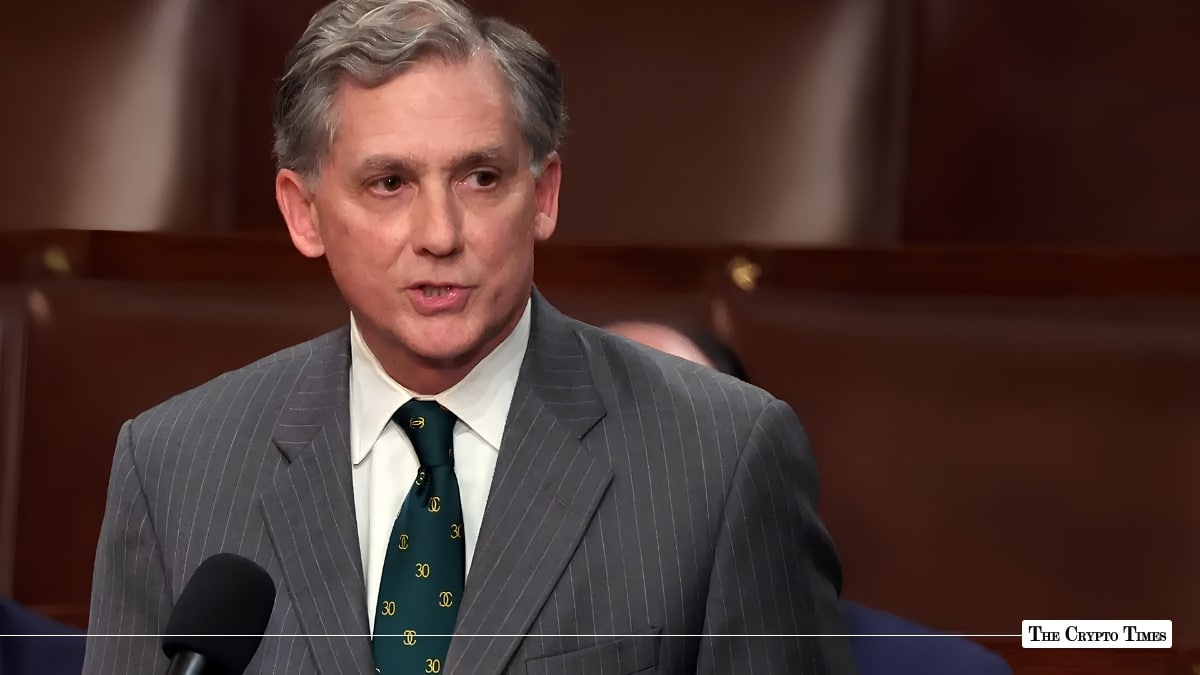
House Financial Services Committee Chairman French Hill defended the proposed CLARITY Act amid growing criticism from banking groups, arguing that traditional financial institutions remain well-positioned to compete in a market increasingly shaped by blockchain-based payments and digital assets.
Speaking on Fox Business’ Mornings with Maria today, Hill said lawmakers are working to bridge differences between the banking sector and crypto industry participants as Congress advances digital asset legislation. His comments come as major banks continue raising concerns about stablecoin rules and competitive advantages for non-bank issuers.
Hill backs compromise on stablecoin rules
Addressing concerns surrounding stablecoin legislation, Hill reiterated his view that payment stablecoins should not offer interest or yield to holders. “We said that stablecoins would not pay interest, and that’s still my position,” Hill said, describing stablecoins primarily as payment instruments rather than investment products.
He pointed to compromise language developed during congressional negotiations, saying it provides a foundation for both banks and crypto firms while leaving implementation details to regulators.
According to Hill, issues involving marketing practices and consumer protections for bank and non-bank stablecoin issuers can be addressed through the regulatory process led by the Treasury Department.
Banking industry seeks additional changes
Hill acknowledged that banks remain concerned about certain provisions in pending legislation and may continue pushing for modifications as the debate moves forward.
Large financial institutions, including those represented by industry trade groups, have argued that restrictions on stablecoin yield should extend beyond issuers to crypto exchanges, affiliates, and other intermediaries. Community banking organizations have echoed those concerns, warning that stablecoins offering economic incentives could create competitive pressures on traditional deposits.
Hill said discussions are continuing and indicated lawmakers remain focused on finding a compromise that can gain broader support. “We’ll just have to work and see how it can be made better there,” he said, referring to ongoing negotiations over stablecoin language.
Chairman says banks can compete with blockchain payments
While acknowledging the rise of digital asset payment systems, Hill rejected the idea that stablecoins pose an existential threat to banks.
He argued that banks are already developing tokenized deposit systems capable of operating on blockchain infrastructure with around-the-clock settlement capabilities. Recent industry announcements, including initiatives involving tokenized deposits, demonstrate that traditional financial institutions are preparing to offer similar services.
According to Hill, tokenized bank deposits could enable instant settlement without necessarily relying on dollar-backed stablecoins for domestic transactions. “The banks will be extremely competitive in this industry,” Hill said, adding that established financial institutions possess the technology, payment infrastructure, and pricing expertise needed to adapt to changing market demand.
Market structure remains a congressional priority
Hill framed the broader debate as part of Congress’s effort to establish a comprehensive regulatory framework for digital assets.
The CLARITY Act is intended to create clearer rules for crypto markets, define regulatory responsibilities, and provide legal certainty for blockchain-based financial products. Supporters argue that such legislation is necessary to keep innovation and investment within the United States while providing safeguards for consumers and market participants.
Despite disagreements over specific provisions, Hill said lawmakers should remain focused on advancing a market structure framework that allows both banks and digital asset firms to operate under clear rules.
“The big picture here is that we get a market structure bill,” Hill said, arguing that regulatory clarity is necessary for the United States to remain competitive in blockchain technology and financial services.
Tokenized deposits and stablecoins may coexist
Hill’s remarks suggest that policymakers increasingly view tokenized deposits and stablecoins as complementary rather than mutually exclusive products. As banks develop blockchain-based payment networks and crypto firms expand stablecoin offerings, Congress faces the challenge of crafting legislation that addresses competition concerns while supporting emerging payment technologies.
The debate is expected to continue as lawmakers advance both stablecoin legislation and broader digital asset market structure reforms through Congress.
Also Read: Congress Reveals First Detailed Look at Strategic Bitcoin Reserve