In the volatile world of cryptocurrency, few events test a project’s mettle like a critical security vulnerability. For Zcash ($ZEC), one of the longest-standing privacy-focused digital assets, early June 2026 delivered exactly that—a soundness bug in its Orchard shielded pool that had lurked undetected since May 2022.
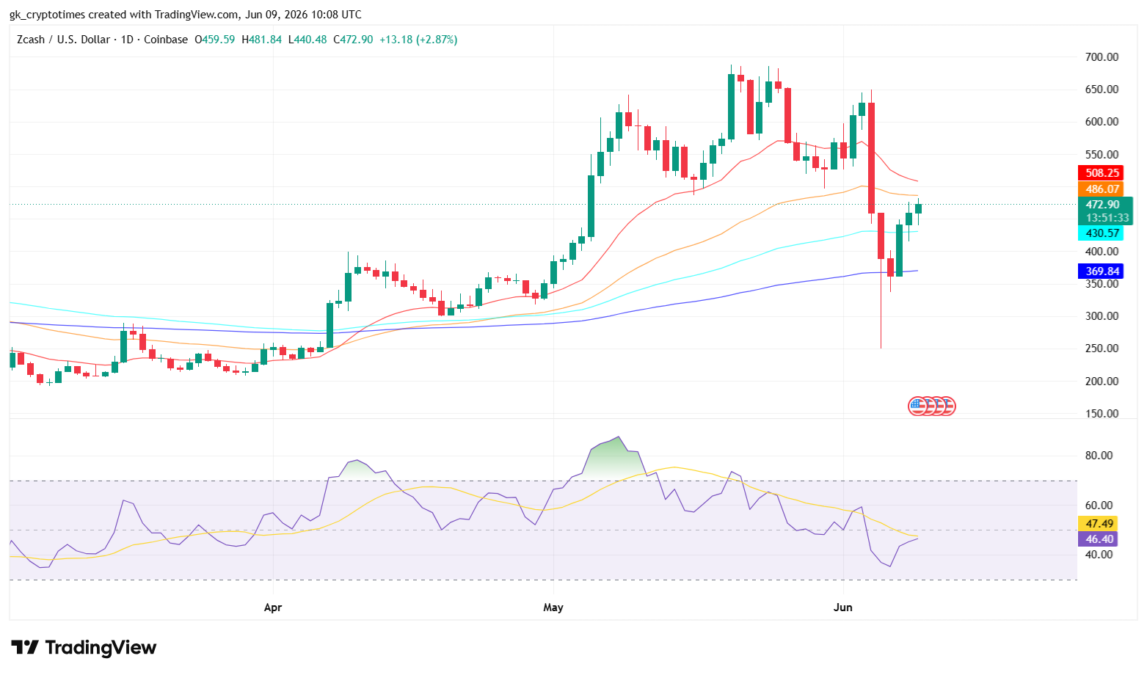
The disclosure triggered a near-50% price crash, wiping out billions in market capitalization within hours. Yet, just days later, ZEC staged a dramatic recovery, surging over 80% from its low near $250 to trade around $480 by June 9.
This rapid rebound wasn’t driven by hype or speculation alone, it stemmed from swift technical fixes, proactive governance, and a forward-looking upgrade proposal called Ironwood that directly addressed the core concern: verifiable supply integrity.
The episode highlights both the inherent risks and strengths of privacy-centric blockchains in an era of increasing regulatory scrutiny and technological complexity.
The Bug That Shook Zcash
The vulnerability surfaced on May 29, 2026, when security researcher Taylor Hornby, auditing for Shielded Labs, identified a critical flaw in the Orchard zero-knowledge proof circuit using Anthropic’s Claude Opus 4.8 AI model.
The issue was a subtle under-constrained element in the circuit that failed to properly enforce input validation rules. In theory, this could have allowed an attacker to create unlimited counterfeit ZEC within the shielded environment—undetectable due to the very privacy features that define Zcash.
Orchard, launched in 2022 as Zcash’s most advanced shielded pool, holds a significant portion of the network’s supply—over 4.5 million ZEC, roughly 27% at the time. Privacy by design meant there was no straightforward way to audit whether the bug had ever been exploited. This uncertainty fueled panic.
ZEC, which had been riding high near $624 amid broader privacy coin momentum, plummeted. Prices hit intraday lows around $250–$303 on June 5, erasing roughly half the token’s value in under 48 hours and trimming market cap from over $10 billion toward $5 billion at the nadir.
Skeptics on X questioned the move, with some labeling the sharp reversal “crime” amid thin liquidity and rapid recovery signals. Yet the fundamentals of the response told a different story.
Emergency Response: Coordinated Forks in Record Time
Zcash developers—spanning the Zcash Foundation, Electric Coin Company (now under Zcash Open Development Lab or ZODL), Shielded Labs, and community contributors—acted with remarkable speed. They had privately contained the issue before public disclosure.
On June 2, a soft fork (emergency upgrade) disabled Orchard transactions network-wide, freezing activity in the vulnerable pool to prevent potential exploitation while a permanent fix was prepared.
On the very next day, the NU6.2 hard fork activated at block 3,364,600, patching the circuit with a corrected verifying key. Orchard transactions were re-enabled safely. This marked only the second security-driven hard fork in Zcash’s history since its 2016 genesis.
Fortunately, no funds were lost and no chain split occurred. Mining pools like ViaBTC and Foundry coordinated effectively, while node operators upgraded promptly. ZODL emphasized that turnstile mechanisms (which enforce supply caps when moving between transparent and shielded pools) likely prevented any net inflation, though full verification remained challenging due to privacy.
The market initially reacted positively to the patch—ZEC even climbed during the upgrade window—but sentiment soured upon full disclosure. Once the immediate threat was neutralized, attention shifted to longer-term solutions.
Enter Ironwood: Restoring Trust Through Verifiability
On June 6, the same developer groups proposed Ironwood, a comprehensive upgrade designed to eliminate lingering doubts about supply integrity. Targeted for activation in late July 2026, Ironwood introduces:
- A new shielded pool built on the fixed Orchard circuit, incorporating formal verification, multiple independent audits, and enhanced AI-assisted reviews.
- Deprecation of the legacy Orchard pool: No new deposits allowed; existing funds must migrate via controlled mechanisms.
- “Turnstile” accounting enhancements enabling node runners and users to independently confirm that total ZEC in circulation does not exceed the 21 million hard cap—without compromising privacy for individual transactions.
Zcash founder Zooko Wilcox and teams framed Ironwood as a direct response to the incident, turning a vulnerability into an opportunity for stronger governance. Once live, users could verify supply soundness trustlessly, a major leap for a privacy coin where opacity has long fueled skepticism.This proposal catalyzed the rebound.
From Friday’s lows, ZEC climbed steadily, reclaiming $2 billion in market value within days. The blockchain’s hashrate hit records, signaling miner confidence, while shielded transaction adoption—already at record levels near 30% of supply—continued unabated.
Broader Context: Privacy Demand Endures
Zcash’s recovery occurred against a backdrop of intact positive catalysts. In January 2026, the SEC closed its investigation into the Zcash Foundation without action, removing a regulatory overhang. Multicoin Capital’s disclosed large position had earlier fueled rallies. Broader market interest in privacy tools persists amid growing concerns over surveillance, data privacy, and financial censorship.
Privacy coins remain niche but vital. Zcash’s Sapling and Orchard protocols offer selective disclosure—users can prove compliance without revealing all details—positioning it uniquely versus fully transparent chains or less flexible alternatives like Monero.
The bug exposed real risks in complex zero-knowledge systems, especially as AI tools accelerate discovery of subtle cryptographic flaws. Yet the response demonstrated maturity: rapid coordination across decentralized teams, transparent communication, and commitment to upgrades.
Risks and Outlook Remain
However, as of now, not all concerns have vanished. Until Ironwood activates and funds migrate successfully, questions about historical supply linger. Volatility also persists—ZEC remained down ~20% on the week despite the bounce, with technical levels like $314 flagged as potential support in case of reversal.
Broader crypto markets, dominated by Bitcoin and Ethereum, influence altcoin moves. Leverage and short squeezes contributed to the speed of both crash and recovery, underscoring ZEC’s high-beta nature.
For long-term holders, the episode reinforces Zcash’s ethos: privacy as a feature worth defending through rigorous engineering. If Ironwood deploys smoothly, it could solidify ZEC’s leadership in private digital cash, potentially attracting renewed institutional and retail interest.
Lessons from the Orchard Incident
Zcash’s June 2026 saga offers several takeaways for the industry:
- Speed matters: Emergency forks, while rare, can contain damage when teams are prepared.
- Verifiability is key: Even privacy coins need mechanisms for users to audit core invariants like supply.
- AI changes security: Tools like Claude Opus are now finding bugs faster than traditional audits alone.
- Community resilience: Record hashrate and dip-buying showed conviction beyond price action.
As of June 9, 2026, ZEC trades with renewed momentum but faces the practical test of upgrade execution. The coin that pioneered zk-SNARKs in blockchain has once again navigated a crisis, emerging with a clearer path toward trustworthy privacy. In crypto, where trust is scarce, actions like these speak louder than any whitepaper.
Whether this rebound marks the end of the downtrend or a temporary relief rally depends on execution. For privacy advocates, however, Zcash’s handling of the Orchard bug may prove a defining moment—proving that robust governance and technical excellence can prevail even under fire.
Also read: THORChain Advances Post-Exploit Recovery With v3.19.0 Security Upgrade