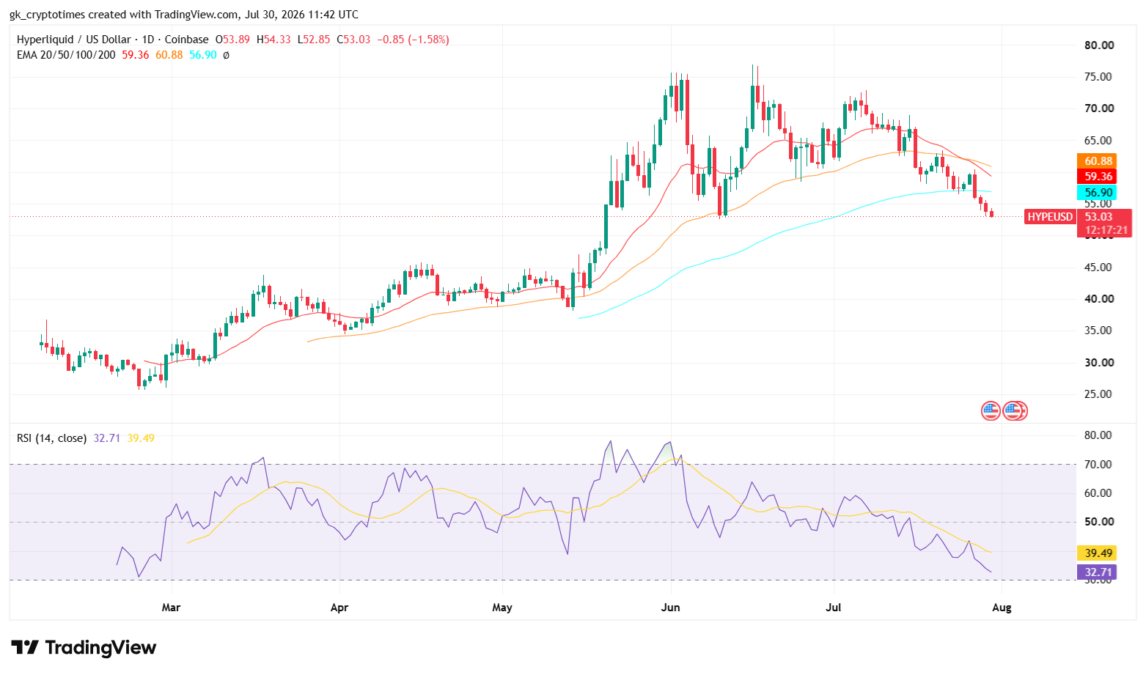
Hyperliquid’s native token HYPE has spent the final days of July under steady selling pressure, trading near $53.50 on Thursday after slipping roughly 30% from its mid-June peak above $76.
The decline in crypto’s new favorite token has unfolded against a backdrop of visible institutional activity, shifting platform rules, and broader market caution, leaving traders to weigh short-term flows against the exchange’s still-growing revenue and buyback mechanics.
On-chain trackers have documented a series of large transfers from wallets tied to known investment firms into centralized exchanges, moves that have coincided with the latest leg lower in price. At the same time, community discussion has focused on a handful of concrete catalysts rather than vague market weakness. The result is a clearer picture of why HYPE has cooled after a strong first half of the year, even as some participants argue the underlying business remains intact.
Institutional Transfers Add to Selling Pressure
Lookonchain, an on-chain monitoring account that follows large wallets and tracks important transactions, has highlighted three notable episodes involving institutional-linked addresses over the past several days.
On July 28, the firm reported that Bitwise moved another 117,917 HYPE, valued at roughly $7.05 million at the time, in what it described as continued selling. The following day a wallet associated with Selini Capital deposited 495,473 HYPE, worth about $26.8 million, into OKX within a short window.
Early on July 30 Lookonchain further noted that Multicoin Capital deposited 137,100 HYPE, approximately $7.51 million, into Coinbase Prime over a 10-hour period, while Bitwise sent an additional 22,463 HYPE, or $1.23 million, to Coinbase.
These transfers have been widely interpreted in trading circles as distribution, though the precise intent of every deposit is not always confirmed. Some market participants pointed out that Multicoin had previously clarified certain earlier movements were not outright sales, and others noted that Bitwise’s activity could partly reflect flows related to its HYPE exchange-traded product (ETP) rather than a directional view on the token itself.
Regardless of individual motives, the cumulative size of the moves, tens of millions of dollars in a compressed timeframe, has contributed to the perception of institutional profit-taking or rebalancing after HYPE’s earlier advance.
These deposits arrived while price was already testing lower levels after failing to reclaim the $70 area, amplifying the sense that larger holders were reducing exposure.
Coinglass data shows that HYPE’s open interest and spot volumes have remained elevated, suggesting the selling has been absorbed to some degree, yet the repeated headlines have kept sentiment cautious.
Multiple Overlapping Catalysts Behind the Pullback
Beyond the institutional transfers, several other factors have been cited by traders and analysts as contributors to the recent decline. One of the more discussed is a recent platform update under HIP-3 that allows deployers to restrict trading to approved address lists. The change is widely viewed as an on-chain mechanism that could support know-your-customer (KYC) requirements.
For users drawn to Hyperliquid’s permissionless model the news landed as a step backward, generating immediate frustration. Supporters of the update counter that institutional capital will eventually require exactly this kind of control before committing meaningful size to on-chain perpetual markets. In their view the friction is temporary and the longer-term payoff could be substantially larger than open interest once traditional firms become comfortable.
A second source of pressure has been unstaking activity. Venture capital wallets are reported to have withdrawn sizable quantities of HYPE from staking contracts in recent days. Even if not every token is immediately sold, the visible reduction in staked supply has fed concerns about impending liquidations and added to the general sense of rotation.
X user Louis.hl (@louisdives) notes that geopolitical tension between the United States and Iran has also weighed on risk assets more broadly. Crypto markets rarely move in isolation during periods of heightened conflict risk, and HYPE has not been immune.
Moreover, the chart itself has drawn technical attention. After two failed attempts to push through the $76 region, price action has formed what some describe as a potential double-top pattern. The neckline near $52 is being watched closely; a decisive break would open room toward the $50 area and the longer-term moving averages that have provided support in previous corrections.
Taken together, these elements—platform governance optics, capital rotation, macro caution, and technical structure—offer a more specific explanation for the sell-off than a generic “risk-off” narrative. Each is temporary in nature according to several market observers, yet their simultaneous appearance has produced a measurable impact on price.
Longer-Term Fundamentals and Market Debate
Despite the recent pressure, discussion around Hyperliquid continues to reference the platform’s revenue generation and token economics. Protocol fees have historically been directed in large part toward open-market purchases of HYPE through an assistance fund, and cumulative burns already total tens of millions of tokens.
Hyperliquid’s spot and perpetual volumes remain substantial relative to many competing venues, and the exchange has expanded into tokenized real-world assets, an area that some trackers say now accounts for a notable share of activity.
According to DeFiLlama data, Hyperliquid currently holds about $6.12 billion in total value locked (TVL). The protocol generated $2.67 million in fees and $1.71 million in revenue over the past 24 hours, with 30-day figures at $53.8 million in fees and $37.5 million in revenue.
Annualized, this equates to roughly $1.03 billion in fees and $781 million in revenue, while cumulative revenue since launch stands at $1.18 billion. Nearly all protocol revenue is directed to the Assistance Fund for open-market HYPE buybacks. Perpetual futures volume remains the dominant activity, exceeding $13 billion in the last day with open interest near $10.9 billion.
HYPE price currently sits near a cluster of technical support that previously marked inflection points. Analysts on X note that a hold above the mid-$50s and the $52 level would keep the possibility of a recovery toward $60 and higher intact. A failure of that zone would shift focus lower, potentially toward mid-$40s.
In trading forums and on social platforms the debate has settled into a familiar split. One side emphasizes the visible institutional outflows, the KYC-related disappointment, and the double-top risk, arguing that the correction has further to run. The other side stresses that none of the recent developments has impaired the core product: high fee capture, ongoing buybacks, and growing institutional interest in regulated on-chain access.
For that group the current levels represent a period of digestion after a strong multi-month advance rather than a fundamental break.
Amid this debate, HYPE’s path through the remainder of the summer will likely be shaped by whether the large transfers continue, how the market digests the allowlist feature, and whether broader risk appetite stabilizes.
Also read: South Korea Confirms 22% Crypto Gains Tax Will Take Effect in 2027