
Bitcoin traded near $63,600 on Friday, July 31, 2026, marking a decline of roughly 1.3% from the previous close around $64,700. The move coincided with the settlement of a substantial block of cryptocurrency options, including approximately 149,000 Bitcoin contracts carrying a notional value of $9.6 billion.
The expiry, part of a larger roughly $10.4 billion event that also included Ethereum contracts, unfolded against a backdrop of range-bound trading and limited fresh capital inflows into digital assets.
Market participants closely monitored the event, which featured a put-call ratio of 0.28 for Bitcoin options, indicating a strong tilt toward calls, and a maximum pain level of $64,000. Ethereum options totaling 435,000 contracts expired with a put-call ratio of 0.63, a maximum pain near $1,850, and a notional value of about $830 million, according to Greeks Live data.
Bitcoin price action on the day reflected the mechanical pressures typical of large options settlements, with Bitcoin gravitating toward the key strike level as dealers adjusted hedges.
Options Settlement and Price Pinning Effect
Large options expiries frequently create temporary gravitational pulls on the underlying asset as open interest concentrates and market makers rebalance delta exposures. In this case, the Bitcoin contracts settled with maximum pain precisely at $64,000, a level the price has repeatedly tested and hovered around throughout the week.
Data from options analytics providers showed the notional value of the Bitcoin portion alone reaching $9.6 billion, underscoring the scale relative to recent weekly expiries.
The extremely low put-call ratio of 0.28 highlighted that call open interest significantly outweighed puts heading into the event. This positioning reflected earlier bullish bets, including notable concentrations of call contracts at higher strikes such as $70,000 in the weeks prior.
Despite that skew, the spot market failed to generate the upward momentum needed to push those higher strikes into the money. Instead, price action remained constrained, with the daily high earlier in the session approaching the mid-$65,000 area before retreating.
Traders noted that roughly 30% of relevant open interest expired in the period surrounding this settlement. Gamma exposure on the call side appeared relatively dispersed, while put-side gamma showed greater concentration.
Such dynamics often contribute to reduced volatility once the contracts clear, though the immediate effect can include localized selling pressure or reduced upward bias as hedges are unwound. Bitcoin’s recent trading range, largely confined near $64,000, aligned closely with this structural level, producing the observed mild decline rather than a more dramatic breakout or breakdown.
Positioning Signals and Spot Market Reality
The call-heavy structure of the expired Bitcoin options stood in contrast to the subdued demand visible in the spot market. Throughout the week, Bitcoin fluctuated in a relatively tight band around $64,000 after failing to sustain moves above $65,000 to $66,000 in prior sessions.
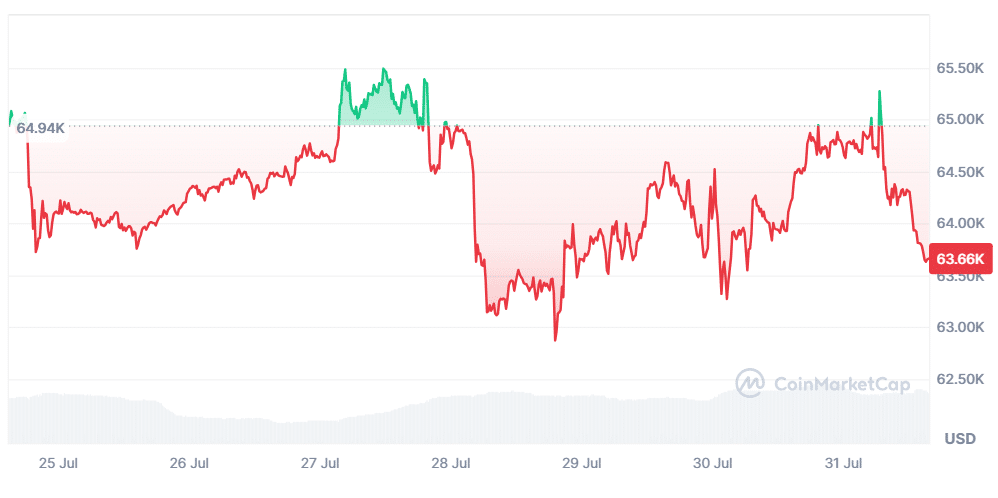
Many analysts on X pointed to the area above $65,000 as a zone of heavy historical trading volume from earlier price advances, creating natural resistance that limited follow-through buying.
Capital flows into cryptocurrencies remained muted. Even as U.S. equity markets experienced notable volatility during the week, there was little evidence of funds rotating into digital assets on either downside moves or subsequent rebounds. In some instances, trading volumes in certain crypto-related equity products exceeded those of the underlying cryptocurrencies themselves, highlighting a preference for traditional market exposure over direct crypto positions.
This environment has persisted amid what some observers describe as an extended soft period for digital assets lasting several months, during which equity market activity has dominated broader risk appetite.
Implied volatility across Bitcoin options has stayed relatively low for an extended period, consistent with the range-bound price action. The low put open interest for Bitcoin, reflected in the monthly put-call ratio near 0.26 in some readings, suggested limited demand for downside protection among participants.
Ethereum, by comparison, retained comparatively higher put interest. These positioning details painted a picture of optimism in the derivatives market that was not fully matched by aggressive spot accumulation or sustained buying pressure.
Market Backdrop and Near-Term Considerations
Beyond the immediate mechanics of the expiry, the broader setting for Bitcoin remains one of consolidation. The cryptocurrency has spent much of recent weeks oscillating without establishing a clear directional trend, with the $64,000 region serving as both a support and a magnet around major settlements. Resistance above $65,000 has proven sticky, while support levels further down, including areas near prior weekly lows, have so far held without triggering cascading liquidations.
The expiry removes a significant portion of open interest from the board, potentially reducing the pinning influence that options can exert in the short term. Once dealer hedging flows normalize, price discovery may shift more toward underlying spot demand, exchange-traded product flows, and macroeconomic developments. Market commentary has emphasized that conditions for a sustained rally do not yet appear firmly established, given the scarcity of fresh inflows and the relative underperformance of crypto compared with equities.
Looking ahead, participants will watch whether the clearance of this large block of contracts allows greater freedom of movement or whether the same range dynamics reassert themselves. The combination of call-skewed positioning that largely expired out of the money and the absence of strong spot support for higher prices underscores the current equilibrium. Bitcoin’s ability to either reclaim levels above $65,000 with conviction or defend the $64,000 zone will likely depend on factors external to the options market, including broader risk sentiment and any shifts in institutional or retail participation.
Overall, the July 31 settlement highlighted the continued influence of derivatives markets on short-term Bitcoin price behavior while also exposing the limits of bullish options positioning in the absence of matching spot demand. The modest decline into the maximum pain level represents a textbook response to a sizable expiry rather than a fundamental shift in the prevailing range-bound regime.
Also read: Coldcard Mk3 Firmware Bug Leaves BTC Wallet Seeds Exposed, $38M Drained