Key Highlights
- Binance Research found that DeFi TVL fell 38% in the first half of 2026 as on-chain market experienced sell pressure.
- Ethereum and Solana recorded lower network revenue and declining activity, while corporate treasury firms overtook spot ETFs as the largest ETH holders.
- Tokenized real-world assets (RWAs) and prediction markets remained bright spots, posting strong growth despite the broader market downturn.
The crypto market endured a difficult first half of 2026, with weakening on-chain activity weighing on decentralized finance (DeFi) and major blockchain networks.
In its Half-Year 2026 On-Chain Markets report, published on Thursday, Binance Research said DeFi lost a large amount of value, while Ethereum, Solana, and other leading blockchains experienced weaker activity, lower revenue, and a drop in market value. The report also showed that a few areas, including tokenized real-world assets (RWAs) and prediction markets, saw major push despite the decline in the market.
According to Binance Research, the downturn was not the result of capital rotating from one blockchain to another. Instead, the broader on-chain market weakened. DeFi’s total value locked (TVL), which measures the value of assets held in DeFi protocols, fell by $43.4 billion, or 38%, during the first six months of the year.
Over the same period, the combined market capitalization of the six major Layer 1 blockchains covered in the report declined by $246.5 billion, or 42%.
Ethereum’s biggest holders are changing
Ethereum was one of the networks that went through major changes during this time. The research team found that spot Ethereum exchange-traded funds (ETFs) reduced their holdings from more than 6 million ETH to 5.2 million ETH.
At the same time, digital asset treasury companies increased their ETH holdings from 6 million to 7.7 million ETH. This means corporate treasury firms now hold more ETH than spot ETFs. The report noted that Bitmine alone now owns close to 5% of Ethereum’s total supply.
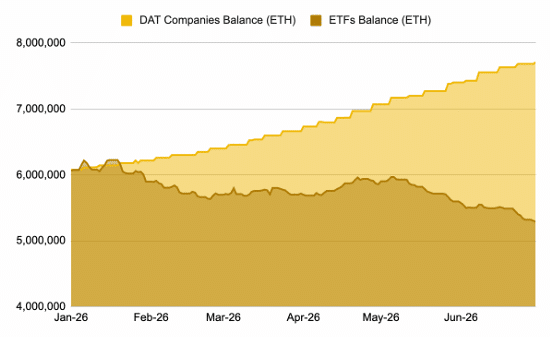
Binance Research said treasury firms have now become larger holders of ETH than spot ETFs, with Bitmine alone controlling close to 5% of the total ETH supply.
The report also found that cheaper transactions did not lead to stronger earnings for Ethereum. After the network increased its gas limit to around 60 million, average gas fees dropped by about 75% compared with 2025.
More people also used the network, with transaction count rising by about 50%. However, despite high activity, Ethereum’s revenue is expected to fall by about 53% this year. Binance Research also said Ethereum’s Foundation narrowed its focus to the core protocol, while new groups such as EthLabs and Ethereum Institutional were created to help drive adoption and bring more value back to the ETH ecosystem.
Solana wasn’t immune to the downturn
Solana had an even tougher period. Its real economic value (REV), which measures transaction fees and tips paid on the network, fell from $40 million in January to $14 million in June.
Binance Research attributed much of this decline to weaker memecoin trading. Trading volume on Pump.fun, one of the biggest memecoin launch platforms, dropped from $30 billion to $17 billion during the same period.
Even so, the report said Solana is slowly expanding beyond memecoins. Memecoins still made up 25% of the network’s decentralized exchange volume in June, but tokenized equities reached 4% of total DEX activity.
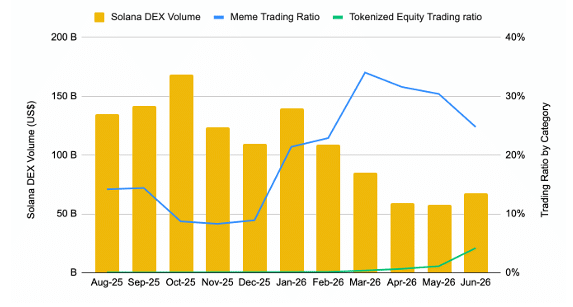
Solana also remained the leading blockchain for PropAMM, handling more than 90% of the market and over $268 billion in trading volume in 2026. Binance Research added that the upcoming Alpenglow upgrade, expected in the third quarter, could improve transaction finality from 12.8 seconds to as little as 100 to 150 milliseconds.
BNB Chain stands out
BNB Chain was one of the stronger performers during the period. The report said its tokenized real-world asset market grew by 107% in the first half of the year, increasing its share of on-chain RWAs from 9.8% to 13.5%.
It also remained the only major Layer 1 blockchain with a deflationary token, recording an annual burn rate of 5.05%.
Hack losses deepened the DeFi slump
The wider DeFi market faced growing security concerns. Active loans fell by 38%, matching the decline in TVL. Binance Research said April was the weakest month after several major hacks damaged confidence in on-chain lending and liquidity.
During the first half of 2026, the industry recorded 207 security incidents that led to losses of about $972 million, the highest number of incidents ever reported in six months. Some of these breaches include the exploits of Drift Protocol, which led to roughly $285 million in losses.
RWAs and prediction markets keep growing
Despite the weak market, not every part of the crypto industry moved backward. The research team found that tokenized real-world assets continued to gain traction, with their total value rising by more than 50% to around $34 billion by mid-July.
Prediction markets also attracted more users during the FIFA World Cup. Monthly trading volume climbed 86% to $51.6 billion between January and June, while non-sports trading across Kalshi and Polymarket increased by 136%, showing that interest in blockchain-based prediction markets extended beyond sports.
Also Read: Patrick Witt Questions Banks’ CLARITY Act Stablecoin Stance