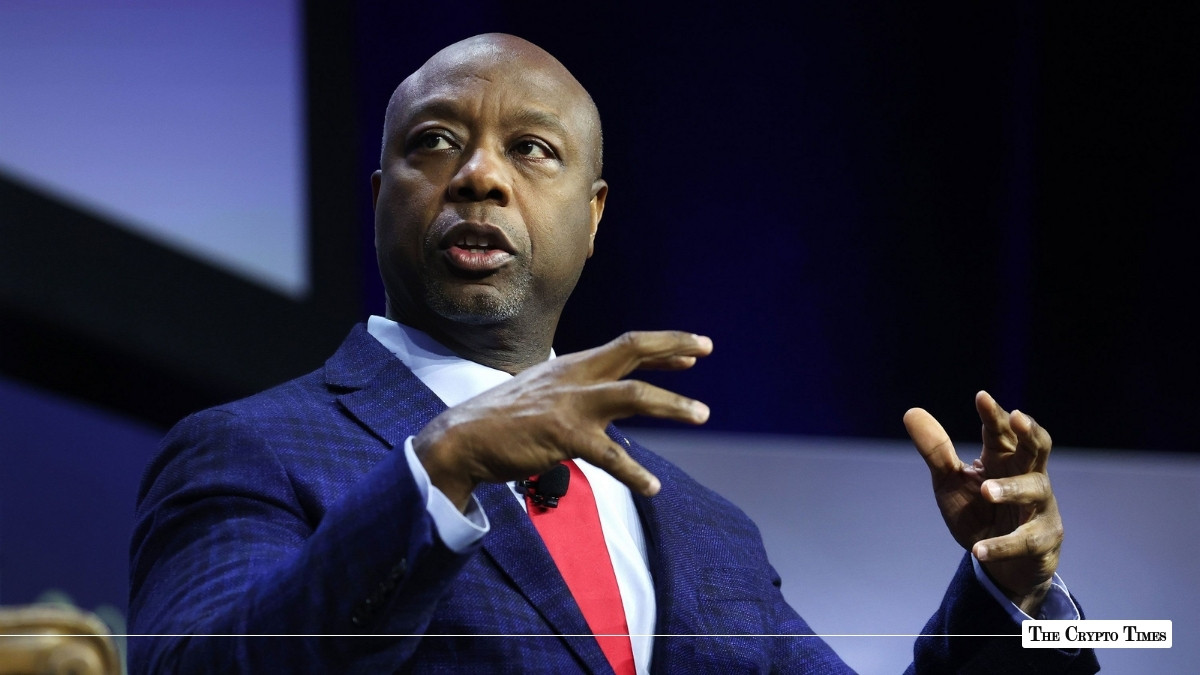
Senate Banking Committee Chairman Tim Scott is urging lawmakers to move quickly on digital asset legislation, arguing that the United States risks losing its leadership position if it fails to establish clear rules for the crypto industry.
Speaking on Fox Business’ Mornings with Maria on Thursday, Scott said digital assets are becoming an increasingly important part of the financial system and warned that America faces a choice between shaping the industry’s future or watching innovation develop elsewhere.
“Digital assets are part of the future of finance,” Scott said. “We can either lead the next era of innovation or be left watching it happen elsewhere.”
Scott ties crypto policy to U.S. competitiveness
Scott’s comments come as lawmakers continue work on the Digital Asset Market CLARITY Act, a broad market structure proposal aimed at defining regulatory responsibilities for digital assets and related businesses. According to Scott, the debate is no longer about whether digital assets will become part of the financial system, but how the United States chooses to regulate them.
“Digital assets are part of the future of finance, so every single industry will want to be a part of that, including banks,” Scott said. “What we’re talking about today is how do we set the rules of the road so that we protect our consumers?”
The South Carolina Republican framed the issue as part of a broader competition for capital, talent, and technological development.
Consumer protection remains a priority
While advocating for digital asset innovation, Scott emphasized that consumer safeguards remain central to the Senate Banking Committee’s approach. He argued that properly structured regulation can both protect users and improve financial infrastructure.
“Job one is making sure that consumers are protected,” Scott said. “Job two is making it less expensive to do business in America and easier to do it 24/7.” He pointed to blockchain-based systems as a way to reduce transaction costs and increase efficiency in payments and financial services.
Stablecoins and dollar dominance
A key part of Scott’s argument focused on stablecoins and their potential role in supporting the U.S. dollar’s global position. He said the growth of dollar-backed stablecoins could strengthen demand for both dollars and U.S. Treasuries, reinforcing the dollar’s status as the world’s reserve currency.
“What we’ve already seen with stablecoins is that our dollar dominance is actually increasing,” Scott said. Most major stablecoins are backed by dollar-denominated assets, including cash and short-term U.S. Treasury securities, creating additional demand for U.S. government debt as adoption grows.
CLARITY Act advances in Senate
Scott’s remarks come as momentum continues to build around digital asset legislation in Washington. The Senate Banking Committee recently advanced the CLARITY Act, while industry groups, technology companies, and lawmakers continue negotiations over issues including developer protections, stablecoin regulation, and anti-money laundering safeguards.
Supporters of the legislation argue that clearer rules would provide certainty for businesses while helping keep crypto innovation and investment in the United States.
Scott echoed that view, saying policymakers should create an environment that attracts entrepreneurs and emerging technologies rather than pushing them overseas. “We have to make sure that we have an environment that is conducive for the brightest minds, the greatest thinkers, and entrepreneurs to descend upon America,” he said.
Crypto’s potential impact on everyday users
Beyond market structure and competitiveness, Scott argued that digital assets could have practical benefits for consumers, particularly those facing high transaction costs. He pointed to faster payments and lower fees as potential advantages for workers and families managing tight budgets.
“For single mothers like the one that raised me and people working paycheck to paycheck, democratization through digital assets will bring down the cost of transactions and speed up the time of delivery,” Scott said.
As Senate lawmakers continue negotiations over crypto legislation, Scott’s message reflects a broader push among supporters of the CLARITY Act: establish regulatory certainty now, or risk seeing innovation, investment, and talent move elsewhere.
Also Read: Ripple CEO Says JPMorgan’s Dimon’s CLARITY Act Criticism Misses Mark