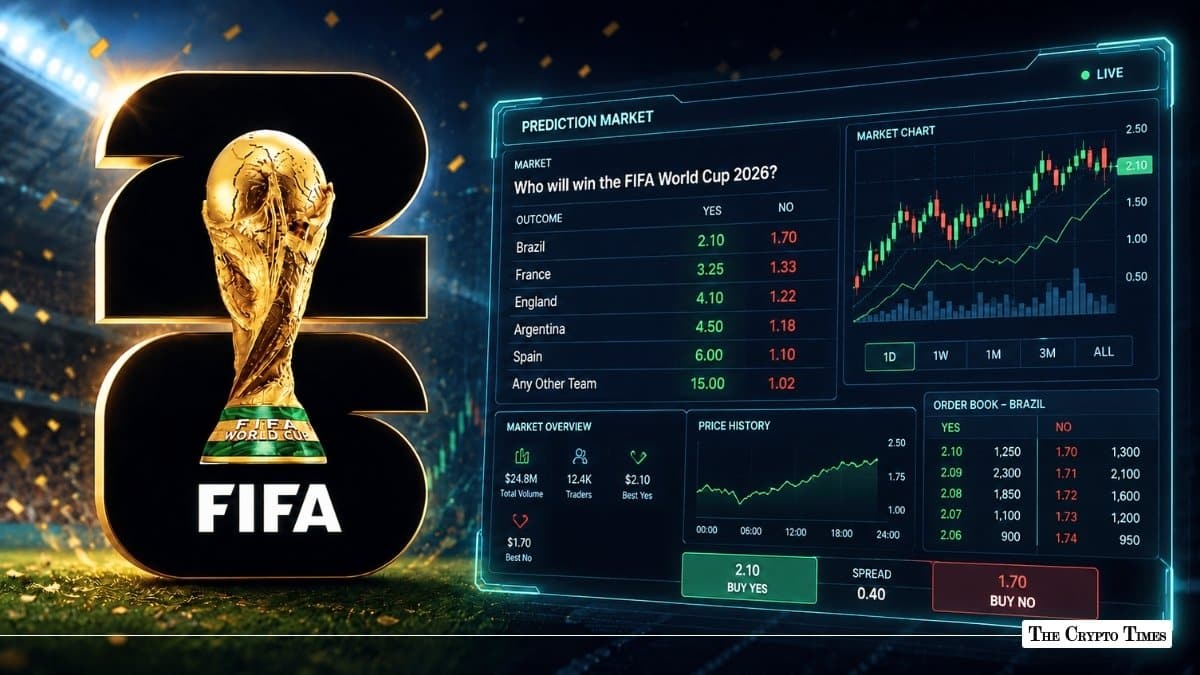
The convergence of global sports and decentralized financial technology has reached a historic milestone. Driven by the highly anticipated, expanded 48-team tournament format, prediction markets have officially transformed from a niche cryptographic sandbox into a dominant financial force.
Data shared by Token Terminal reveals that global trading volume across major prediction platforms surged to more than $24 billion last month, up from less than $5 billion just months prior.
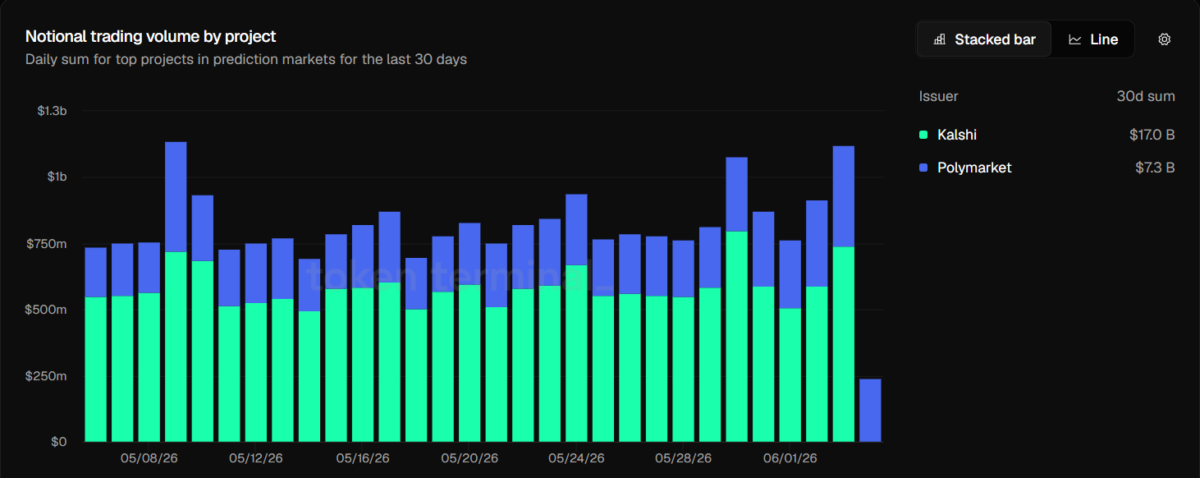
According to data published by the Pew Research Center, this meteoric rise positions decentralized and centralized event-contract exchanges ahead of traditional, licensed sportsbooks. For context, the average monthly volume wagered across all legal sportsbooks in the United States historically hovered around $14 billion.
As the multi-nation tournament across the United States, Mexico, and Canada takes center stage, it is serving as a massive accelerant for a tectonic shift in the global betting landscape.
The scale of the tournament prediction market boom
Prediction markets operate fundamentally differently from traditional bookmakers. Instead of placing a static wager against “the house,” users buy and sell binary contracts (valued between $0.00 and $1.00) that settle based on the real-world outcome of an event. If an event occurs, the contract settles at $1.00; if it does not, it expires worthless.
The structural advantages of this model, unprecedented liquidity, continuous price discovery, and the ability to exit positions mid-match, have turned this global sports cycle into the most heavily traded sporting event in digital asset history.
Market velocity and liquidity milestones
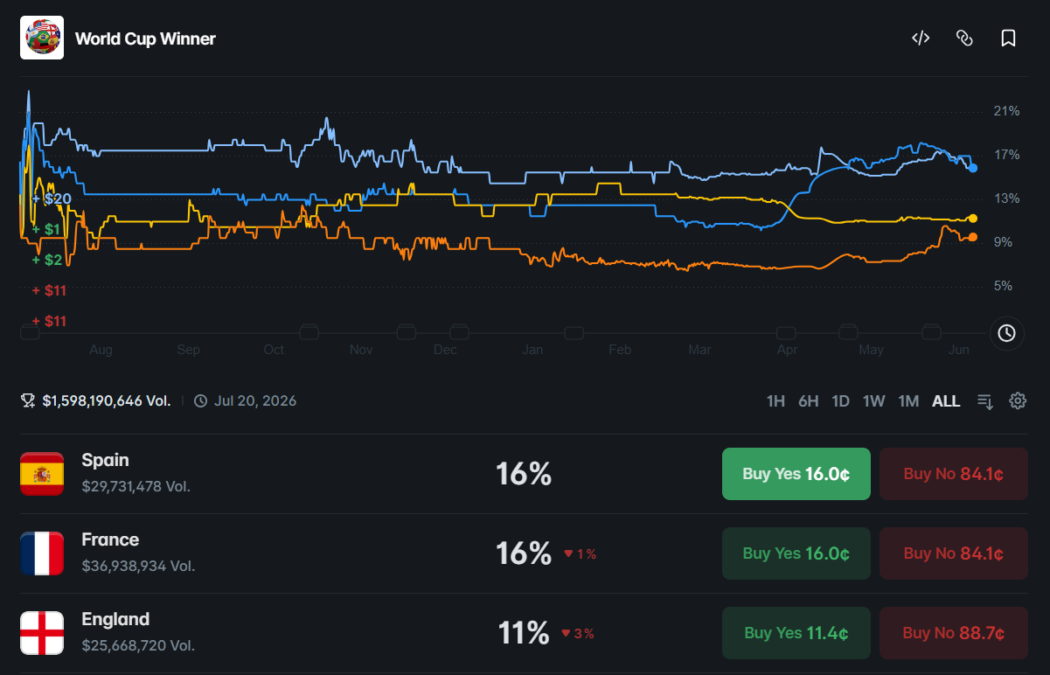
The sheer volume concentrated on tournament outcomes highlights this momentum. On the decentralized prediction platform Polymarket, the outright winner contract alone has exceeded $1.6 billion in total trading volume, maintaining a deep pool of over $280 million in active liquidity. Daily trading velocity on tournament outcomes routinely touches $30 million.
This growth is heavily reinforced by massive infrastructure expansion. Self-custodial crypto platforms and mainstream consumer apps are directly integrating prediction pipelines into their ecosystems. A prime example is Bitget Wallet’s native partnership rollout with Polymarket to its 90 million global users, creating a direct bridge for everyday retail sports fans to access on-chain prediction contracts without navigating complex decentralized finance (DeFi) architecture.
Traditional sportsbooks face the tectonic shift
While traditional sportsbooks are still projected to experience massive absolute growth during the tournament, with total global sports betting volumes expected to surpass $50 billion across the event’s 104 matches, their market dominance is being aggressively challenged by event contract exchanges.
The core metrics compiled by the Pew Research Center outline a stark divergence in capital efficiency and user preference:
| Metric | Prediction Markets (Global Monthly Peak) | U.S. Legal Sportsbooks (Monthly Avg.) |
|---|---|---|
| Trading / Handle Volume | $24 Billion | ~$14 Billion |
| Market Structure | Peer-to-Peer Order Book (Exchange) | Peer-to-House (Fixed Odds / Variable Vig) |
| Primary Fee Mechanism | Drastically lower exchange fees / Zero fee sweepstakes | Embedded “Vig” or “Juice” (Typically 4% to 10%) |
| Position Flexibility | Real-time contract trading & continuous exit options | Restrictive, house-controlled “Cash Out” features |
Why prediction markets are challenging traditional sportsbooks
The mass migration of capital from traditional sportsbooks like DraftKings, FanDuel, and BetMGM over to platforms like Kalshi and Polymarket represents a fundamental structural advantage that favors the consumer.
1. Eradicating the house “vig”
In a traditional sportsbook setting, bookmakers bake a mathematical edge, known as the “vig” or “juice,” directly into the odds. If both sides of a bet have an equal probability, a sportsbook might force a bettor to risk $110 to win $100. This hidden tax makes long-term profitability exceedingly difficult for retail sports fans.
Prediction markets disrupt this completely by utilizing a peer-to-peer exchange structure. Because users are trading directly against other sports fans and market makers, the bid-ask spreads are incredibly tight. This setup delivers drastically better pricing, lower fees, and in some sweepstakes or fully decentralized variations, completely fee-free environments.
2. Complete position control and early exits
Traditional sports betting is largely a binary commitment: a bettor places a wager and waits for the final whistle, or they are forced to accept a highly punitive, opaque “cash-out” price dictated by the sportsbook’s internal risk algorithms.
Prediction markets function exactly like equity options or stock markets. If a trader buys contracts on a national team to advance past the group stage at $0.40 per share, and that team wins its opening match, those contracts might instantly shoot up to $0.75. The user does not need to wait weeks for the group stage to conclude; they can instantly sell their shares on the live order book to lock in an 87.5% profit. This continuous price discovery gives users total control over their exposure and capital efficiency.
3. Regulatory arbitrage and broader accessibility
The regulatory framework surrounding prediction markets has provided them with unique geographic and legal advantages. In the United States, sports betting remains a state-by-state patchwork system, leaving large portions of the population without legal access to online sportsbooks.
In contrast, platforms like Kalshi are directly regulated as Designated Contract Markets (DCMs) by the Commodity Futures Trading Commission (CFTC). By offering event contracts under federal commodities laws rather than state gambling mandates, prediction platforms have carved out legal operational pathways in jurisdictions where traditional mobile sports wagering remains completely blocked or highly restricted. However, this approach has not gone unchallenged: Minnesota became the first state to pass an outright legislative ban on prediction markets under a bill signed by Governor Tim Walz on May 18, prompting the CFTC to file a lawsuit within 24 hours.
Trump enters prediction market debate
The growing influence of prediction markets has also drawn direct attention from the White House. On May 26, President Donald Trump publicly backed the Commodity Futures Trading Commission’s (CFTC) authority over prediction markets, calling it “critically important” that the agency retain exclusive jurisdiction over event contracts. The intervention marked Trump’s first direct public entry into the ongoing dispute between federal regulators, state governments, and prediction market operators.
Trump also linked prediction markets to his broader digital asset agenda, arguing that the United States must maintain leadership in emerging financial technologies. His comments arrived as regulators and lawmakers increased scrutiny of the rapidly expanding sector.
Meanwhile, on June 3, a group of nine House Democrats led by Representatives Kevin Mullin and Gabe Vasquez urged the Federal Trade Commission (FTC) to investigate whether prediction market platforms may be engaging in potentially misleading business practices. The lawmakers argued that some companies market themselves similarly to sports betting platforms while simultaneously maintaining before regulators and courts that their products should be classified as financial instruments rather than gambling products.
The debate has attracted additional attention because of the Trump family’s connections to the industry. Donald Trump Jr. serves as a paid strategic advisor to Kalshi and sits on Polymarket’s advisory board, having made a double-digit-million-dollar strategic investment through his venture firm 1789 Capital. Meanwhile, Trump Media & Technology Group has announced plans to launch Truth Predict, a prediction market product being developed in partnership with Crypto.com Derivatives North America (CDNA), a CFTC-regulated exchange.
As prediction markets continue to expand, questions surrounding consumer protection, regulatory oversight, jurisdictional authority, and potential conflicts of interest are becoming increasingly central to the industry’s future.
Demographics of the boom: Millennials and Gen Z take over
The driving force behind this $24 billion ecosystem is a demographic shift in consumption and capital management. Younger generations who grew up trading fractional shares on Robinhood and swapping digital assets on crypto exchanges view traditional sports betting as an outdated, static product.
A comprehensive consumer sentiment survey published by compliance and fraud prevention firm SEON reveals just how quickly alternative platforms are capturing the youth market.
Expected U.S. Adult Wager Channels for the Global Tournament:
- Licensed Sportsbooks (29%)
- Prediction Markets (19%)
- Social Casinos (17%)
- Crypto-based Betting Platforms (8%)
- Offshore Betting Sites (8%)
As reported by Gambling Insider, while the broader adult population still shows a slight preference for licensed sportsbooks (29% vs. 19%), the data changes drastically when isolating the Millennial and Gen Z demographics:
The Millennial Parity: Among Millennial respondents, 36% stated they explicitly plan to use prediction markets to trade the tournament, running virtually neck-and-neck with the 38% who plan to use traditional licensed sportsbooks.
Widespread Engagement: Only 24% of Millennials and 28% of Gen Z respondents report that they do not engage in any form of wagering or event trading. This contrasts sharply with older generations; 70% of Baby Boomers and 56% of Gen X respondents state they have zero intention of participating in any betting markets during the tournament.
George Pace, Lead Product Marketing Manager for Betting and Gaming at SEON, commented on the survey, stating, “Younger consumers already manage most of their financial lives through apps. Betting is following the same pattern, accelerated by the expansion of legal sports betting across the U.S. and a general shift in how gambling is perceived.”
Macro context: The scale of the expanded tournament
The macro environment of the tournament provides the perfect framework for these economic dynamics to unfold. This iteration of the global games is fundamentally different from any sports entertainment event that came before it:
- 48 teams across 12 groups: Every squad in action multiple times before elimination begins.
- 104 matches over 39 days (June 11 to July 19): An unbroken daily news cycle of injury reports, VAR decisions, squad rotation, and tactical developments, each representing an immediate informational edge that can be priced and traded in real-time.
- USA opens June 12 in Los Angeles vs. Paraguay; Mexico opens June 11 in Mexico City vs. South Africa: Both North American host nations provide prime-time trading windows aligned with peak U.S. liquidity hours.
- France vs. Spain on current Polymarket and Kalshi pricing are virtually tied as favorites, creating the tightest top-of-market in World Cup prediction market history.
According to FIFA, the tournament spans prime North American time zones throughout, a structural advantage over Qatar 2022, whose games were broadcast in early morning U.S. hours and suppressed live in-game trading volumes.
Systemic risks, security obstacles, and fraud challenges
The migration of billions of dollars into prediction platforms has also exposed significant systemic vulnerabilities. The hyper-growth of these platforms has outpaced both infrastructural security and consumer confidence.
Consumer trust gap
Despite the immense volume flowing into these platforms, users remain highly skeptical of the underlying technology’s security framework. The SEON compliance study highlighted a stark reality for operators: nearly 45% of surveyed participants admitted they are not confident that digital wagering and prediction platforms can adequately protect their personal and financial data during a high-traffic surge.
Operational fraud and the “new user” paradox
For platform risk teams, a tournament of this scale creates a highly complex security environment. Millions of legitimate retail sports fans are downloading these applications and depositing capital for the very first time. This creates a major vulnerability that bad actors eagerly exploit.
Because a massive influx of genuine, first-time users looks structurally identical to a coordinated bot attack or a series of synthetic identity fraud attempts, operators face what risk analysts call the “New User” paradox. If a platform enforces friction-heavy, slow Identity Verification (KYC) protocols to weed out bad actors, they ruin the user experience and lose customers to nimbler competitors. However, if they ease their security gates to capture the transaction wave, they open the floodgates to severe financial and regulatory compliance failures.
Furthermore, consumers are actively shopping across multiple platforms to exploit promotional arbitrage, deposit bonuses, and mispriced odds. This multi-platform behavior makes tracking cross-app fraud patterns and account takeover (ATO) attacks incredibly difficult for security teams operating under tight time constraints.
The road ahead: A structural shift in sports media
The prediction market boom surrounding the 2026 World Cup may prove to be more than a temporary surge in activity. By allowing users to trade real-time views on sporting outcomes, these platforms are increasingly blending elements of finance, forecasting, and sports wagering.
As the tournament progresses, platforms such as Kalshi and Polymarket are emerging as influential venues for measuring public sentiment and market expectations, processing billions of dollars in trading activity along the way.
Also Read: White House Reviews CFTC Rules for US Prediction Markets