Coinbase stock is setting up for its first credible breakout attempt of 2026. Shares of the Nasdaq-listed exchange closed Wednesday at $195.90, up 6.23% on the session, extending a move that began April 10 when CEO Brian Armstrong reversed his position on the CLARITY Act after blocking it twice this year and the Senate Banking Committee signaled a late-April markup window.
The rally reclaimed the 20-day moving average at $179, flipped the MACD bullish for the first time in the current leg, and established the first higher-high on the daily chart since March. Word was that by late April the United States will have its crypto bill passed with the stablecoin topic in the rearview mirror. This optimism got traders and investors to get bullish on the stock.
Then on Wednesday, the Senate Banking Committee published its April 20 calendar. The CLARITY Act was not on it. The only scheduled item: a Tuesday nomination hearing for Federal Reserve Chair candidate Kevin Warsh. The markup is delayed — pushed to the April 27 week or early May at the latest — but it is not dead. Tim Scott’s committee is still working the text, and Coinbase’s policy team, Ripple’s CEO, and the White House crypto adviser were all publicly signaling progress as of Tuesday.
For Coinbase stock, that distinction is everything. A delayed markup is a catalyst deferred by two weeks. A dead markup is the 2026 bull case gone. COIN traded Wednesday as if the market believes the former.
The next objective on the chart is clear: $220.
That level — the March swing high and the point where the previous two relief rallies failed — is the line separating a counter-trend bounce from a confirmed trend reversal. Cleared on volume, it opens the path to $245 and puts the January breakdown zone at $260 back into play. Rejected, and COIN stays trapped in the same staircase lower that defined its 2026 price action, with the February low at $140 as the magnet.
For a stock down 23% year-to-date and trading on policy hope more than fundamentals — Q4 2025 earnings missed EPS by 364.89% and revenue by 2.52% — the CLARITY Act catalyst is doing the heavy lifting. The chart is finally starting to cooperate. Whether it sustains depends on whether the markup lands before Memorial Day.
The three sessions that built the move
The rally didn’t happen on the day of Armstrong’s reversal. It happened in the three sessions that followed.
Friday, April 10: Armstrong reverses, market yawns. COIN closed red near $169 on the day of the CEO’s public CLARITY Act endorsement. The reversal was announced into a weekend, and with the Senate still on recess, traders had nothing concrete to price. The news set the narrative. The tape didn’t move.
Monday, April 13: Senate returns, first buyers step in. With the Senate back from Easter recess and the Banking Committee’s markup window officially open, COIN printed a green session and closed around $175. Volume was modest. This was positioning, not conviction.
Tuesday, April 14: Markup listing confirms the catalyst. News broke that the Senate Banking Committee was targeting a late-April markup for the CLARITY Act, and Coinbase shares responded with a roughly 5% jump to close near $185. The 20-day moving average came into play as resistance. This was the session that flipped the daily trend.
Wednesday, April 15: The breakout session. COIN opened at $185.66, ran to an intraday high of $196.46, and closed at $195.90, up 6.23% on the day, the strongest single-session move since early March. The 20-SMA was reclaimed, the MACD flipped bullish, and the first higher-high on the daily chart since March printed on the close.
The technical setup: Breakout structure is building
Wednesday’s close at $195.90 took out the April 7 swing high and established the first higher-high on the daily chart. And if we take a look back on the price action, after January’s selloff bottomed at $140 in early February, COIN printed a higher low at $155 in late March, then another at $160 in early April.
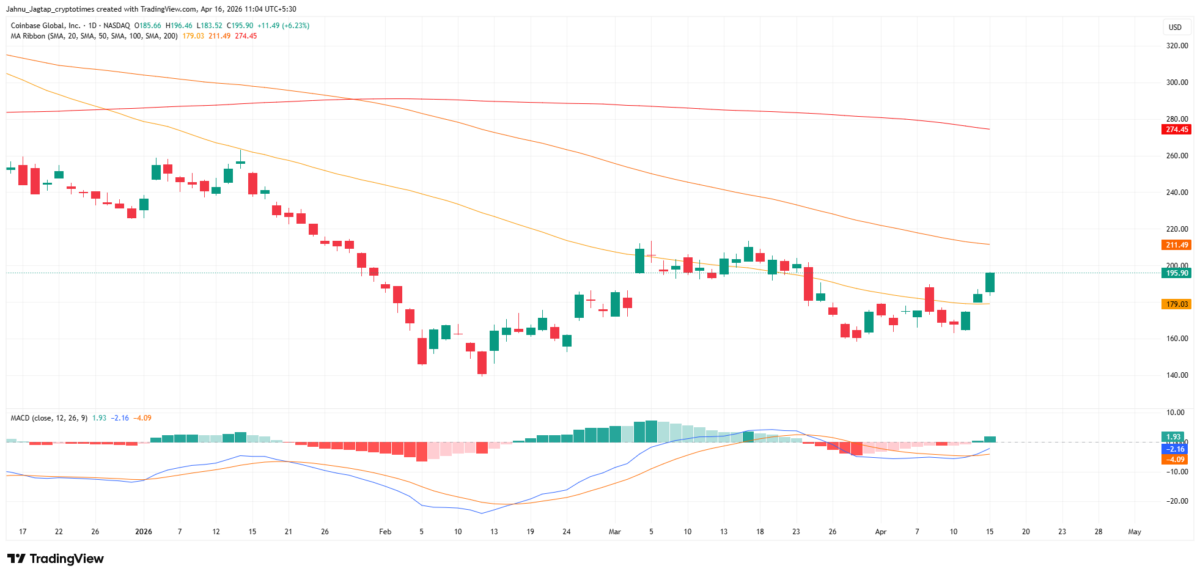
The moving average ribbon tells the story in one glance: 20-SMA at $179, 50-SMA at $211, 200-SMA at $274. Price has to earn its way through each one, in order. The 20-SMA is already done. The 50-SMA is the next test.
What Wednesday’s candle did accomplish:
- Reclaimed the 20-SMA at $179 on above-average volume, the first clean break since late March
- Flipped the MACD bullish for the first time in the current leg, with the histogram crossing from negative to +1.93
- Printed a closing session high of $196.46, taking out the April 7 swing high near $175 and establishing the first higher-high on the daily chart since March
What comes next:
- Reclaim the 50-SMA at $211
- The March swing high at $220 is breakout confirmation
- The MACD signal line at -2.16 needs to cross above zero to confirm momentum
Translation: The base is built. The breakout is starting. The bar for confirmation is $211, then $220.
The scenarios: Three paths from $195
Bull case — CLARITY clears the April 27 week, and COIN reclaims $220:
If the Senate Banking Committee adds the markup to the April 27 calendar or the first week of May with stablecoin yield language Coinbase can live with, and the bill moves to a floor vote by late May as Ripple’s CEO Brad Garlinghouse projects, the regulatory overhang that has defined COIN’s 2026 disappears.
On top of it, short interest, which is elevated heading into this week, unwinds violently. First target: the 50-SMA at $211. Second target: the March swing high at $220. A close above $220 opens the path to $245–$260, where the January breakdown originated. Probability-weighted, this is the setup if — and only if — the bill clears committee without watered-down yield provisions that gut Coinbase’s Base and staking revenue lines.
Base case — Markup slips to May, range-bound grind between $175 and $210:
The Senate Banking Committee has missed deadlines on this bill three times already. The April 20 week just became the fourth miss. Chairman Tim Scott controls the calendar and has shown no urgency.
If the markup pushes into mid-May or later, or if the revised stablecoin yield text lands closer to the bank-friendly March 23 draft than the crypto industry compromise, COIN loses its near-term catalyst density. The stock grinds in a $175–$210 range into Q1 2026 earnings (early May, per the chart’s E marker). In this scenario, the 20-SMA becomes the pivot — hold it, and bulls retain control of the tactical setup. Lose it, and the April low at $160 comes back into play.
Bear case — Memorial Day deadline missed, earnings disappoint, retest of $140:
Coinbase missed EPS by 364.89% last quarter. Q1 2026 revenue was down 22.17% year-over-year. The stock is trading on policy hope, not fundamentals, and hope is expensive when you have a negative earnings trajectory.
Senator Bernie Moreno has warned publicly that failure to reach the Senate floor by May effectively shelves the legislation for the rest of 2026 — Galaxy Research has mapped only 18 working weeks left before the October midterm recess.
If the CLARITY Act misses the Memorial Day window and Q1 2026 earnings disappoint, the February low at $140 is the magnet. That is a 28% drawdown from current levels. The MACD would need to roll back over and the 20-SMA break would confirm it, but the structural setup — lower highs, lower lows, inverted moving averages — is still intact. This is not a tail risk. It is the default path if the catalyst fails.
The levels that matter
| Level | Significance |
|---|---|
| $220 | March swing high — breakout confirmation above here |
| $211 | 50-SMA — first major resistance, where the last two rallies failed |
| $200 | Psychological round number — intraday pivot |
| $195.90 | Current price |
| $179 | 20-SMA — near-term support, must hold on any pullback |
| $165 | April consolidation floor |
| $140 | February low — bear case target |
What to watch this week
Three things decide whether Wednesday’s move holds:
One, the Senate Banking Committee’s April 27 calendar. With the April 20 week already locked in for a Fed chair nomination hearing, the committee’s next published schedule is the single biggest tell. Tillis is expected to release revised stablecoin yield text imminently — that language is the trade. Permissive activity-based rewards keep Coinbase’s revenue model intact. Restrictive yield bans strip an estimated $1.35 billion from the P&L.
Two, Bitcoin. COIN has a 0.45 correlation to BTC over the trailing 90 days. If Bitcoin breaks $80,000 resistance and extends, COIN gets dragged through $200 on flow alone. If BTC rolls over, the CLARITY narrative will not save this stock.
Three, short interest data. If the April 15 short interest print (due April 24) shows the shorts covered into the rally, the squeeze fuel is gone and the rally needs organic buyers. If shorts held, the squeeze is still ahead.
The bottom line
Coinbase stock has the cleanest setup it has offered investors all year. The trade setup is clean: long above $200, add above $211, target $220 and $245. Invalidation is a daily close back below $179. Risk-reward at $195 is roughly 1:2 to the $220 target against the $179 stop — and materially better if the Senate markup lands by Memorial Day and COIN extends toward the $245–$260 breakdown zone.
The catalyst is real. Armstrong’s “we agree” stance removed the single biggest industry obstacle that had blocked the CLARITY Act twice in 2026. The White House is applying pressure. The yield compromise is holding. Short interest is elevated. And the Senate calendar, while slipping, still has a runway through late April and early May.
The risks are clear and worth naming. If the markup misses the Memorial Day window, election-year politics shelve the bill into 2027 or later. If Q1 2026 earnings in early May reveal deeper deterioration than Q4 2025’s EPS miss suggested, the catalyst narrative meets a fundamental wall. If Bitcoin rolls over, COIN’s 0.45 correlation pulls it down regardless of Washington.
None of that changes the setup. It sharpens it. Wednesday’s move was the market pricing in a path to $220 that did not exist two weeks ago.
Also Read: Kevin Warsh Hearing May Push Clarity Act to Late April or May