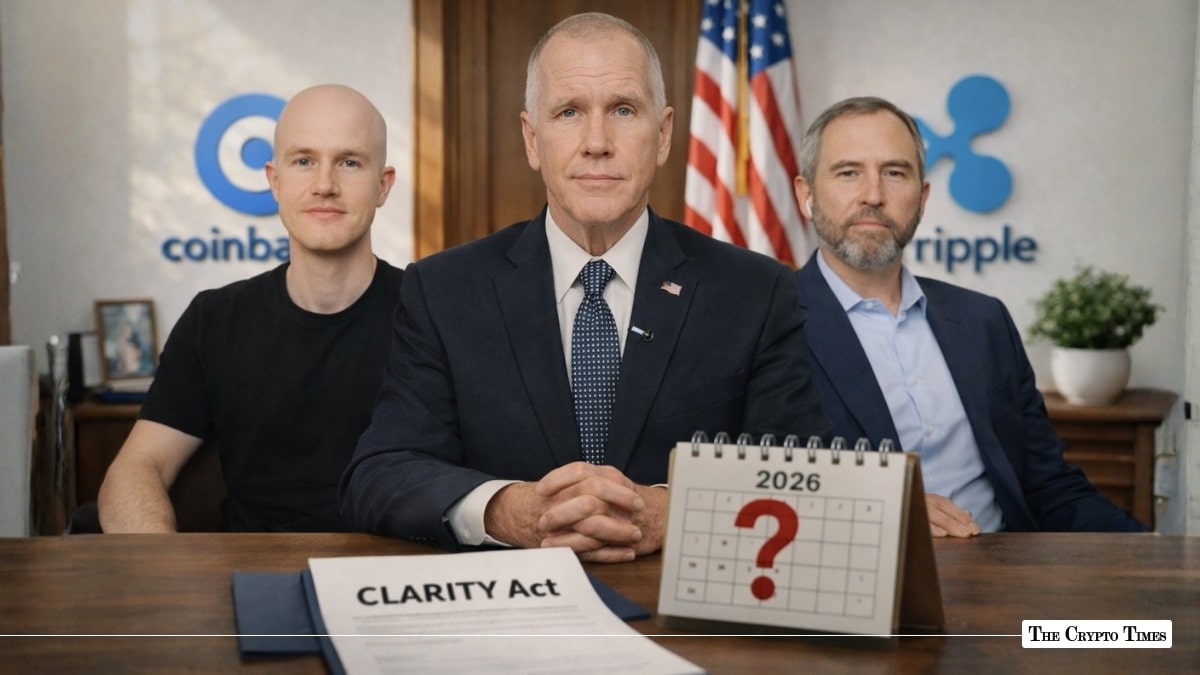
For the first time in the year-long fight over America’s crypto market structure bill, the people who matter are no longer fighting each other. They’re waiting on one man.
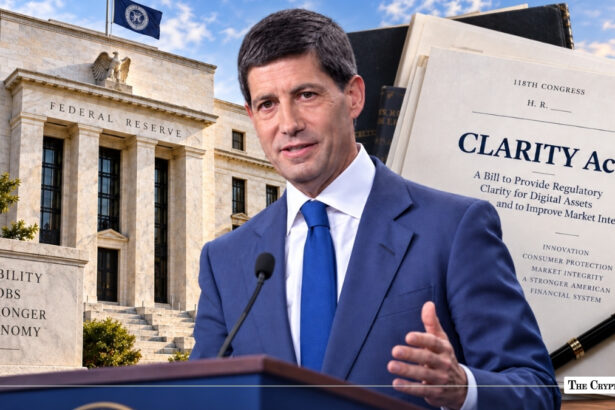
The Digital Asset Market Clarity Act (H.R. 3633) — better known as the CLARITY Act — has cleared every political obstacle that was supposed to kill it. Coinbase CEO Brian Armstrong, who twice withdrew his support and helped torpedo a January markup, publicly endorsed the bill on April 9 after Treasury Secretary Scott Bessent published a Wall Street Journal op-ed urging immediate passage.
Ripple CEO Brad Garlinghouse went on record at the Semafor World Economy event in Washington on April 13, saying he expects the bill signed into law by the end of May. And Senator Thom Tillis is releasing the long-delayed revised stablecoin yield text this week, the final piece of legislative language anyone was actually waiting on.
Yet, the Senate Banking Committee has not scheduled a markup. The crypto industry—which has spent over $149 million through the Fairshake super PAC and assembled a $193 million war chest specifically to secure this kind of legislative win—is now openly frustrated.
The coalition that took months to build
For most of 2026, the CLARITY Act’s failure could be blamed on substantive disagreement. Banks wanted a hard ban on stablecoin yield. Crypto firms wanted preserved rewards programs. Coinbase publicly opposed compromise language in March. Senate Democrats raised concerns about ethics provisions and DeFi treatment. White House negotiators ran weeks of meetings between the warring camps.
That coalition is now built. Senators Thom Tillis and Angela Alsobrooks reached an agreement in principle in March that bans passive yield on stablecoin balances while permitting activity-based rewards—payments, transfers, and platform engagement. The White House Council of Economic Advisers released a report on April 8 estimating that a full passive-yield ban would shift only $2.1 billion in lending across a $12 trillion market — a 0.02% effect — undercutting the banking lobby’s core argument. SEC Chair Paul Atkins called for fast-track passage. Treasury Secretary Bessent has now spoken publicly multiple times urging movement before the midterms.
What’s left to negotiate is small. What’s left to do is procedural. And procedure is where the bill is now stuck.
The bottleneck
Senate Banking Committee Chairman Tim Scott controls the markup calendar. Under committee rules, the bill text must be published at least 48 hours before any markup hearing — which means once Tillis releases the revised text this week, the procedural clock to schedule a vote is technically already running. Scott has the votes to move the bill out of committee. He has not announced a date.
Senator Bill Hagerty, speaking at a Vanderbilt University policy summit, said he believed the bill could clear Banking during the work period that began April 13 and reach the full Senate before the end of April. Senator Cynthia Lummis has publicly confirmed a late-April markup target. Both are working from the assumption that Scott will act. He hasn’t said whether he will.
The industry’s frustration is no longer about the bill’s content. It’s about whether anyone in Senate leadership treats this as urgent.
Why industry patience is wearing thin
The pressure on Coinbase, Ripple, and the broader industry to deliver legislative results is not abstract. Crypto super PACs spent hundreds of millions during the 2024 election cycle on the explicit promise that a friendly administration plus friendly congressional majorities would produce a comprehensive market structure framework. The House delivered, passing the bill 294-134 in July 2025. The Senate Agriculture Committee marked up its portion on January 29, 2026. Every other piece of the puzzle is in place.
What industry advocates are now openly saying—quietly to reporters, less quietly on X—is that the bill’s failure now would be entirely attributable to Senate inaction, not to substantive opposition. Polymarket odds for a 2026 signing have collapsed to 58%, down from above 82% earlier this year.
JPMorgan analysts have called passage by midyear a “positive catalyst” for digital assets. Institutional investors who were preparing custody products and tokenization frameworks against the assumption of statutory clarity are now being told to wait.
Justin Slaughter, VP of Policy at Paradigm, has noted publicly that Senate floor procedure typically requires two to three weeks. Working backward from the Memorial Day deadline that proponents have informally treated as a hard stop, the Banking Committee must clear the bill by mid-May at the latest.
Every additional week of inaction compresses an already tight reconciliation process—the bill must still be reconciled with the Senate Agriculture version, survive a 60-vote Senate floor vote requiring meaningful Democratic support, and then be reconciled again with the House-passed version before reaching the President’s desk.
The quiet math of inaction
Senator Bernie Moreno has been blunt: if the CLARITY Act doesn’t reach the Senate floor by May, it likely doesn’t move at all this Congress. The August recess runs from August 10 to September 11. The midterm campaign recess begins October 5.
By traditional Senate norms, bipartisan cooperation on major legislation collapses entirely once members are running for reelection. A bill that misses the May window doesn’t get rescheduled—it gets reborn in a different Congress, with different priorities and potentially a different political majority writing the rules.
That is the math that has the industry on edge. The compromise everyone fought for is sitting on a desk. The senators who want to vote on it are ready to vote. The Chairman who controls the calendar has not picked up a pen.
For an industry that spent two years and hundreds of millions of dollars to be in exactly this position, the silence from the Senate Banking Committee is no longer a procedural delay. It is starting to look like the answer.
Also Read: The CLARITY Act Countdown: Will the Senate Deliver a Crypto Win or Run Out the Clock?
The Crypto Files: The Clarity Act Explained