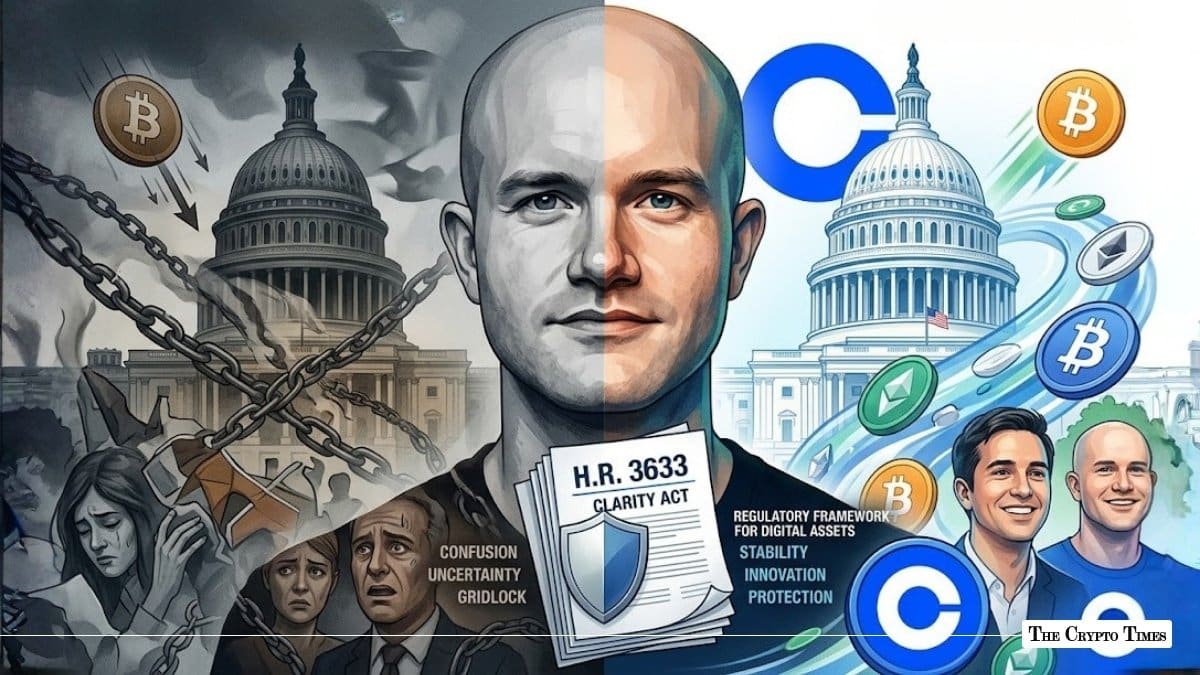
Just 48 hours ago, the Digital Asset Market Clarity Act (CLARITY Act, H.R. 3633) looked hopelessly mired in the same old Senate gridlock. Traditional banks were digging in against stablecoin yields, and Coinbase, the largest U.S. crypto exchange, had already blocked the bill’s markup twice.
Tensions hit a boiling point earlier this week on April 7, when U.S. Treasury Secretary Scott Bessent took to Fox News to openly criticize Coinbase as a “recalcitrant actor” holding up landmark legislation, rejecting CEO Brian Armstrong’s stance that no bill is better than a flawed one.
Then, on April 10, 2026, Armstrong dropped a bombshell on X, directly replying to Secretary Bessent: “We agree…It’s time to pass the Clarity Act.”
This plot twist is exactly what our April 10 news updates captured—and it completely flips the script on the previous regulatory deadlock. Armstrong’s U-turn signals that the bitter war over stablecoin yield has reached a resolution. A compromise is locked in, and the Senate Banking Committee (Chair Tim Scott) is now targeting a late-April markup when they return from Easter recess on April 13. Failure by May almost certainly kills the bill for the 2026 election cycle.
Here is the definitive guide to how we got here, the mechanics of the stablecoin yield compromise, and what the CLARITY Act means for the trillion-dollar crypto market.
What Is the CLARITY Act? (H.R. 3633)
Passed by the House in July 2025 by a historic, bipartisan 294-134 vote, the CLARITY Act creates the first comprehensive U.S. digital asset market structure framework. It builds directly on the regulatory foundation laid by the GENIUS Act (which formalized stablecoin reserves and issuance in July 2025, and saw fresh FDIC implementation rules proposed just days ago).
The core goal of CLARITY is to end “regulation by enforcement” by clearly dividing jurisdiction between the SEC and the CFTC.
Key Provisions:
- Digital Commodities Definition: The bill establishes a “Mature Blockchain Test.” If no single entity controls more than 20% of a blockchain’s supply or governance, its token is classified as a digital commodity. This grants the CFTC exclusive jurisdiction, bypassing the SEC.
- DeFi Safe Harbors: Protects software developers and peer-to-peer activities while focusing regulatory efforts on centralized intermediaries rather than code.
- Self-Custody Protections: Codifies the right of individuals to hold their own digital assets.
- Tokenization Rules: Creates clear frameworks for bringing real-world assets (RWAs) on-chain.
- Illicit Finance Safeguards: Ensures centralized digital asset intermediaries are subject to strict Bank Secrecy Act (BSA) and anti-money laundering (AML) frameworks.
CLARITY Act vs. Current Regulatory Landscape
| Issue | Pre-CLARITY (Current State) | Post-CLARITY (If Passed) |
|---|---|---|
| Jurisdiction | SEC claims broad authority over most tokens | Clear split: CFTC handles mature commodities; SEC handles securities |
| DeFi | Legal gray area; developers face enforcement risk | Explicit safe harbors for code and decentralized protocols |
| Stablecoins | Bitter yield fights; regulatory uncertainty | Defined rules for rewards and activity-linked incentives |
| Self-Custody | Constantly at risk of backdoor bans | Federally protected |
The Stablecoin Yield Battle: Full Mechanics & The Compromise
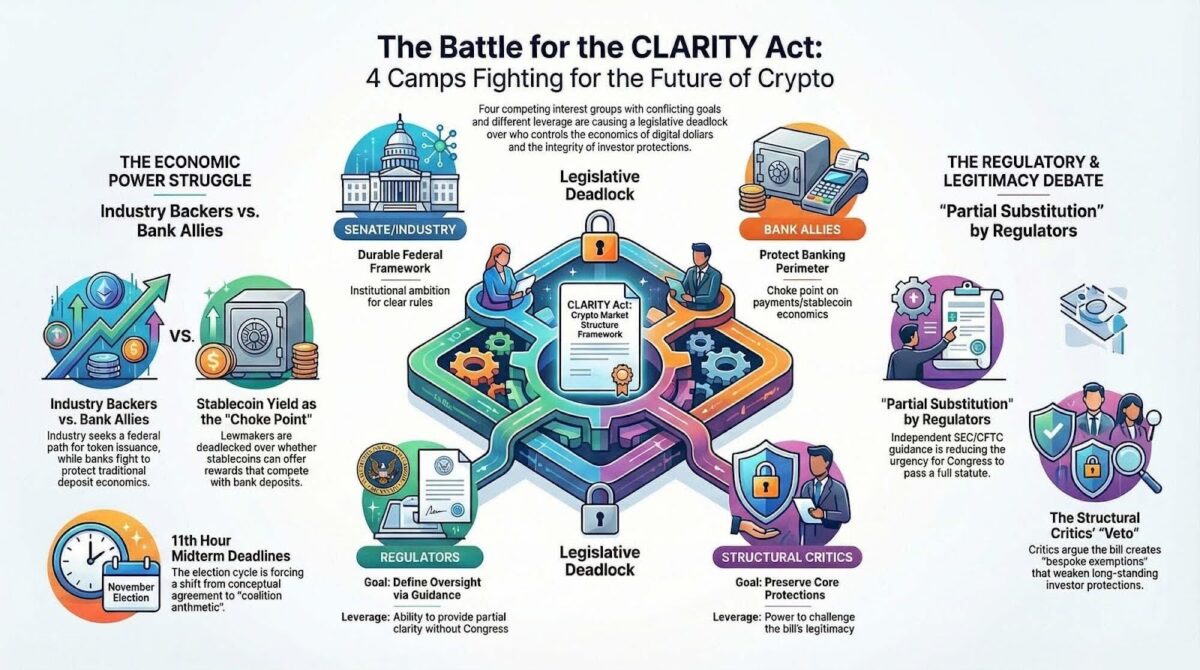
The single issue that killed two markup attempts earlier this year was the fierce battle over stablecoin yields. The stakes were astronomical for both traditional finance (TradFi) and the crypto industry.
The Core Conflict
Traditional banks (backed by the ABA and OCC) warned that yield-bearing stablecoins—currently offering 5-6% APY on platforms like Coinbase and Circle—would trigger massive deposit flight from traditional savings accounts paying ~0.1%. They framed this as a systemic risk to the $25.11 trillion U.S. banking sector and demanded a total ban on stablecoin interest.
Crypto advocates countered that yield is a fundamental consumer benefit and a standard in DeFi. For Coinbase, the stakes were existential: their stablecoin revenue alone hit $1.35 billion in 2025, representing roughly 20% of total revenue. Banning yield would decimate this income stream.
The Turning Point: White House CEA & The Tillis-Alsobrooks Deal
On April 8, 2026, the White House Council of Economic Advisers (CEA) released a game-changing report. It found that a full ban on passive yield would cost consumers $800 million in lost returns annually, while providing only a “negligible” benefit to bank deposit stability.
This data validated the Tillis-Alsobrooks Compromise (drafted in late March), a delicate legislative needle-thread:
- Banned: Direct or indirect passive yield paid simply for holding a stablecoin balance.
- Allowed: Narrowly defined, activity-based rewards (e.g., transaction rebates, payment incentives, transfers, or loyalty programs).
- Implementation: The SEC, CFTC, and Treasury get 12 months to issue detailed, synchronized rules.
Armstrong’s April 10 reversal proves this compromise successfully addressed industry concerns. By allowing activity-based carve-outs, the updated language protects enough of Coinbase’s revenue engine for the exchange to finally drop its opposition.
Fact-Checking the Drama
- Myth: Banks will collapse if stablecoins yield.
- False. White House CEA data shows minimal impact on bank deposits. Furthermore, the FDIC’s new 191-page proposed rule under the GENIUS Act strictly monitors stablecoin issuer reserves, neutralizing systemic risk.
- Myth: Coinbase killed the bill twice entirely out of greed.
- Partially true, but outdated. While Armstrong did block the bill to protect a $1.35B revenue stream, his reversal shows that he was willing to accept a middle-ground compromise rather than holding out for a total victory or letting the bill die.
- Myth: The new yield ban means no more USDC/USDT rewards.
- False. While passive “sit-and-earn” yield on balances is banned, activity-based rewards and loyalty programs remain entirely legal.
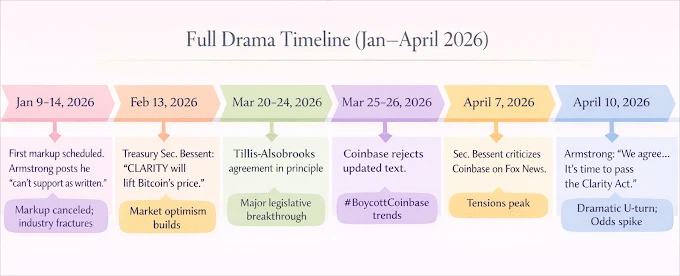
Full Drama Timeline (Jan–April 2026)
| Date | Event | Market Impact |
|---|---|---|
| Jan 9–14, 2026 | First markup scheduled. Armstrong posts he “can’t support as written.” | Markup canceled; industry fractures. |
| Feb 13, 2026 | Treasury Sec. Bessent states passing CLARITY will “lift Bitcoin’s price” and steady battered markets. | Market optimism builds. |
| Mar 20–24, 2026 | Tillis-Alsobrooks agreement in principle is formed (passive yield ban, active rewards allowed). | Major legislative breakthrough. |
| Mar 25–26, 2026 | Coinbase rejects the updated text in closed-door meetings. | Second markup block; #BoycottCoinbase trends. |
| April 7, 2026 | Sec. Bessent explicitly criticizes Coinbase on Fox News as a “recalcitrant actor.” | Tensions peak before second White House summit. |
| April 10, 2026 | Armstrong posts: “We agree… It’s time to pass the Clarity Act.” | Dramatic U-turn; Polymarket odds spike. |
Community Sentiment & Market Implications
The immediate reaction across crypto communities has shifted from deep skepticism to cautious euphoria. Just days ago, Reddit threads on r/CryptoCurrency were heavily pessimistic, with top-voted comments lamenting that the clock was ticking as senators looked to “sacrifice stablecoin yield.”
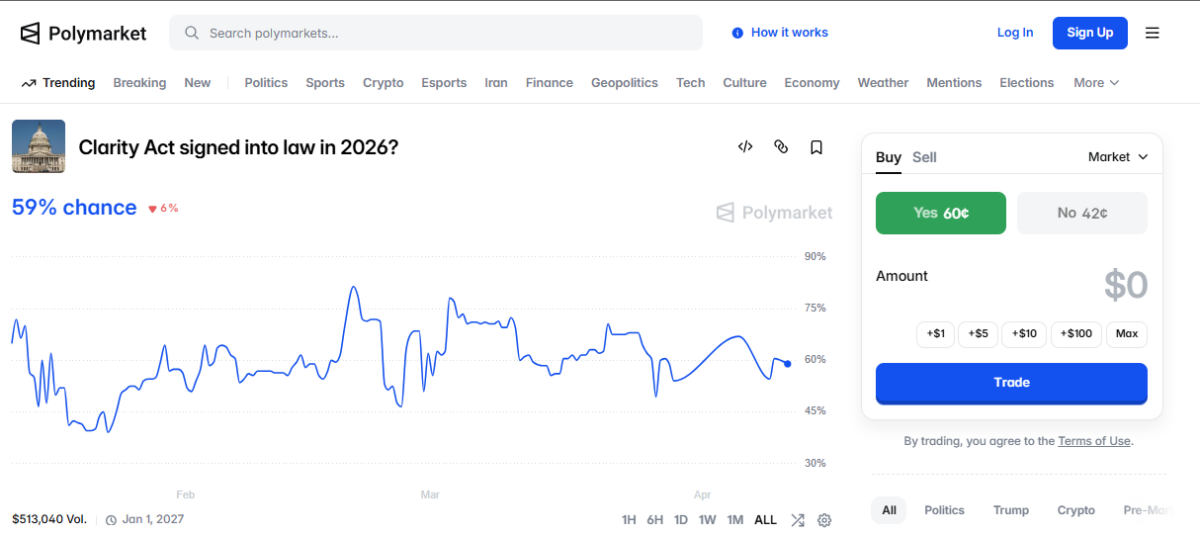
Following Armstrong’s tweet, X lit up. Prominent voices like @mewwts echoed Bessent’s sentiment that passing CLARITY will “unleash a golden era for finance.” Polymarket odds for the bill’s passage in 2026, which were hovering stubbornly around 59%, spiked aggressively following the Coinbase truce.
What This Means for Traders
If the CLARITY Act passes by late 2026:
- Altcoin Validation: Tokens like XRP and SOL get clear paths to being classified as CFTC-regulated commodities, removing the dark cloud of SEC enforcement and acting as a massive price catalyst.
- Institutional Floodgates: JPMorgan analysis suggests full market structure clarity will trigger a massive wave of institutional capital entering the space.
- RWA Explosion: The bill provides the legal scaffolding necessary for the tokenized Real-World Asset market to scale exponentially.
The Political Pressure Cooker:
Beneath the surface of the stablecoin yield debate lies a deep, pervasive anxiety within the crypto community. Industry leaders, lobbyists, and pro-crypto lawmakers are sounding the alarm that the window for a generational legislative win is rapidly closing.
The sense of urgency is driven by three stark political realities:
- The Ghost of the “Biden Era”: The crypto industry is still nursing wounds from the previous administration. Under President Biden, SEC Chair Gary Gensler’s “regulation by enforcement” strategy saw record numbers of lawsuits against major U.S. crypto firms. Leading voices are actively using this as a rallying cry, warning that without the permanent statutory protections of the CLARITY Act, the industry remains just one election away from returning to a hostile regulatory environment.
- A “Pro-Crypto” Administration Expects Results: Donald Trump actively courted the crypto vote during his campaign, promising to make the U.S. the “crypto capital of the planet.” In return, the crypto industry—led by massive Super PACs like Fairshake and heavy hitters like Coinbase and Ripple—poured hundreds of millions in donations to help secure his victory. The CLARITY Act is widely viewed as the essential “return on investment” for those efforts. Lawmakers are highly aware that failing to deliver could alienate a massively well-funded donor base.
- The Looming Midterm Cliff: If the CLARITY Act gets bogged down in committee and pushed past the summer, it bleeds into the 2026 midterm election cycle. During midterms, bipartisan cooperation historically freezes. Furthermore, if the political makeup of Congress shifts, or if Trump loses power in a future cycle without this framework codified into law, the industry risks losing its hard-fought legislative momentum entirely.
What Happens Next? (The Critical April Window)
The clock is ticking. For the CLARITY Act to become law in 2026, it must survive a very narrow legislative window:
- April 13: The Senate returns from Easter recess.
- Late April: Targeted markup session in the Senate Banking Committee (controlled by Chair Tim Scott).
- May Deadline: The bill must face a floor vote by May. If it slips past this, election-year politics and the approaching midterms will almost certainly kill its momentum.
With the banks and Coinbase finally shaking hands, the biggest roadblocks have been cleared. Now, all eyes are on the Senate Banking Committee.
The Crypto Files: The Clarity Act Explained
Disclaimer:
Some elements of this content may have been enhanced with the help of our artificial intelligence (AI) assistants for purposes such as basic refinement, review, image generation, and translation to deliver high-quality news in a shorter time frame. However, all AI-assisted content is reviewed and approved by our team to ensure accuracy, fairness, and editorial integrity.