Key Highlights
- CFTC Chair Mike Selig said he was working with House Majority Whip Tom Emmer on Capitol Hill to help move the CLARITY Act forward.
- The CLARITY Act aims to create a federal market-structure framework for digital assets and define the roles of the CFTC and SEC.
- The bill still faces major political hurdles, including stablecoin reward rules, banking-sector concerns and the need to align House and Senate versions.
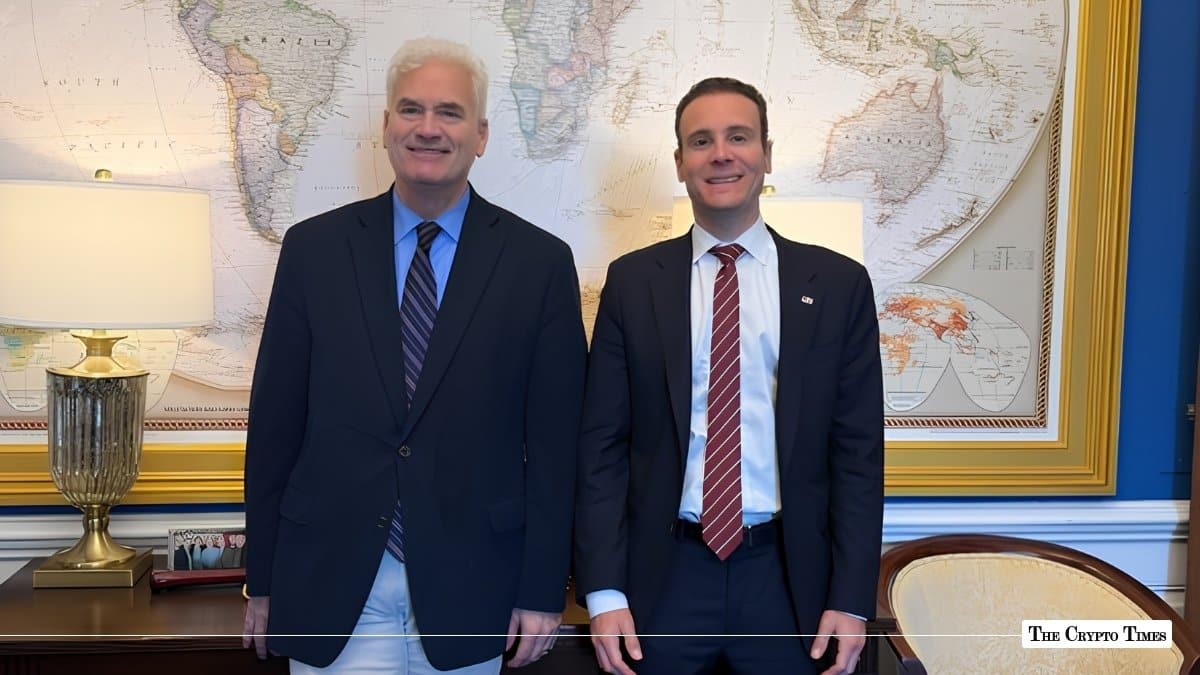
CFTC Chair Mike Selig met with House Majority Whip Tom Emmer on Capitol Hill as supporters of the CLARITY Act step up efforts to push the crypto market-structure bill toward final passage.
In a post on X, Selig said he was “hard at work” with Emmer to help get CLARITY “across the line.” He said the bill would deliver clearer rules, protect software developers and strengthen the United States’ position as a global crypto hub.
The meeting places one of Washington’s most pro-crypto House Republicans alongside the head of the CFTC, the agency expected to receive a much larger role under the legislation. The CFTC’s own public materials list Michael Selig as chairman, and the SEC has also described Selig and SEC Chair Paul Atkins as leading a joint push on crypto regulatory harmonization.
CLARITY Act Push Gains Fresh Momentum
The CLARITY Act, formally H.R. 3633, was introduced by House Financial Services Committee Chairman French Hill and House Agriculture Committee Chairman G.T. Thompson in May 2025 to establish a regulatory framework for digital assets in the United States.
The bill is designed to settle one of crypto’s biggest regulatory fights: when a digital asset should fall under the SEC as a security and when it should be treated as a digital commodity under the CFTC. Senate version seeks to clarify jurisdiction, set rules for stablecoin rewards, impose anti-money-laundering obligations on digital commodity platforms, define DeFi treatment and keep tokenized securities under securities-law protections.
Emmer has been closely tied to the developer-protection side of the bill. His office said elements of the Blockchain Regulatory Certainty Act were included in CLARITY and would clarify that non-custodial digital asset developers and service providers are not money transmitters.
Senate Remains the Main Hurdle
The renewed Capitol Hill push comes after the Senate Banking Committee advanced its version of the Digital Asset Market Clarity Act on May 14, 2026. That version still needs to be reconciled with the Senate Agriculture Committee’s digital commodity legislation before the full Senate can take it up, and any final Senate package would then need to be reconciled with the House version.
Stablecoin rewards remain one of the most difficult issues. The upcoming crypto bill would ban rewards on idle stablecoin balances that resemble bank deposits, while allowing rewards tied to transaction activity. Banks have argued that looser rules could pull deposits away from the regulated banking system, while crypto firms say broad restrictions would hurt competition.
Treasury Secretary Scott Bessent has also urged Congress to pass the CLARITY Act, arguing that unclear U.S. rules have pushed crypto development and investment toward jurisdictions such as Abu Dhabi and Singapore.
Senate Vote Math Becomes the Next Test
The meeting also follows comments from Sen. Cynthia Lummis, who said the CLARITY Act can still reach the Senate’s 60-vote threshold despite pressure from the banking lobby.
Lummis said the challenge is to convince lawmakers who are concerned that community banks could lose deposits to crypto products. She argued that stablecoins and bank deposits can coexist, and that community banks may eventually benefit from digital asset services.
For crypto firms, the bill could decide how exchanges, DeFi platforms, token issuers, stablecoin businesses and non-custodial software developers operate in the U.S. For lawmakers, it is now a political test of whether Congress can turn years of crypto hearings and draft bills into a final regulatory framework.
Also Read: Rep. French Hill Defends CLARITY Act Amid Banking Industry Concerns