Key Highlights
- Jensen Huang’s endorsement on the All-In Podcast, likening Bittensor to a “modern version of Folding@home,” ignited the rally after Chamath Palihapitiya showcased the successful decentralized training of the 72-billion-parameter Covenant-72B model.
- Bittensor achieved the largest permissionless LLM pre-training run to date with Covenant-72B on Subnet 3 (Templar). Over 70 independent contributors used everyday GPUs and home internet to process 1.1 trillion tokens — proving high-performance AI can be built without centralized data centers.
- With its first halving in December 2025 slashing emissions, ~75% of TAO supply staked, and over 128 active subnets (including top ones valued near $550 million collectively), the network is seeing rising real usage and built-in demand for TAO as the gateway to its AI economy.
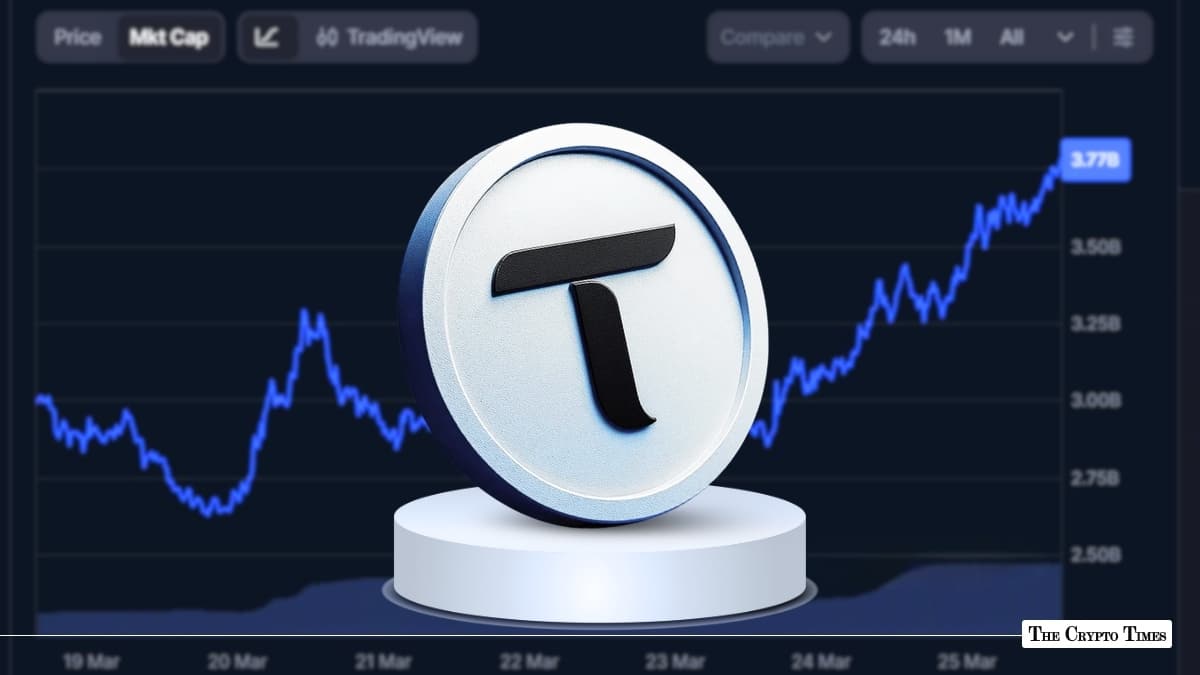
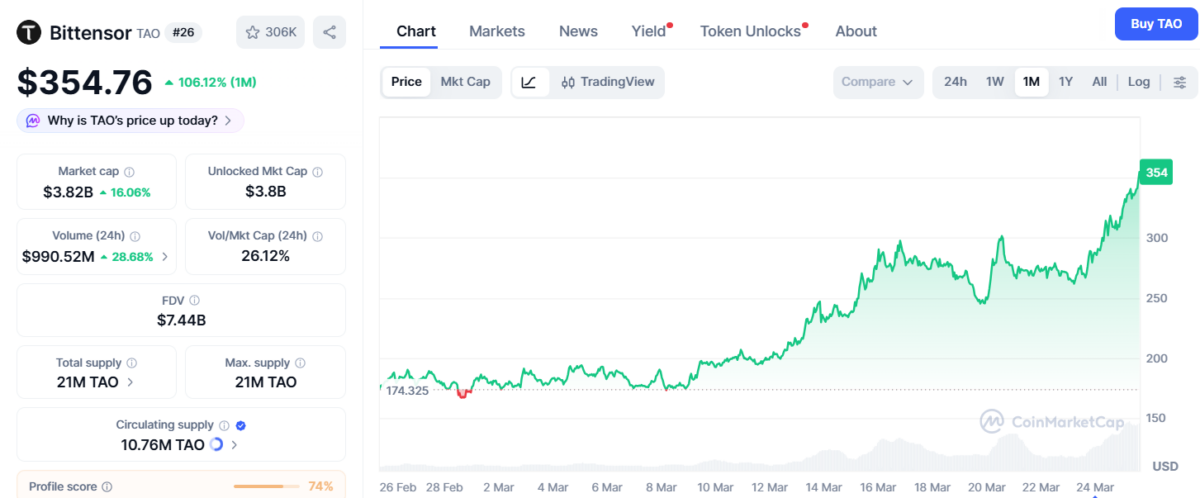
Bittensor’s TAO token has exploded higher in recent weeks, climbing more than 100% over the past month and roughly 26% in the last seven days as of late March 2026.
The decentralized AI network’s native token briefly pushed above $350, currently trading at $352.7—as per CoinMarketCap data—with daily volumes exceeding $900 million, vaulting it as the 26th largest cryptocurrency by market cap.
The immediate and the continued spark in TAO price comes from an unexpected mainstream spotlight. On a recent episode of the All-In Podcast, NVIDIA CEO Jensen Huang responded to Chamath Palihapitiya’s description of Bittensor’s latest breakthrough by calling the project “a modern version of Folding@home.”
Palihapitiya had highlighted the successful training of Covenant-72B, a 72-billion-parameter language model completed permissionlessly on Subnet 3 (Templar). More than 70 independent contributors, using ordinary home internet connections and spare GPUs, pre-trained the model on 1.1 trillion tokens without any centralized data center. Huang’s casual endorsement sent shockwaves through crypto markets, triggering a sharp rally as traders piled in.
What is Bittensor and how exactly does it work?
Bittensor is an open-source, decentralized blockchain protocol that creates a global peer-to-peer (P2P) marketplace for artificial intelligence. Built on its Subtensor network, it allows machine learning models to collaborate, compete, and improve through a system of incentives powered by its native token, TAO.
Participants act as miners—who provide AI computations, data, or model outputs—and validators, who score the quality of contributions using a unique mechanism called Yuma Consensus. The best performers earn newly minted TAO based on the real value they deliver to the collective intelligence.
Within its ecosystem, specialized “subnets” function as independent incentive marketplaces, each focused on a distinct AI task such as inference, data processing, or large-scale model training. Buying or staking into these subnets requires TAO, generating built-in demand for the base token.
With a fixed supply of 21 million TAO and periodic halvings, the network rewards useful intelligence rather than raw computing power, aiming to democratize AI development beyond the control of big tech.
Bittensor’s leap in decentralized LLM training models
Behind the price action lies genuine technical progress. Covenant-72B stands as the largest decentralized LLM pre-training run ever recorded, with performance metrics that rival closed-source efforts.
The broader Bittensor network now hosts around 128 active subnets—as per TaoApp explorer data—focused on everything from inference and data to confidential computation. Top subnets on the network have collectively reached valuations near $1.84 billion, and buying or staking into them requires TAO, creating built-in demand.
The project’s first halving in December 2025 cut daily emissions in half, tightening supply at a moment when real usage is accelerating.
Beside, signals from institutions have also added fuel as Grayscale’s Bittensor Trust gained fresh visibility, while a staked TAO product listed in Europe opened new doors for traditional capital. With roughly three-quarters of the supply already staked, sellers are scarce as network activity grows.
This combination of celebrity validation, tangible AI delivery, and improving tokenomics has shifted Bittensor from a niche experiment to one of the most watched stories at the intersection of blockchain and artificial intelligence. Whether this marks the start of sustained adoption or another crypto hype cycle will depend on execution in the months ahead.
Also read: LiteLLM Supply Chain Attack Steals 300GB Data and 500K Credentials