Key Highlights
- tZERO has responded publicly to Securitize’s patent infringement defense.
- The company argues that intellectual property protections are critical for institutional adoption of tokenized assets.
- Securitize recently filed a lawsuit seeking a declaratory judgment that it does not infringe tZERO patents.
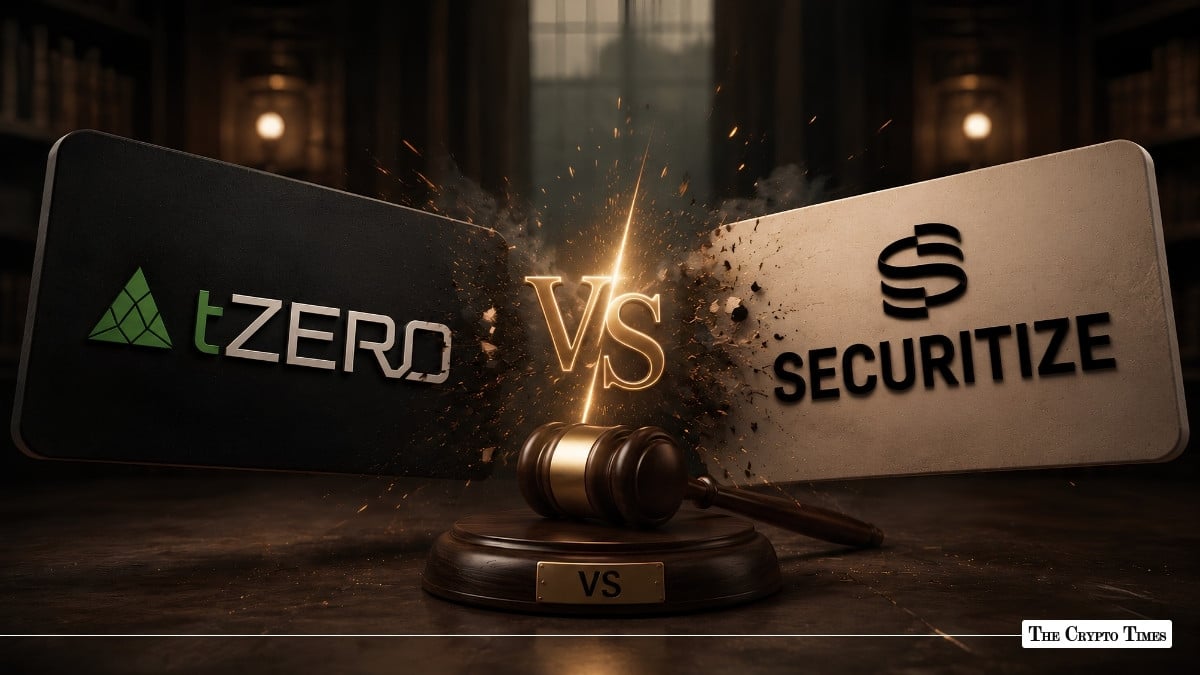
The legal battle between digital securities firms tZERO and Securitize has intensified, with tZERO publicly defending its intellectual property claims and rejecting Securitize’s criticism of patent enforcement efforts.
In a detailed post on X on Tuesday, tZERO pushed back against Securitize’s characterization of the dispute, arguing that patent protections remain a fundamental part of building a tokenization industry capable of attracting institutional capital.
tZERO rejects Securitize’s “fair play” argument
The latest exchange follows Securitize’s announcement that it had filed a complaint in the U.S. District Court for the District of Delaware seeking a declaratory judgment that it does not infringe any tZERO patents. At the time, the firm described tZERO’s infringement allegations as meritless and said the claims ran counter to the “spirit of fair play” within the blockchain industry.
“Securitize’s ‘spirit of fair play’ framing seems to argue that intellectual property rights do not apply to tokenization — the old open-source ethos conveniently dressed up in PR language,” tZERO wrote.
The company added that institutional investors and major financial firms expect intellectual property protections to be respected just as they are across traditional financial markets.
Patent enforcement at the center of the dispute
The disagreement stems from tZERO’s ongoing review and commercialization of its intellectual property portfolio.
On June 15, tZERO disclosed that it had identified what it believes to be potential patent infringement involving Securitize and several other companies operating in tokenized assets and digital securities markets.
The company subsequently sent a cease-and-desist letter to Securitize, alleging that products including the DS Protocol and Vault Registrar infringe patents related to security token compliance and crypto integration infrastructure.
The allegations are part of a broader intellectual property enforcement initiative first outlined by tZERO in April, when the company revealed it was reviewing its portfolio of 105 patents across 23 patent families.
tZERO has also stated that it is investigating at least six additional market participants involved in sectors such as tokenized real-world assets (RWAs), digital securities platforms, decentralized exchanges, liquidity aggregation, and crypto infrastructure.
Institutional adoption requires legal certainty
In its latest statement, tZERO argued that respect for intellectual property is a necessary component of a mature financial market. “Institutional capital does not flow into legal vacuums,” the company said.
According to tZERO, the same financial institutions now exploring blockchain-based capital markets have historically built their businesses around intellectual property protections and legal certainty.
The company further argued that tokenization platforms cannot simultaneously seek mainstream legitimacy and investment while dismissing patent enforcement as unfair or unnecessary.
Securitize maintains its position
Securitize has maintained that tZERO’s allegations lack merit. The company recently stated that it would vigorously defend itself against the claims and emphasized that its products do not incorporate key components covered by the patents in question.
The company also argued that innovation and product development, not litigation, remain the primary drivers of growth in tokenized finance. It said it looks forward to presenting its case in court while continuing to expand its tokenization platform.
Tokenization industry faces legal test
The dispute comes as tokenized assets attract increasing attention from banks, asset managers, and financial institutions worldwide.
Both tZERO and Securitize have emerged as prominent players in the digital securities sector, helping bring traditional financial assets onto blockchain infrastructure.
As institutional adoption grows, the outcome of the case could have broader implications for how intellectual property rights are interpreted and enforced across the tokenization industry.
For now, both firms appear prepared for a prolonged legal battle, with tZERO reiterating that its patents represent years of pioneering work in regulated digital securities.
Also read: Hut 8 to Pay $2.35M in Investor Lawsuit Over USBTC Merger Claims