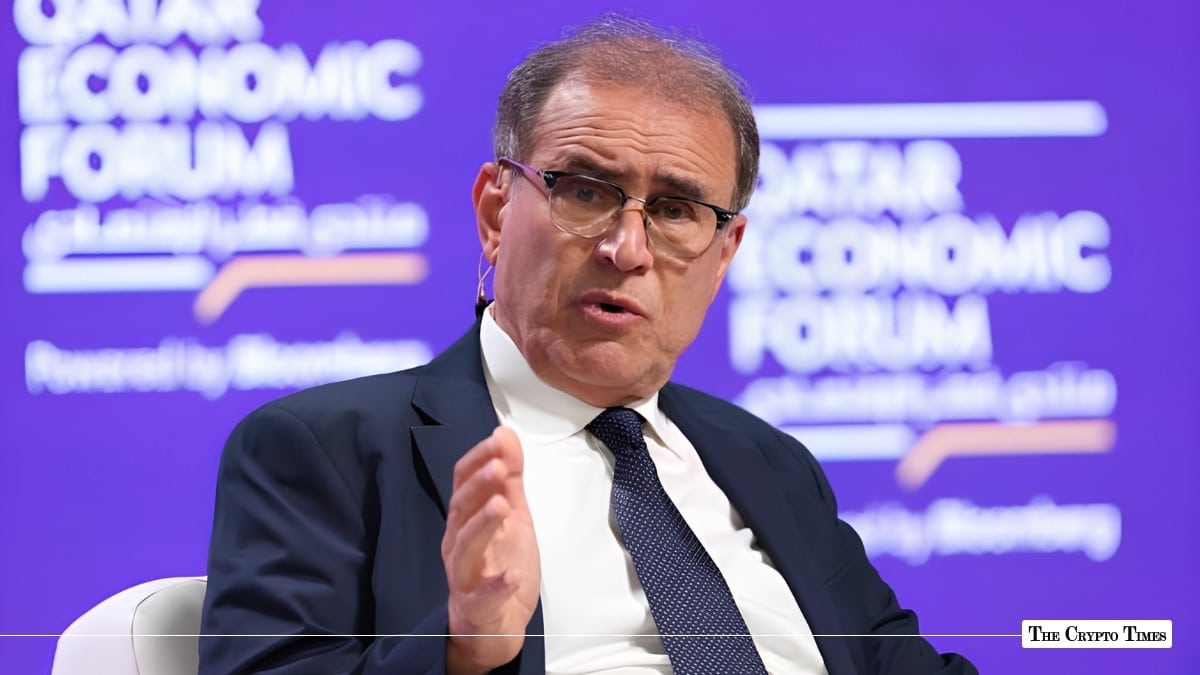
Economist and longtime Bitcoin critic Nouriel Roubini is bringing one of his investment products onto the blockchain through the launch of USAFi, a token backed by the Atlas America Fund, a Nasdaq-listed exchange-traded fund he oversees.
According to a Bloomberg report, the move, announced on Tuesday, places Roubini among a growing group of traditional finance figures embracing tokenization, the process of representing real-world financial assets on blockchain networks, despite his continued criticism of cryptocurrencies such as Bitcoin.
USAFi brings traditional assets on-chain
According to the report, USAFi will be backed by the Atlas America Fund (NASDAQ: USAF), a roughly $17 million ETF that invests across a mix of U.S. Treasuries, gold, and real estate investment trusts (REITs).
The token is designed primarily for investors outside the United States and will operate under the supervision of Dubai’s Virtual Assets Regulatory Authority (VARA). Tokenization infrastructure will be provided by Securitize, a platform backed by BlackRock that specializes in bringing traditional financial assets onto blockchain networks.
The launch will allow eligible investors to gain exposure to the underlying fund through a blockchain-based representation of the asset rather than through conventional brokerage channels.
Why the move matters
The launch highlights how tokenization is increasingly being adopted by traditional financial institutions as they explore new ways to distribute and settle investment products. While debates over cryptocurrencies continue, interest in blockchain-based versions of traditional assets has accelerated across the financial sector.
Industry participants argue that tokenized assets can improve accessibility, streamline transfers, and broaden investor participation in markets that have historically been limited by geographic or operational barriers.
Roubini remains critical of Bitcoin
Roubini has been one of the most vocal critics of cryptocurrencies for years, frequently arguing that Bitcoin lacks the characteristics required of both a currency and a reliable store of value. Speaking about the new initiative, Roubini maintained the distinction between cryptocurrencies and blockchain infrastructure.
He argued that while Bitcoin and many digital assets remain speculative and unsuitable as money, blockchain technology itself can be used to support financial products backed by traditional assets with established value. The economist has previously advocated for asset-backed alternatives that combine blockchain efficiency with exposure to conventional financial instruments.
Part of a larger tokenization trend
The USAFi launch comes as major financial institutions continue expanding their tokenization efforts. Asset managers, banks, and infrastructure providers have increasingly explored blockchain-based versions of money market funds, Treasury products, and other real-world assets.
Recent industry data shows the tokenized real-world asset market has grown significantly over the past year, with firms such as BlackRock and JPMorgan expanding their blockchain initiatives.
Traditional finance continues expanding tokenization efforts
Institutional interest in tokenized assets has continued to grow beyond asset managers and crypto-native firms. In May, crypto liquidity and capital markets firm GSR announced a strategic investment from Standard Chartered’s investment arm, SC Ventures.
The partnership is focused on expanding access to tokenization and developing compliant digital asset market infrastructure for institutional participants. Both firms said the collaboration aims to accelerate the convergence of traditional finance and digital asset markets, reflecting a broader industry push to bring conventional financial products onto blockchain networks.
The deal adds to a growing list of initiatives from banks, asset managers, and fintech firms seeking to build infrastructure around tokenized assets, a trend that also underpins the launch of Roubini’s USAFi token.
For Roubini, the launch represents a notable shift in approach. While he remains skeptical of cryptocurrencies themselves, USAFi signals that he sees a role for blockchain technology in delivering traditional investment products to a broader global investor base.
Also Read: EU Parliament Committee Backs Digital Euro Bill After Key Vote Approval