Key Highlights
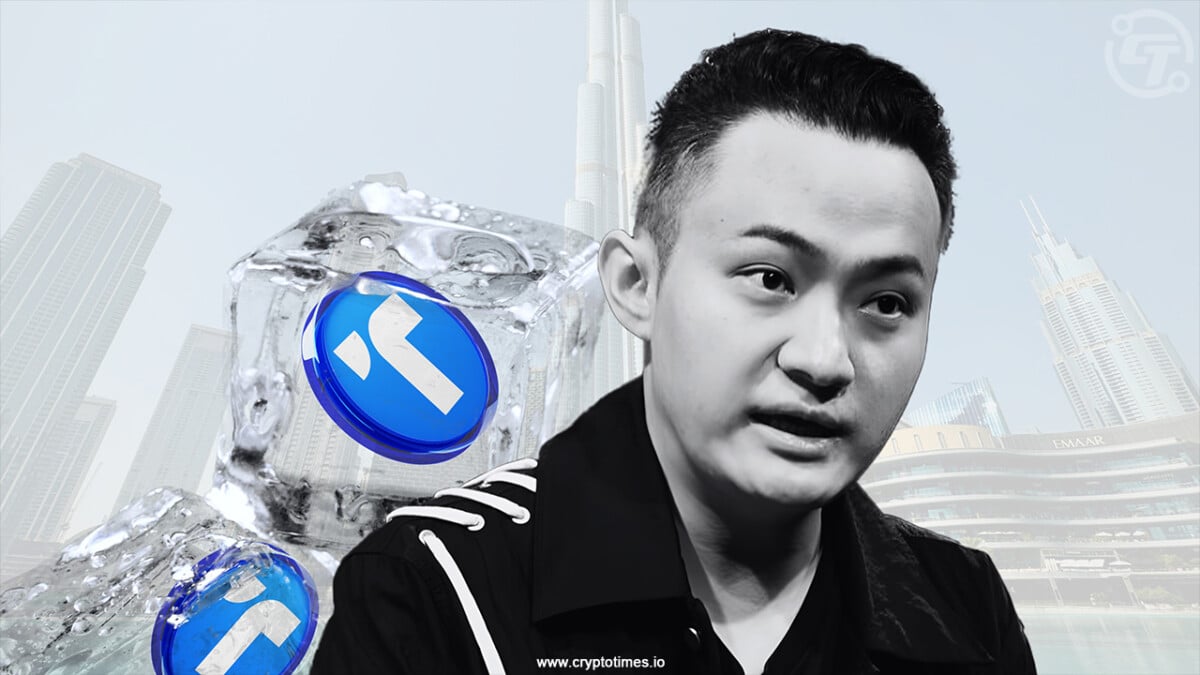
- Dubai’s Digital Economy Court froze $456M tied to TRON Founder Justin Sun’s bailout of TrueUSD issuer Techteryx.
- Techteryx says funds meant for TrueUSD reserves were diverted into private ventures by Aria Commodities.
- Justice Michael Black KC found “serious issues to be tried” and ordered a global freeze to prevent asset moves.
Dubai’s Digital Economy Court has ordered a worldwide freeze on $456 million linked to a bailout of the TrueUSD stablecoin, marking the court’s first global freezing order. The case centers on claims that money meant to back TrueUSD’s reserves was siphoned into private investments instead of being kept liquid.
The frozen funds trace back to a reserve shortfall that forced crypto entrepreneur Justin Sun to step in earlier this year to protect holders of TrueUSD, or TUSD.
Sun, best known as the Founder of the TRON blockchain and an investor behind several stablecoin ventures, personally intervened when Techteryx Ltd., TrueUSD’s issuer, could not redeem tokens for cash.
According to court documents, Techteryx says the missing reserves, totaling $456 million, were transferred in 2021 and 2022 through First Digital Trust Limited and Legacy Trust, both run by Hong Kong financier Vincent Chok, into accounts of Aria Commodities DMCC, a Dubai-based firm controlled by Matthew William Brittain.
Funds used for illiquid ventures, not cash reserves
Techteryx alleges the money was funneled into commodity trading, mining projects, and other long-term ventures through Aria’s network of companies, instead of being held in liquid form as promised.
The company argues this breached its custody agreements and left TrueUSD unable to meet redemptions when market demand spiked.
Brittain, who runs both Aria DMCC and Aria Fund, has maintained that the transfers were legitimate loans and investments initiated by First Digital Trust.
“ARIA CFF has never held [its] strategy out as highly liquid, or appropriate for the reserves of a stablecoin,” Brittain said earlier.
Justice Black’s findings: “Serious issues to be tried”
In a ruling dated October 17, 2025, Justice Michael Black KC said Techteryx had shown “serious issues to be tried” and that there was compelling evidence of a breach of trust.
Black found that Aria had offered “no evidence” explaining how the money was transferred or what assets were bought. He added that there was a “real risk” that Brittain could dissipate or restructure assets “to frustrate the enforcement of any judgment.”
The court’s order freezes the disputed funds worldwide and prevents them from being moved, sold, or hidden until a final decision is reached by the Hong Kong courts, where a parallel case is underway.
The Hong Kong proceedings
Techteryx filed its Hong Kong lawsuit on December 19, 2023, against First Digital Trust, Finaport Pte Ltd, Aria Fund, and Aria DMCC.
The company accuses them of acting as constructive trustees and engaging in a fraudulent conspiracy that redirected reserve funds into unrelated ventures.
Brittain has claimed that First Digital Trust’s Vincent Chok personally ordered the transfers, while Chok has denied doing so.
Techteryx says Aria’s explanations, including a supposed “Porting” exercise used to justify repayments in assets were invented after the fact.
Justice Black agreed that documentation from Aria showed “anomalies” and that the company had been unable to demonstrate how the funds were used. Aria has attributed this to “the lapse of time.”
Dubai’s first worldwide freezing order
The ruling marks the first time Dubai’s Digital Economy Court has imposed a worldwide freezing order. Justice Black noted that Dubai’s Supreme Court holds the power to freeze assets tied to anticipated foreign judgments, explaining that doing so preserves the enforcement process once those judgments are registered under the Foreign Judgments Act.
He also affirmed that the Dubai International Financial Centre (DIFC) Courts have authority to recognize and enforce foreign rulings in such cases.
Techteryx’s position: Protecting investors
Techteryx argued that the order was necessary to ensure wrongdoers could not move assets out of reach before restitution.
The company told the court there was “no reason why the English court should not intervene when a company or its members act in a manner prejudicial to its creditors and in bad faith.”
Justice Black agreed the freeze was justified to protect investors and maintain the integrity of the enforcement process.
Justin Sun responds
After the ruling, Justin Sun posted on X, writing, “Thank you to Dubai’s Digital Economy Court for their ruling, marking their first worldwide freezing order to protect the holders of #TUSD. #Justice may be delayed, but it will never be denied.”
Sun’s intervention earlier this year helped TrueUSD avoid collapse after questions over its reserves triggered market uncertainty.
A warning for the stablecoin industry
The case has quickly become one of the most closely watched disputes in the digital asset space. For many in the industry, it exposes how fragile stablecoin systems can become when reserve funds are mixed with risky or opaque investments. It also underscores how thin the line can be between holding assets in trust and using them as private capital.
For now, the $456 million in question will stay frozen under the court’s order until the Hong Kong proceedings reach a conclusion — a process that lawyers say could take well into next year, or even longer.
Whatever the final judgment, Dubai’s ruling has sent a strong signal through the global crypto industry: courts are increasingly willing to step in when digital assets stray beyond the boundaries of transparency and trust.
Also Read: Argentina Judge Freezes Assets in $LIBRA Crypto Probe