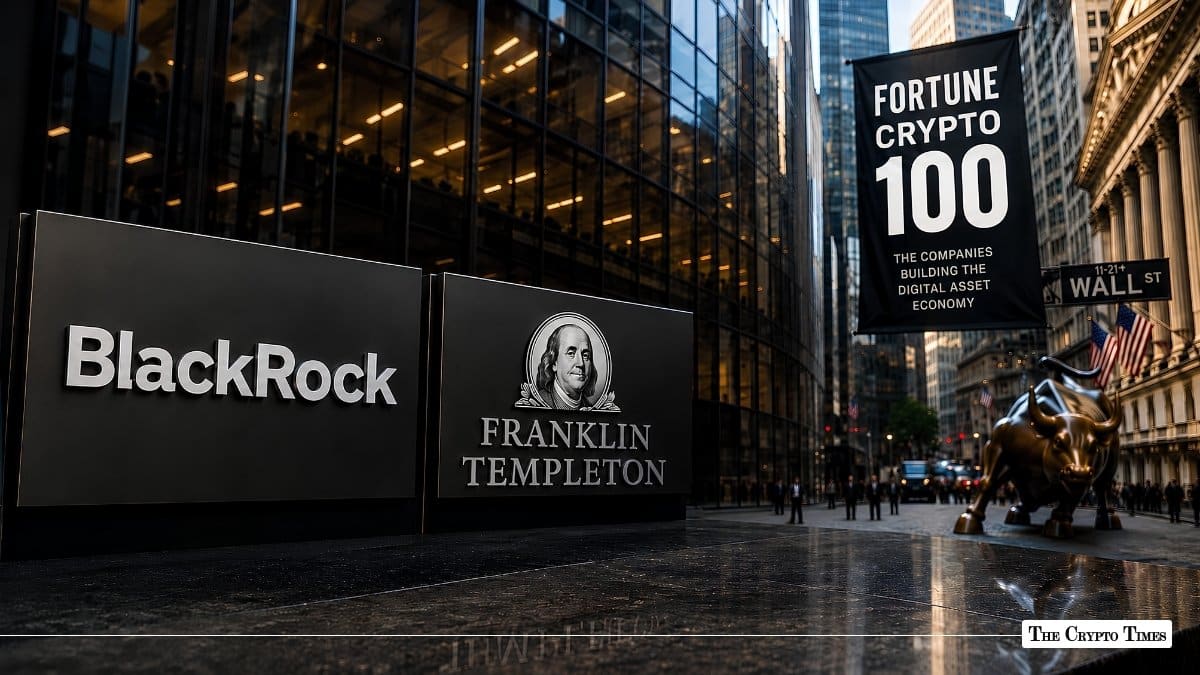
Traditional finance has planted its flag firmly in crypto’s establishment, with Wall Street heavyweights dominating large stretches of Fortune’s first-ever Crypto 100, the ranking published Thursday.
The list, an expansion of the 2023 Crypto 40, ranks 100 companies and protocols across 10 categories of 10 each, compiled using data analysis from Inca Digital alongside a survey of crypto experts. Fortune frames its arrival as a “suit-and-tie era” of crypto, and the rankings bear that out: names like BlackRock, JPMorgan, and Goldman Sachs now sit beside the industry’s crypto-native pioneers.
The 10 category leaders are Coinbase (CeFi), Franklin Templeton (TradFi), Robinhood (Fintech), Hyperliquid (DeFi), Andreessen Horowitz (VCs), Tether (Stablecoins), Chainalysis (Crypto Services), BlackRock (DATs & ETFs), MARA Holdings (Mining), and Bitcoin (Blockchains & Protocols).
Wall Street Takes the Top Seats
The clearest signal of crypto’s institutional turn is the TradFi category, a near-complete roster of Wall Street: Franklin Templeton leads, followed by JPMorgan Chase, Nasdaq, Goldman Sachs, Intercontinental Exchange, Morgan Stanley, Standard Chartered, CME Group, BNY, and Citigroup. The world’s largest financial institutions are no longer crypto skeptics on this list; they are ranked participants.
The pattern repeats in the new DATs & ETFs category, where BlackRock—whose Bitcoin ETF has reshaped institutional access—ranks first, ahead of Michael Saylor’s Strategy at second, with Grayscale, BitMine, and Fidelity rounding out the top five. The Fintech category is similarly stacked with mainstream names: Robinhood leads, followed by Stripe, Visa, PayPal, and Mastercard.
The Crypto Natives Still Hold Their Ground
The pioneers have not been displaced. Coinbase tops CeFi ahead of Binance and Kraken; Bitcoin leads Blockchains & Protocols; and Andreessen Horowitz heads the venture category over Paradigm and Dragonfly. Tether leads stablecoins ahead of Circle, and Chainalysis tops Crypto Services. The result is a list that reads as a merger rather than a takeover—Wall Street institutions and crypto-native firms occupying the same rankings, often within the same categories.
Hyperliquid Dethrones DeFi’s Old Guard
The most striking single result sits in DeFi, where Hyperliquid ranks first — ahead of Aave, Lido, and Uniswap. The placement marks a sharp changing of the guard: Uniswap Labs topped the DeFi category in the 2023 Crypto 40 but slipped to fourth this time, as the on-chain perpetuals venue Hyperliquid claimed the top spot. Eigen, PancakeSwap, Morpho, Meteora, Kamino, and Raydium fill out the category, a lineup weighted toward newer protocols.
What Changed Since 2023
The category structure itself tells the story of where crypto has moved. Fortune dropped the NFTs category entirely—it featured OpenSea and Yuga Labs in 2023 — and added Stablecoins, DATs & ETFs, Mining, and a Fintech category split out from TradFi. The Blockchains & Protocols category now runs Bitcoin, Ethereum, Solana, Chainlink, and Polygon at the top, with XRP at sixth and the privacy coin Zcash claiming the tenth spot. In stablecoins, the Trump-linked World Liberty Financial ranks eighth, a sign of how politically entangled the sector has become.
A Suit-and-Tie Era
Taken together, the rankings capture an industry that has matured into the mainstream financial system rather than around it. Fortune Crypto editor Jeff John Roberts framed the list as recognition of those who turned Bitcoin’s original vision into a global industry, arriving at a moment when banks and asset managers are increasingly central to it.
Whether that institutional embrace reads as crypto’s vindication or its capture depends on the observer—but the Crypto 100 leaves little doubt that the suits have arrived and that they now share the industry’s marquee list with the pioneers who built it.
Also Read: Vitalik’s New DeFi Idea: No Loans, No Liquidations, Just Options