
The technology behind blockchain might seem banal to the uninitiated. Something that is no different than a traditional database application. However, the concept of data storing and security in blockchain is a much more complex subject and goes beyond a simpler understanding of cryptocurrencies and their workings. The working of blockchain consists of a combination of cryptographic algorithms, consensus mechanisms, the scope of utility, and Hashrate.
Hashrate, a core element in the blockchain mining process, holds immense importance for blockchain networks which depend upon proof-of-work consensus. In this article, we will take a deep dive into the world of Hashrate and its immense significance in the working of Blockchain technology.
What is Hashrate?
Hashrate is a measurement unit of computational power in the proof-of-work (PoW) blockchain network. It describes how many cryptographic ‘hashes’ are generated in a timeframe of one second. This sum of Hashrate could be measured for a particular hardware device (specifically used for cryptocurrency mining), a group of combined mining hardware devices, or a whole blockchain network.
In the sector of blockchain and cryptocurrency mining, a hash is an alphanumeric value that is the output of a cryptographic hash algorithm. Once a hash is generated, it is nearly impossible to break it. In the creation of a new block in the PoW blockchain, a random hash is generated by the system. To propose a valid block and broadcast it to the blockchain, a miner needs to guess that particular hash. This process of finding the exact hash is known as ‘hashing’ and it requires higher than normal computational power. Here, the Hashrate refers to the number of hashes that miners can guess using their computational power.
Hashrate is generally represented in per second ratio. For instance, 1 GH/s or one giga hash per second – which describes the processing of one billion hash in one second. An average GPU (graphics processing unit) could generate over 1 MH/s or one million hash per second.
The table below best describes all the variations of Hashrate and what capabilities it requires to generate the specific amount of hashes.
| Abbreviation | Hashrate Per Seconds | Power Generation |
| Hash (H/s) | One | Any processor |
| Kilo Hash (KH/s) | One Thousand | General processor |
| Mega Hash (MH/s) | One Million | Single GPU |
| Giga Hash (GH/s) | One Billion | Cluster of GPUs or a mining rig |
| Tera Hash (TH/s) | One Trillion | ASIC or a mining pool |
| Peta Hash (PH/s) | One Quadrillion | A large mining pool |
| Exa Hash (EH/s) | One Quintillion | Entire PoW blockchain network |
| Zetta Hash (ZH/s) | One Sextillion | Beyond current capabilities |
What is Bitcoin Hashrate?
Hashrate is an important metric for Bitcoin and its block-mining process. All the entities involved in Bitcoin mining, need to solve a complex mathematical puzzle to find a hash for an upcoming block. This method empowers competition between miners and it eventually increases the security of the Bitcoin network. The current Bitcoin hashrate is 655.73 EH/s – according to data from Coinwarz.
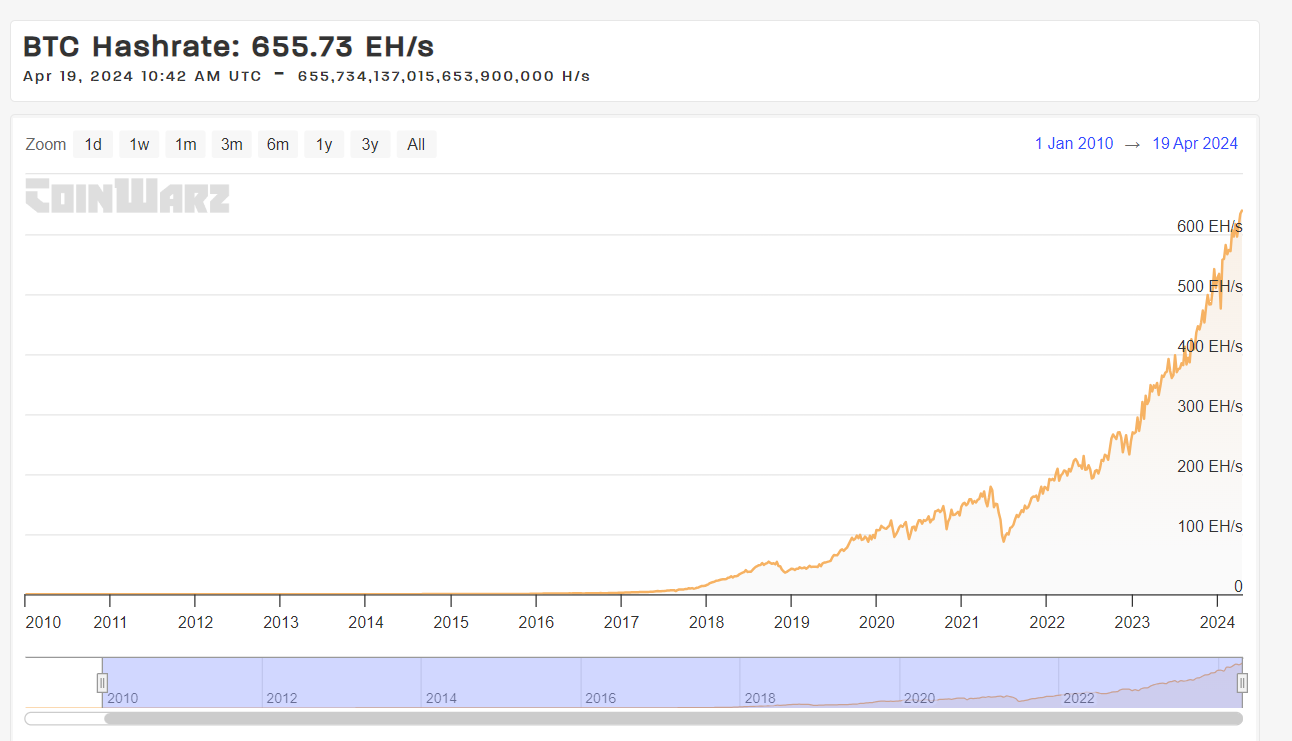
An increase in hash rate can lead to an adjustment in the mining difficulty of a blockchain. In some cases, blockchains may raise the difficulty of mining a block as the hash rate goes up. We have also seen that the Bitcoin hashrate has increased throughout the years alongside the increased number of miners.
Why Bitcoin Hashrate Is Important?
Hashrate is an important indicator of the security of a blockchain network. The more Hashrate a blockchain has, the more secure it is. For example; if a malicious entity wants to attack PoW blockchain networks like Bitcoin, they would need a 51% Attack and generate more than 50% Hashes of the total blockchain hashrate. Bitcoin currently has a Hashrate of nearly 627 EH/s which means that the attacker would require to generate 314 EH/s in order to manipulate past data and transactions. Generating such a high Hashrate is currently beyond capabilities as it would require computational resources costing billions of dollars.
Also read: Can Blockchain Be Hacked? How Secure Blockchain Are
Hashrate is also an important element for miners in the Proof-of-Work (PoW) blockchain network as they depend on mining difficulty to run their operations. The Hashrate of the blockchain helps in measuring how difficult it is to solve the mathematical puzzle and mine a block. There is a direct relationship between the blockchain network’s Hashrate and mining difficulty. The difficulty of mining a block usually increases when the Hash Rate increases and similarly, the mining difficulty decreases when Hashrate decreases.
Does Bitcoin Halving Affect Hashrate?
Halving is considered a bullish event for Bitcoin price but it also brings severe complications to the network. The 50% slashing in block rewards leads non-profitable miners towards catastrophic financial situations and often most of them leave during or after the halving. This mass deportation results in a sharp drop in Bitcoin hashrate while raising concerns about its security.
Bitcoin has seen a significant decline in hashrate within days after the occurrence of past halvings. After the first halving in 2012, Bitcoin hashrate dropped by over 13% and after the second halving of 2016, it dropped by 5%. However, the past halving of 2020 brought the highest decline of 15% in Bitcoin hashrate. While the hashrate has currently reached record highs alongside ever-increasing activity on the Bitcoin network, this fourth halving will probably affect the Bitcoin hashrate negatively as the block mining rewards will be merely 3.125 BTC. In addition to this, the mining profitability on Bitcoin has reached its lowest point – according to data from Bitinfocharts.
Conclusion
Hashrate is an important element in the blockchain network. It represents the overall security of a PoW blockchain as well as serves as a unit of traction. Hashrate does not much impact the day-to-day use of Bitcoin for an average user who just sends transactions but it holds much significance among miners. With the fourth halving, miners are stressed over their current state of unsustainability. The profitability of miners has continually decreased due to an increase in Bitcoin hashrate which now requires more computation power for finding a hash for a candidate block.
FAQs
Why is hashrate important in Bitcoin mining?
Hashrate makes blockchain networks secure. The more hashrate Bitcoin has, the more computational power it requires to mine a valid block.
Does halving affect Bitcoin hashrate?
Halving does not have any direct impact on Bitcoin hashrate. But after halving period has historically witnessed a sharp decrease in hashrate.
What is EH/s in Bitcoin?
EH/s is an abbreviation for Exa Hash per second, meaning that Bitcoin has a hashrate of that amount. For example, if the Bitcoin hashrate is 600 EH/s – the Bitcoin network possesses one quintillion ( a million trillion) hashes per second.