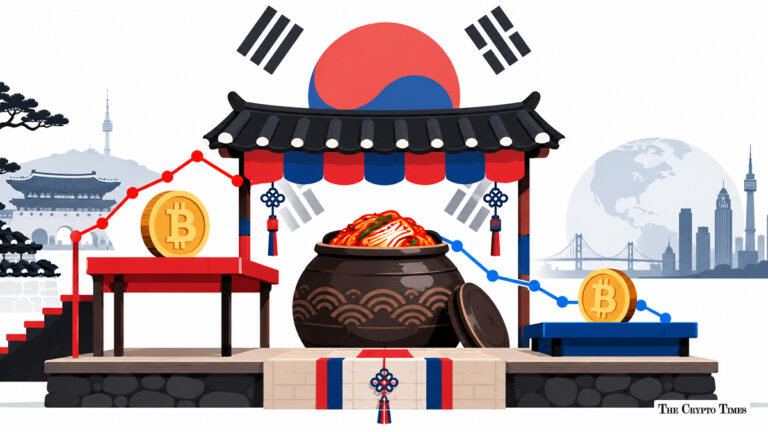
Bitcoin trades around the clock on exchanges worldwide, yet its price is not always identical across markets. In South Korea, where cryptocurrencies are commonly traded against the Korean won, the difference can be especially noticeable.
The country is best known for the Kimchi premium, a price gap that emerges when cryptocurrencies cost more on Korean exchanges than internationally. But the relationship can also reverse. When Bitcoin or another cryptocurrency trades below its comparable international price after currency conversion, the market is showing what is known as a reverse Kimchi premium.
The phenomenon became particularly visible in 2026. Bitcoin traded at a discount in South Korea for extended periods during the summer, while dollar-linked stablecoins such as Tether’s USDT also recorded negative premiums earlier in the year.
These discounts raise an important question: why would an asset available globally become cheaper in one of Asia’s established cryptocurrency markets? The answer involves more than investor sentiment. Exchange-rate movements, local trading activity, market liquidity, and restrictions on cross-border transactions can all affect the gap.
What is the reverse Kimchi premium?
The reverse Kimchi premium is a negative price difference between a cryptocurrency traded in South Korea and its comparable international price, after accounting for the Korean won’s exchange rate against the U.S. dollar. A negative reading means the asset is cheaper on the selected Korean exchanges than under the international benchmark used for comparison.
For example, if Bitcoin’s international price converts to ₩100 million but its Korean market price is ₩98 million, Bitcoin is trading at a 2% discount. The underlying calculation is the same whether the result is positive or negative. A positive value represents a Kimchi premium. A negative value represents a reverse Kimchi premium.
| Market condition | Example reading | Meaning |
|---|---|---|
| Positive premium | +3% | Crypto costs 3% more in Korea |
| No premium | 0% | Korean and global prices match |
| Reverse premium | −2% | Crypto costs 2% less in Korea |
The figure is a relative price measurement, not a direct estimate of how much money is entering or leaving South Korea.
For broader context, The Crypto Times has also covered Bitcoin’s Kimchi premium returning as Korean prices moved back above global levels in September 2026.
Key takeaways
- A reverse Kimchi premium means a local discount, not necessarily a cryptocurrency price decline. Bitcoin can rise in Korean won and still become cheaper relative to international markets.
- The discount can emerge from several factors: weaker relative local demand, selling pressure, foreign-exchange movements, and differences in market liquidity.
- Bitcoin and USDT discounts should be interpreted separately. For USDT, its global price relative to the dollar must also be considered.
- A negative premium does not guarantee an arbitrage profit. Market access, legal requirements, fees, and settlement risks can prevent traders from capturing the difference.
Why does the reverse Kimchi premium happen?
A negative Kimchi premium can develop when cryptocurrency prices in South Korea weaken relative to prices elsewhere. That does not necessarily mean the entire Korean market is selling aggressively. The gap can also widen when international prices rise faster or when the dollar strengthens against the won.
Four factors help explain these differences.
1. Weaker domestic demand relative to global markets
Cryptocurrency prices reflect the balance between buyers and sellers on individual exchanges. When purchasing activity in South Korea weakens relative to international markets, local prices may fail to keep pace with increases elsewhere.
Suppose Bitcoin rises 5% on major international exchanges but gains only 2% in Korean won terms, with the exchange rate unchanged. The international benchmark has advanced more quickly than the local price, and that relative movement can reduce an existing Kimchi premium or push it into negative territory.
Changes in investor preferences may contribute to such a divergence. During parts of 2026, South Korean investors showed increased interest in domestic equities while cryptocurrency trading activity weakened. An August 2026 report by The Block found that Upbit’s parent company, Dunamu, and Bithumb reported substantial year-on-year revenue declines in the first half of the year, alongside weaker domestic cryptocurrency trading volumes.
Such evidence is consistent with softer trading activity, although exchange revenue figures alone cannot establish the cause of any particular Bitcoin discount.
2. Selling pressure and differences in liquidity
A reverse premium can also emerge when sellers exert greater pressure on Korean order books than on international exchanges. Large sales can move prices more sharply where available buy-side liquidity is limited. The effect is especially important when comparing a domestic exchange with a substantially more liquid international market.
For example, a large market sell order on a Korean exchange may consume several available bid levels, lowering the local execution price while the global reference changes comparatively little. The resulting discount can be temporary or persistent, depending on subsequent trading activity.
Exchange-specific liquidity matters too. Bitcoin may trade at slightly different premiums on Upbit and Bithumb because their order books, participants, and trading conditions are not identical. A single-exchange reading should therefore not automatically be treated as representative of the entire Korean cryptocurrency market.
3. Changes in the USD/KRW exchange rate
Foreign-exchange movements can change the Kimchi premium even when Bitcoin’s local price is unchanged. The standard Bitcoin calculation converts its global U.S. dollar price into Korean won, so when the dollar strengthens against the won, the converted global Bitcoin price rises, assuming its dollar price is unchanged. Unless the Korean Bitcoin price rises by the same proportion, the measured premium declines.
Consider a hypothetical situation:
- Bitcoin trades at ₩96 million in South Korea.
- Its international price remains $70,000.
- The USD/KRW rate rises from 1,400 to 1,440.
At ₩1,400 per dollar, the international reference is ₩98 million, producing a discount of approximately 2.04%. At ₩1,440 per dollar, the international reference rises to ₩100.8 million, increasing the measured discount to approximately 4.76%. Bitcoin did not become cheaper in Korean won. The larger discount was caused entirely by the change in the currency-converted benchmark.
This distinction is supported by research from Dooyeon Cho and Kyung-woo Lee, published in the Southern Economic Journal. Their study of economic policy uncertainty and the Kimchi premium found that a stronger dollar against the won can more than offset increases in Korean Bitcoin prices, lowering the measured premium. It illustrates why the indicator cannot be interpreted without the foreign-exchange component.
4. Cross-border trading and regulatory frictions
In an integrated global market, traders could try to buy a cryptocurrency on the cheaper exchange and sell it on the more expensive one. That activity would tend to narrow the price difference. But South Korea’s cryptocurrency market operates within banking, foreign-exchange, and anti-money-laundering requirements that can complicate cross-border transactions.
The Financial Services Commission’s rules for virtual-asset service providers include real-name account requirements and obligations related to transfers of virtual assets. These rules affect who can access particular trading and banking services and how transactions are processed. Consequently, the ability to move assets internationally does not automatically mean that traders can move and settle the corresponding fiat currencies just as easily.
A reverse premium can therefore persist even when participants recognize the difference.
However, regulation does not make every arbitrage transaction illegal or impossible. The feasibility depends on the participant, accounts, transaction structure, and applicable rules.
When has South Korea experienced a reverse Kimchi premium?
Although the conventional Kimchi premium drew attention during cryptocurrency bull markets, negative readings have also appeared across different market cycles.
Bitcoin’s extended discount during summer 2026
In August 2026, South Korean financial media documented an unusually prolonged period in which Bitcoin traded below comparable international prices. According to Asia Economy’s August 11 report, citing market data, Bitcoin showed a reverse Kimchi premium for 35 consecutive days between June 20 and July 24, 2026.
The extended period was significant because the price difference remained negative rather than quickly returning to a premium. Later that summer, the gap narrowed and eventually moved back above zero. As The Crypto Times reported on September 1, 2026, Bitcoin’s premium had returned to around 1% after a prolonged period of discounts. The sequence shows that the relationship between Korean and international prices can change direction without a corresponding reversal in Bitcoin’s broader global trend.
USDT also traded at a discount in May 2026
The reverse Kimchi premium is not limited to Bitcoin. On May 25, 2026, Seoul Economic Daily reported that the USDT premium on Upbit was around −0.7% during an observed trading period, after having fallen as low as approximately −2% earlier in the month. The publication linked the weakening premium to subdued domestic cryptocurrency activity and competition for investor funds from South Korea’s equity market.
Those explanations were interpretations of the conditions at the time, not proof that any single factor caused the discount.
The USDT readings also differ from Bitcoin premium observations and should not be combined into a continuous series. Together, the examples show why the Kimchi premium needs to be examined separately by asset, date, venue, and methodology.
How to calculate the reverse Kimchi premium
The basic calculation compares the Korean cryptocurrency price with its international price converted into Korean won.
For Bitcoin:
Reverse Kimchi premium (%) = [(BTC/KRW ÷ (BTC/USD × USD/KRW)) − 1] × 100
Where:
- BTC/KRW is Bitcoin’s price in Korean won.
- BTC/USD is Bitcoin’s international spot price in U.S. dollars.
- USD/KRW is the number of Korean won per U.S. dollar.
Example: A 2.04% Bitcoin discount
Assume these hypothetical prices:
| Input | Value |
|---|---|
| Korean BTC price | ₩96,000,000 |
| Global BTC price | $70,000 |
| USD/KRW reference rate | ₩1,400 |
| Global BTC price converted into KRW | ₩98,000,000 |
| Reverse Kimchi premium | −2.04% |
First, convert the international Bitcoin price:
$70,000 × 1,400 = ₩98,000,000
Next, compare the Korean price against the converted benchmark:
[(96,000,000 ÷ 98,000,000) − 1] × 100 = −2.04%
The result means Bitcoin is approximately 2.04% cheaper on the selected Korean market than under the global reference price. All prices here are hypothetical and provided only to explain the calculation.
For reproducible results, analysts must use a consistent price source, synchronized observations, and a clearly identified foreign-exchange benchmark. The European Central Bank’s published exchange-rate references provide EUR/KRW and EUR/USD observations that can be used to derive USD/KRW:
USD/KRW = EUR/KRW ÷ EUR/USD
The ECB reference rates are generally published on European working days. They are not continuous live dealing prices, and their observation dates should be disclosed when used alongside cryptocurrency markets that trade on weekends.
For Korean cryptocurrency prices, Upbit’s public order-book documentation explains how to obtain bid and ask quotations and their available sizes. Using a consistent bid-ask midpoint can make a benchmark more comparable across venues, although it does not represent the execution price available for every trade.
Can USDT have a reverse Kimchi premium?
Yes. USDT can trade at a discount on South Korean exchanges relative to its international value converted into Korean won. But calculating the stablecoin discount requires an additional distinction.
USDT is designed to maintain a value close to one U.S. dollar, yet its international market price can deviate from $1. For that reason, a USDT reverse premium can be measured using either a raw or peg-adjusted formula.
Raw USDT premium
The raw premium compares the Korean USDT price directly with the USD/KRW reference rate.
Raw premium (%) = [(USDT/KRW ÷ USD/KRW) − 1] × 100
Peg-adjusted USDT premium
The peg-adjusted premium uses USDT’s actual international dollar market price.
Peg-adjusted premium (%) = [(USDT/KRW ÷ (USD/KRW × USDT/USD)) − 1] × 100
This adjustment matters because a global USDT discount should not be mistaken for a Korea-specific discount.
Example: Measuring a reverse USDT premium
Assume the following hypothetical values:
| Input | Value |
|---|---|
| Korean USDT price | ₩1,370 |
| USD/KRW reference | ₩1,400 |
| Global USDT price | $0.998 |
| Raw premium | −2.14% |
| Peg-adjusted premium | −1.95% |
The raw calculation is:
[(1,370 ÷ 1,400) − 1] × 100 = −2.14%
For the peg-adjusted calculation, first convert USDT’s global price into won:
1,400 × 0.998 = ₩1,397.20
Then:
[(1,370 ÷ 1,397.20) − 1] × 100 = −1.95%
The peg-adjusted discount is smaller because USDT itself trades below its intended dollar peg internationally.
An important consequence follows: a raw negative premium does not always mean the peg-adjusted premium is negative.
If USDT trades at ₩1,395 in Korea while USD/KRW is ₩1,400 and global USDT/USD is $0.99, the raw premium is approximately −0.36%. Yet the peg-adjusted premium is approximately +0.65%. Under that second benchmark, USDT is cheaper than one reference dollar but more expensive than its actual global market value. This is why a stablecoin index should clearly identify whether it publishes raw or peg-adjusted readings.
The Crypto Times explains this distinction further in its guide to reading and citing raw versus peg-adjusted stablecoin premiums.
What does a negative Kimchi premium tell investors?
A reverse Kimchi premium can provide information about regional pricing conditions, but it is not a standalone investment indicator. The most useful interpretation comes from examining it alongside other market data.
It can indicate weaker relative local demand
A persistent negative reading may suggest that Korean buying pressure is insufficient to keep local prices aligned with global markets. But the indicator cannot identify demand as the cause without supporting evidence from trading volumes, order-book depth, and other observations.
It can reflect international price strength
A negative premium can also emerge because Bitcoin rises faster internationally than in Korea. Under those conditions, the local price may still be increasing even as the discount deepens.
It can reveal market fragmentation
Price differences that persist across exchanges and trading sessions may indicate that cross-border arbitrage is not fully eliminating regional imbalances. The size of the gap, however, depends on how the data are collected.
It cannot reliably predict Bitcoin’s next move
A negative premium does not establish that Bitcoin is oversold, that a rebound is imminent or that the global market will decline. A return to a positive premium could result from stronger Korean buying, weaker global prices, exchange-rate changes, or multiple factors operating together. It would be misleading to attribute a subsequent Bitcoin rally or sell-off to the reverse premium without additional evidence.
Does the reverse Kimchi premium create an arbitrage opportunity?
In theory, a trader might seek to buy cryptocurrency on a Korean exchange where it is cheaper and sell it on an overseas exchange where the price is higher. That looks attractive when the headline discount is substantial. But the spread is not the same as net profit.
A trader may face trading fees, bid-ask spreads, blockchain withdrawal charges, transfer delays, banking restrictions, settlement costs, and foreign-exchange conversion expenses. There is also execution risk: the quoted price difference may change before the second transaction is completed.
For a large order, available liquidity can make the actual purchase or sale price materially different from the displayed midpoint. Account eligibility and legal compliance are additional considerations, especially for participants seeking to transfer fiat proceeds across borders.
A reverse premium should therefore be treated as a pricing observation, not an assurance that the difference can be captured by any particular investor.



How should readers track Korea’s Bitcoin and USDT discounts?
A useful premium index needs more than a displayed percentage. The measurement should identify the underlying cryptocurrency, the Korean exchanges included, the international benchmark, the exchange-rate source, and the time at which prices were observed.
For Bitcoin, readers should distinguish between local BTC/KRW prices and the international BTC/USD comparison.
For USDT, they should also check whether the displayed discount is raw or peg-adjusted.
The Crypto Times is developing separate Korea-focused indices to track these regional price relationships.
The planned Korea Bitcoin Premium Index, CTPI-BTC-SPOT-KRW, is intended to measure Bitcoin’s local premium or discount relative to an international dollar-denominated price.
The planned Korea USDT Premium Index, CTPI-USDT-SPOT-KRW, is intended to distinguish USDT’s raw premium from its peg-adjusted premium.
These are separate measurements and should not be treated as interchangeable.
The broader data project already includes The Crypto Times’ India Stablecoin Premium Indices, including dedicated USDT and USDC index pages. These published India series show why documenting the reference rate, observation window, underlying exchange prices, and methodology is necessary for interpreting regional cryptocurrency premiums.
Korea and India readings should not be directly compared without accounting for the assets, market structures, currency benchmarks, and calculation methods used.
The bottom line
The reverse Kimchi premium occurs when a cryptocurrency is cheaper in South Korea than its comparable international price after currency conversion. That discount can reflect subdued local trading demand, selling pressure, stronger overseas prices, or movements in the Korean won. It can also persist because the Korean cryptocurrency market is not seamlessly integrated with international banking and trading systems.
But a negative premium does not automatically mean investors are abandoning crypto, capital is leaving Korea, or Bitcoin is about to recover. The distinction is particularly important for dollar-linked stablecoins, where the token’s international price can affect whether the observed local discount remains negative after adjustment.
For a meaningful interpretation, readers need to know which asset is being measured, which exchanges are included, how the foreign-exchange benchmark is calculated, and whether the observation represents a comparable, timely market price. The reverse Kimchi premium is a measure of regional price differences—not a trading signal.
Frequently asked questions
1. Is a reverse Kimchi premium good or bad for Bitcoin?
Neither conclusion automatically follows. The indicator shows that Bitcoin is relatively cheaper in South Korea than internationally. It does not independently predict a future price increase or decrease.
2. What causes a negative Kimchi premium?
Potential contributors include weaker relative domestic demand, local selling pressure, stronger international prices, changes in USD/KRW, and differences in exchange liquidity. The cause of a particular reading requires additional evidence.
3. Can the reverse Kimchi premium happen during a bull market?
Yes. Bitcoin can appreciate globally and in Korean won while its Korean price rises more slowly. That relative difference can produce a negative premium even during a wider market rally.
4. Does a reverse Kimchi premium mean South Korean investors are selling Bitcoin?
Not necessarily. Selling can contribute, but the premium measures relative prices rather than net selling or capital flows. Changes in global prices and foreign-exchange rates can also produce a discount.
5. Can stablecoins such as USDT trade at a reverse Kimchi premium?
Yes. USDT can trade below its international converted market price on Korean exchanges. Analysts should distinguish between the raw premium, which assumes a $1 reference, and the peg-adjusted premium, which uses USDT’s observed international dollar price.
6. Is the reverse Kimchi premium the same as the reverse premium in foreign exchange?
No. The Kimchi premium is a cryptocurrency market-price differential. It is not an official foreign-exchange quotation, an offshore won exchange rate, or evidence of a parallel currency market.
7. How long can a reverse Kimchi premium last?
There is no fixed duration. The discount can disappear quickly or remain negative across multiple sessions. Its persistence depends on changing prices, liquidity, exchange rates, and the ability of market participants to arbitrage the gap.
Disclaimer: This article is for informational and educational purposes only. Cryptocurrency markets involve substantial risks. Regional price differences are not guaranteed arbitrage opportunities, official foreign-exchange rates, or investment recommendations.