In 2026, real-world asset (RWA) tokenization is no longer just a pitch from blockchain startups. The Depository Trust & Clearing Corporation (DTCC), which settles almost every stock and bond trade in the United States, has begun rolling out a tokenization service that could reshape how securities are recorded.
More than 50 firms are involved, including BlackRock, Goldman Sachs, JPMorgan, Morgan Stanley, Nasdaq, NYSE Group, Citadel Securities, and Robinhood. Limited production trades were set to begin in July 2026, with a broader launch planned for October.
The promise sounds simple. Finance could become faster, cheaper, and more open. The reality is more complicated. A token is not always the asset itself, regulation is still catching up, and the legal claim behind each product matters more than the technology used to issue it.
So what exactly are investors buying when they buy a tokenized asset? And why are the biggest names in finance suddenly paying attention?
Here’s what it actually means, how it works, what could go wrong, and where it’s headed next.
What Is Real-World Asset Tokenization?
Real-world asset tokenization is the process of converting the legal and economic rights to an off-chain asset, a US Treasury bond, a piece of commercial real estate, a corporate loan, a bar of gold, into a digital token that lives on a blockchain.
The token itself isn’t the asset. It’s a digital representation of a claim on that asset.
It works a little like how a share certificate represents a claim on a company’s equity, or how a demat account entry represents your ownership of stocks in India. The blockchain doesn’t change what the asset is. It changes how ownership of that asset is recorded, transferred, and settled.
Here’s a familiar comparison. An Indian fixed deposit pays you interest, and your bank’s ledger records that you own it. A tokenized US Treasury fund does something similar — it pays yield, except instead of a bank ledger, a blockchain records who owns what.
The underlying economics are ordinary. What’s new is the settlement layer sitting underneath.
How Tokenization Actually Works
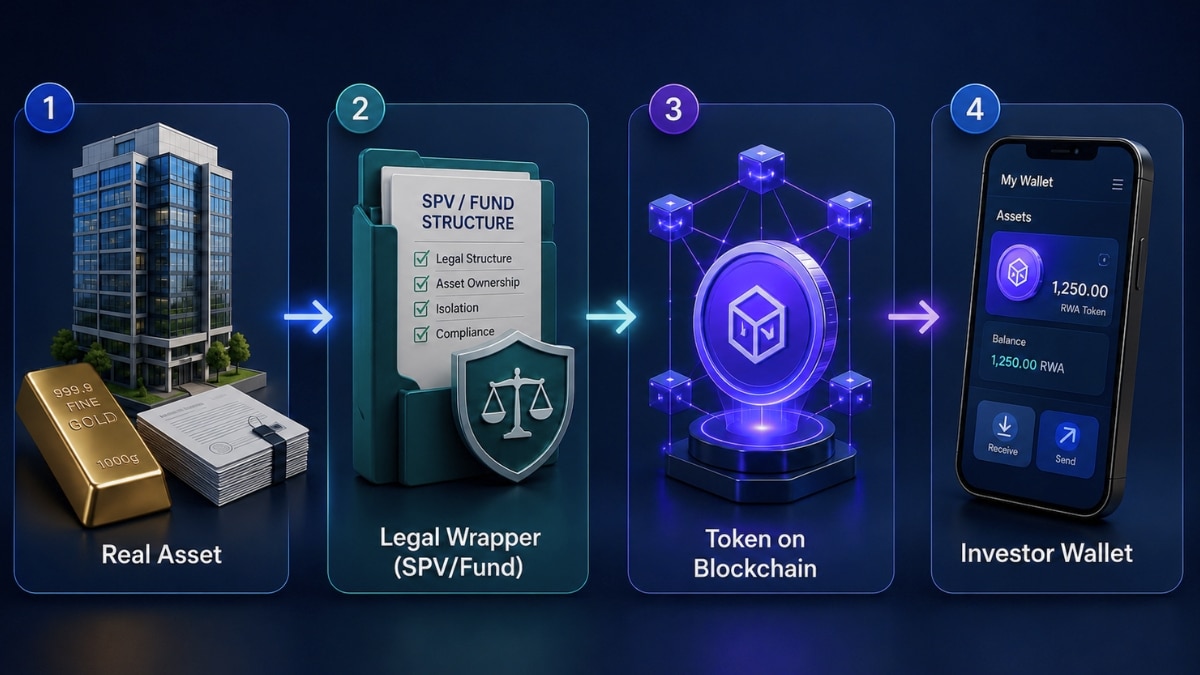
Despite the futuristic branding, most institutional tokenization today follows a fairly conventional legal structure.
The asset sits inside a legal wrapper.
In most institutional deployments, the underlying asset — say, a portfolio of Treasury bills — is placed inside a special purpose vehicle (SPV) or a regulated fund. The token that investors buy represents a contractual or beneficial claim on that structure, not direct, unmediated ownership of the physical asset.
Compliance and valuation stay off-chain.
Net asset value calculations, audits, and regulatory checks are typically still performed the traditional way, off the blockchain. What moves on-chain is the record of who owns the token and the transfer of that ownership.
Settlement increasingly uses “delivery versus payment” (DvP).
This mechanism ensures an asset and its payment change hands at the same moment, removing the risk that one side of a trade settles while the other fails. Institutional pilots such as DTCC’s tokenization service and the Canton Network are built around this principle, aiming to cut settlement risk while still connecting to existing financial infrastructure.
In short: the legal and compliance scaffolding of traditional finance hasn’t disappeared. Tokenization mostly replaces the settlement and record-keeping layer sitting on top of it — at least in the institutional-grade products that dominate the market today.
The Market, By the Numbers
Tracking the RWA market is trickier than it looks. Different data providers count different things — some include stablecoins, some don’t; some count only on-chain assets, others include broader “represented” value.
Here’s the clearest picture available as of mid-2026.
According to RWA.xyz, the leading tracker for this sector, the tokenized real-world asset market stood at roughly $31.7 billion in distributed on-chain value as of early July 2026, with total asset holders climbing past 950,000.
Zoom out and the growth is dramatic. The same tracker showed the market at around $5.4 billion at the start of 2025 — meaning it has grown several-fold in about eighteen months. (Note that month-to-month figures can dip; the number softened slightly through mid-2026 even as the holder count kept rising.)
Ethereum remains the dominant settlement layer, hosting the majority of tokenized asset value.
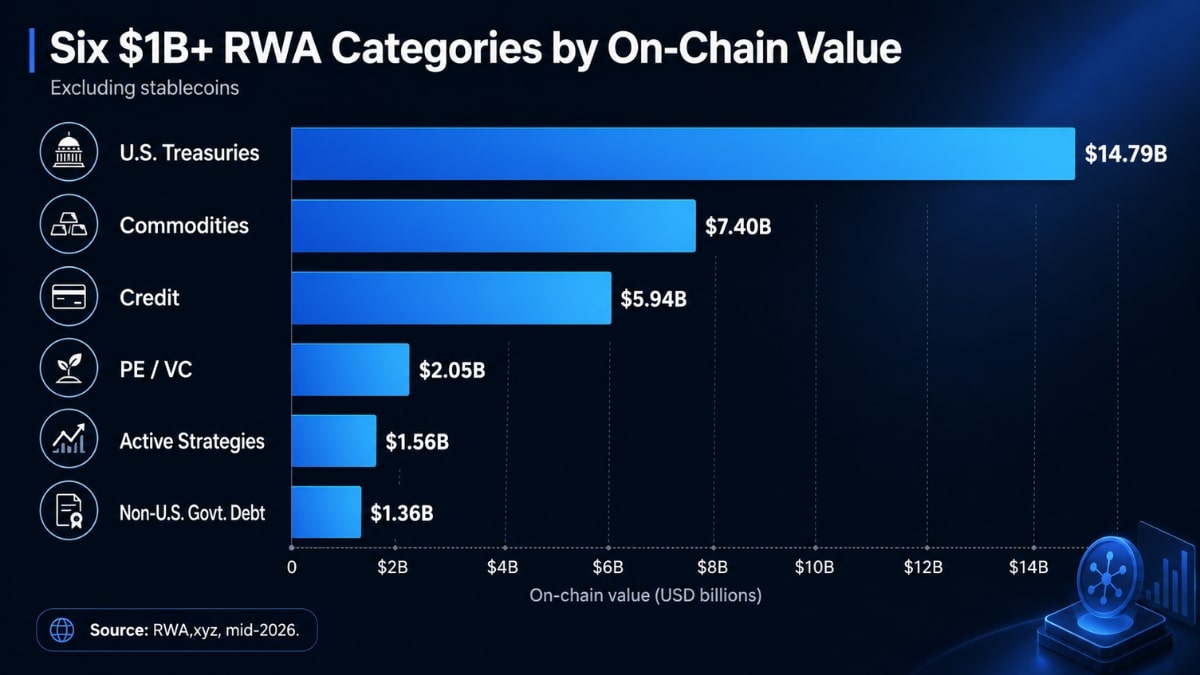
For the first time, the market isn’t dependent on a single asset class. Per data reported by PYMNTS and CoinDesk, six categories have each independently crossed $1 billion in on-chain value: private credit, commodities, US Treasuries, corporate bonds, non-US sovereign debt, and institutional alternative funds.
That diversification matters. A market built on one asset class is one regulatory decision away from a sharp drawdown. A market spread across six is structurally harder to dislodge.
The products actually driving flows:
- BlackRock’s USD Institutional Digital Liquidity Fund (BUIDL) — the asset-management giant’s tokenized money-market fund — is among the largest single products, holding assets in the low billions of dollars.
- Ondo Finance‘s tokenized Treasury products rank among the biggest in that category.
- JPMorgan’s My OnChain Net Yield Fund (MONY) launched in January 2026 and is competing for the same treasury-style institutional mandate.
- Tokenized stocks — equity and ETF tokens from platforms like Robinhood, Ondo Global Markets, and xStocks — crossed $1 billion in value with well over 185,000 holders, up from roughly $20 million and fewer than 1,500 users in December 2024.
One more thing worth understanding rather than glossing over: the gap between today’s reality and the long-term forecasts is enormous.
McKinsey’s base case puts the tokenized asset market at roughly $2 trillion by 2030 (with a bullish case near $4 trillion). Boston Consulting Group’s more optimistic model estimates $16 trillion by the same year — nearly ten times higher. Standard Chartered goes further still, projecting $30 trillion by 2034.
Why such a wide spread? Mostly methodology, not hype. Some models count only public, permissionless blockchain assets. Others fold in private bank ledgers, tokenized deposits, and stablecoins.
The takeaway: treat any single headline forecast with healthy skepticism, and pay more attention to which asset classes and structures are actually growing.
Why Institutions Are Paying Attention
The appeal for large financial institutions isn’t speculative token price appreciation. It’s operational efficiency.
- Faster settlement. Traditional securities settlement can take one to two business days. Tokenized transactions on a blockchain can settle almost instantly.
- Lower issuance costs. Industry estimates put traditional asset issuance fees at 5% to 8%, versus 1% to 3% for tokenized issuance. If that cost gap holds or widens, tokenization becomes the economically rational choice for new issuance — not just a novelty for migrating existing assets.
- Programmable yield and collateral. Tokenized fund shares can distribute yield automatically and can potentially serve as collateral on-chain. A corporate treasurer managing cash reserves finds that genuinely useful, independent of any crypto narrative.
- Fractional access. Assets historically reserved for large institutions or the wealthy — commercial real estate, private credit, pre-IPO equity — can, in principle, be split into smaller units that a broader base of investors can reach.
The Risks Nobody Should Skip
This is the part of the RWA story that promotional content tends to underplay. The risks are real, specific, and in some cases already playing out in public.
A token isn’t always what it claims to be
In mid-2025, Robinhood launched tokenized exposure to shares of OpenAI and SpaceX for European users, handing some out as part of a promotional giveaway.
OpenAI responded publicly and unambiguously: the tokens were not OpenAI equity, the company had not partnered with Robinhood on the offering, and any transfer of its actual equity requires the company’s approval. Robinhood maintained that the tokens offered indirect exposure through a special purpose vehicle holding a stake in OpenAI shares, and that no such authorization was legally necessary for that structure.
Whichever side you find more persuasive, the episode is a clean illustration of a risk every RWA investor should internalize: owning a token linked to an asset is not automatically the same as owning the asset, and the gap between the two can be legally and financially significant.
Synthetic exposure is not ownership. Read the structure behind any tokenized product before assuming you’re getting direct economic or legal rights to what’s underneath it.
Legal enforceability is still being built
If a dispute arises over a tokenized real estate position — a disagreement about a property’s title, or a default — the enforceability of the token holder’s claim depends heavily on the jurisdiction, the specific contract structure, and how local regulators treat the arrangement.
In many markets, including India, the legal infrastructure to resolve these disputes at scale simply doesn’t exist yet.
Thin liquidity
A tokenized asset that can’t be sold easily offers little real advantage over the paper version it replaced.
As of 2026, most tokenized assets are held rather than actively traded, and secondary-market volume remains low relative to the total value outstanding. The promise of instant, liquid markets for previously illiquid assets is still largely aspirational — not yet a delivered reality.
Regulatory fragmentation
The same token can be treated completely differently depending on where its holder lives.
In the United States, most tokenized securities are analyzed under the Howey Test to determine whether they qualify as securities, which triggers registration and disclosure obligations. In the European Union, the Markets in Crypto-Assets Regulation (MiCA) governs the custody side, while tokenized securities often separately fall under MiFID II disclosure rules.
Platforms operating across borders must navigate all of this at once — and the gaps between frameworks are exactly where investor protection tends to break down.
The India-specific risk: tax and regulatory uncertainty
For Indian readers, two issues stand out.
First, taxation is unforgiving. Under the Income Tax Act, earnings from tokenized assets are classified as income from virtual digital assets under Section 2(47A) and taxed at a flat 30%, with no deduction allowed for costs other than the acquisition price, and no ability to offset losses against other income.
A 4.5% dollar yield on a tokenized Treasury product looks considerably less attractive after this tax treatment than it does on paper.
Second, the domestic framework remains unsettled outside GIFT City. India’s most developed environment for tokenized assets exists within the International Financial Services Centre at GIFT City, where the IFSCA runs a supervised regulatory sandbox and has published consultation work specifically on tokenizing real-world assets.
Outside that zone, SEBI has not notified specific rules governing token offerings, and has told Parliament’s Standing Committee on Finance that regulating crypto-assets is technically difficult given the nature of the underlying technology. Where tokenized products offer investment returns, SEBI generally treats them as securities — bringing the full weight of disclosure, registration, and investor-protection obligations.
Until clearer guidance arrives, any platform operating outside GIFT City is doing so in a genuine grey zone.

Where the Regulatory Picture Stands Globally
Regulation is the single biggest variable determining how fast — and how safely — this market grows.
United States. Reuters reported in June 2026 that the SEC was preparing a policy that could allow crypto companies to offer blockchain-based tokenized stocks domestically through an “innovation exemption.” That would be a significant shift, since most tokenized US equity products today are offered only to non-US users. Separately, the DTCC service is backed by a December 2025 SEC no-action letter authorizing it for a defined set of highly liquid assets.
European Union. MiCA is now fully operational for the custody and service-provider side of digital assets, while tokenized securities separately fall under MiFID II’s disclosure regime.
US state law. More than 30 states have adopted 2022 amendments to the Uniform Commercial Code’s Article 12, creating a legal category called “Controllable Electronic Records.” This lets banks formally recognize a security interest in a digital token — which in practice means tokenized real estate can be used as collateral for conventional bank loans, a meaningful bridge between decentralized and traditional finance.
India. As above, GIFT City’s IFSCA sandbox is the clearest pathway, while the mainland framework remains a work in progress, with more specific SEBI guidance widely expected in the 2026–2027 window.
What to Watch Next
Three developments will tell you more about where this market is really headed than any single price chart.
1. Whether central banks accept tokenized assets as loan collateral. Several have been actively assessing this through 2025 and 2026. The moment any major central bank formally accepts tokenized Treasuries or money-market fund shares as eligible collateral in repo markets, institutional demand shifts upward sharply. That is a bigger signal than any retail adoption metric.
2. Whether the DTCC rollout succeeds at scale. With 50+ major firms signed on and a broader launch targeted for October 2026, this is the clearest test yet of whether tokenization can be absorbed into mainstream capital-markets infrastructure rather than remaining a parallel, crypto-native system.
3. Whether secondary-market liquidity actually develops. Tokenization only delivers on its core promise — turning illiquid assets liquid — if trading volume grows relative to the value locked in these products. Right now, it hasn’t. This is arguably the single most important number to track over the next two to three years, more so than total market size.
The Bottom Line
Real-world asset tokenization has moved past the experimental phase. The world’s largest asset managers, custodians, and exchanges are no longer just piloting the idea — they’re building shared infrastructure around it. That’s a genuine shift from where this technology stood even eighteen months ago.
But “institutional interest is real” and “the risks are resolved” are two very different claims. Legal enforceability frameworks are incomplete. Secondary-market liquidity is thin. Regulatory treatment varies sharply by jurisdiction — and in India specifically, both the tax treatment and the rulebook outside GIFT City remain unsettled.
The Robinhood–OpenAI episode is a useful reminder that the gap between “exposure to an asset” and “ownership of an asset” can matter a great deal, especially when something goes wrong.
For now, tokenization is proving useful in narrow, well-defined use cases — tokenized Treasuries and money-market funds chief among them — where the legal structure is simple and the underlying asset is already liquid and well understood.
Whether it expands successfully into messier categories like real estate, private equity, and infrastructure debt will depend far less on blockchain technology itself, and far more on whether regulators, courts, and market-infrastructure providers can build the legal and liquidity plumbing to support it.
Also Read: Real World Assets on the Blockchain: A Comprehensive Handbook
Frequently Asked Questions
Is owning a tokenized asset the same as owning the real asset?
Not necessarily. Most tokenized products represent a contractual or beneficial claim on an asset held inside a legal structure like an SPV, rather than direct legal title to the physical or financial asset. The Robinhood–OpenAI dispute in 2025 highlighted exactly this gap, when OpenAI stated publicly that tokens tied to its name did not represent its actual equity.
Is RWA tokenization legal in India?
It isn’t explicitly banned, but it exists in a regulatory grey zone outside GIFT City’s IFSCA sandbox. SEBI has not issued specific rules for token offerings on the mainland, and formal guidance isn’t expected until 2026–2027 at the earliest.
How is income from tokenized assets taxed for Indian investors?
Under Section 2(47A) of the Income Tax Act, earnings are treated as income from virtual digital assets and taxed at a flat 30%, with no deductions beyond acquisition cost and no ability to offset losses against other income.
Which category of tokenized RWA is considered lowest-risk for a beginner to understand?
Tokenized US Treasuries and money-market funds are generally viewed as the simplest entry point, since the underlying asset is highly liquid, well regulated, and doesn’t carry the legal complexity of real estate or private equity structures. That said, “lowest risk” among RWAs is still not the same as risk-free — currency, regulatory, and platform risk all still apply.