It arrived without fanfare, yet it carried the weight of a quiet reckoning.
In the last days of March 2026, Google Quantum AI released a whitepaper that reframed one of the longest-standing questions in cryptocurrency security. The document, co-authored by Google researchers, Stanford cryptographer Dan Boneh, and Ethereum Foundation researcher Justin Drake, did not declare Bitcoin broken.
Instead, it delivered a sharper warning: the mathematical lock protecting Bitcoin’s private keys is not as distant or unbreakable as many had assumed.
At its core, the paper reveals that a future quantum computer could break the strong mathematical lock protecting Bitcoin wallets using far less computing power than experts once believed. The new estimation sits at roughly the equivalent of a machine with about half a million basic processing units, running for just a few minutes.
Earlier, it was expected that the task would require vastly more resources, perhaps millions of units or more. This roughly 20-fold improvement changes the timeline and makes the threat feel closer.
How trillions of dollars in Bitcoin are at risk
When someone spends Bitcoin (BTC) from an address, the public key becomes visible on the blockchain. At that moment, a sufficiently advanced quantum machine could derive the private key and steal the funds.
In modeled scenarios, this could happen in about 9 minutes—close to Bitcoin’s average block time—giving an attacker a realistic chance of hijacking a transaction before it is confirmed.
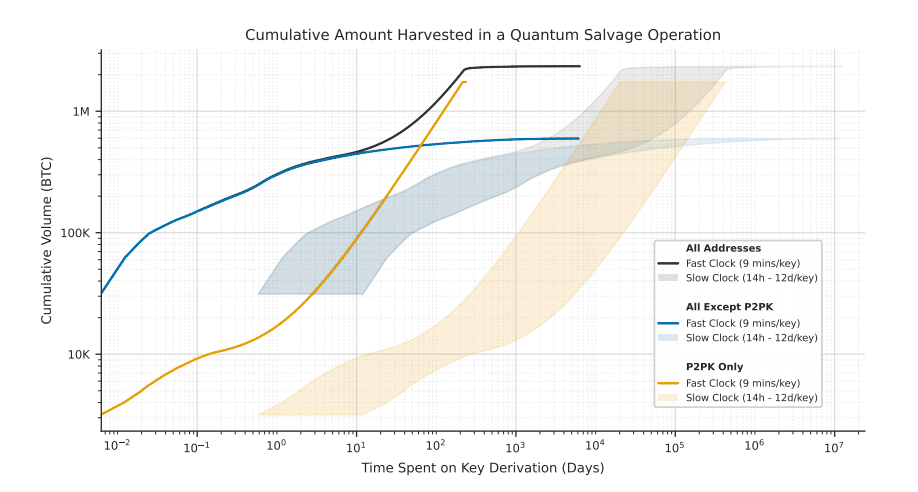
For roughly 6.7 to 6.9 million BTC (around one-third of the total supply, worth hundreds of billions of dollars), the risk already exists because their public keys have been exposed through past spending, address reuse, or certain wallet patterns. These include many early and dormant coins, some possibly linked to Satoshi Nakamoto’s holdings.
However, considering the risk, the authors were careful. They did not publish the full attack details and only published a mathematical proof that their approach works. They also made clear that Bitcoin’s mining system remains safe for the foreseeable future.
To note, the real danger targets digital signatures, not the proof-of-work that secures the network. Google presented the research as responsible disclosure, urging the crypto industry to begin moving toward quantum-resistant protections before the threat becomes real.
Also Read: Google Shows Japanese Yen and Indian Rupee to Zero Against Bitcoin
The spark: How Google’s whitepaper shook the crypto world
The timing was no coincidence. Just days before the paper dropped, Google had accelerated its own internal deadline for switching to post-quantum cryptography to 2029, citing faster progress in hardware and algorithms. The Bitcoin-focused paper built directly on that momentum.
Advances in quantum computing had been steady but relentless. Google’s own processors showed improving performance, and multiple research teams in early 2026 published work that kept lowering the estimated resources needed to break elliptic curve cryptography. Bitcoin’s design makes the issue especially visible.
Unlike traditional banks, where private keys can stay hidden, every Bitcoin spend reveals the public key on the public ledger. Early wallet habits, address reuse, and some features of newer upgrades inadvertently increased exposure. At the same time, Bitcoin’s decentralized nature makes quick upgrades difficult. With trillions of dollars now at stake, even a theoretical risk draws serious attention.
The long road of quantum computing
The foundations of this moment go back decades. In the 1980s, physicist Richard Feynman suggested that quantum machines could simulate nature far more efficiently than ordinary computers.
The game-changing moment for cryptography came in 1994 when Peter Shor published an algorithm showing that a quantum computer could factor large numbers and solve certain math problems exponentially faster than classical machines. That paper turned quantum computing from a physics curiosity into a national security concern.
Early experiments were tiny, a 7-qubit demonstration in 2001 that factored a small number. Hardware evolved slowly through different approaches: superconducting circuits, trapped ions, and photonic systems.
By the late 2010s, claims of “quantum supremacy” appeared, though truly useful, error-free computation remained distant. The biggest hurdle has always been error correction, building reliable “logical” processing units from many noisy physical ones.
By the mid-2020s, steady gains in stability and scale brought practical applications closer. Governments and companies began preparing for a future where encrypted data collected today could be decrypted later by quantum machines—the so-called “harvest now, decrypt later” strategy. In 2016, NIST started standardizing new cryptographic algorithms designed to resist both classical and quantum attacks.
Why does the timeline suddenly feel urgent?
Google’s paper does not claim a quantum computer capable of breaking Bitcoin will exist by 2029. However, it aligns with the company’s own accelerated timeline for protecting its systems.
Justin Drake, who co-authored the paper, called the release a “monumentous day” for quantum computing and cryptography. He suggested further improvements could make the requirements even smaller and raised his personal estimate: at least a 10% chance that a machine could crack an exposed Bitcoin key by 2032.
Reactions in the crypto world split along familiar lines. Coinbase CEO Brian Armstrong took the news seriously, saying he would “start spending time on this personally” and that the industry must solve the problem “sooner rather than later.”
Coinbase had already formed a Quantum Advisory Board earlier in 2026 that included prominent experts. Armstrong described the challenge as difficult but solvable engineering work and called for coordinated efforts across different blockchains.
Former Binance CEO Changpeng Zhao, known as CZ, offered a more measured response. “It’s always easier to encrypt than decrypt,” he wrote. “More computing power is always good. Crypto will stay, post quantum.” He pointed out that the real difficulty lies in execution: getting decentralized networks to agree on upgrades, avoiding chain splits, and dealing with dormant coins. CZ suggested ideas like time-locking or burning very old vulnerable addresses but stressed there was no need for panic.
Life after quantum breakthroughs: What a broken signature system would mean
If powerful quantum computers arrive, exposed Bitcoin addresses would become easy targets. An attacker could systematically drain legacy wallets at their leisure. Real-time hijacking of transactions could become possible, although Bitcoin’s 10-minute block time provides some protection compared to faster chains. Ethereum would face broader risks across smart contracts, staking, and Layer-2 systems.
The indirect effects could be significant. Even before any actual thefts, loss of confidence might trigger sell-offs and hurt mining economics. While Bitcoin’s proof-of-work would likely remain resilient, a sharp drop in coin value during a transition period could destabilize the network.
Practical steps and industry responses: Building defenses before the storm
Short-term actions are clear. Users and services should stop reusing addresses and avoid sharing extended public keys. Those holding large amounts in older addresses can gradually move funds to newer, safer setups, though doing so briefly exposes the key.
Long-term, the industry needs to adopt quantum-resistant signatures. New algorithms already standardized by NIST offer strong protection. Ethereum seems better positioned to move quickly, with active research projects and improvement proposals already underway. Bitcoin’s slower, consensus-driven process raises legitimate concerns about delays, potential forks, and what happens to stranded funds.
Google, Coinbase, and others are pushing for collaboration across the ecosystem. Ideas include better wallet designs, quantum-safe address formats, and “crypto agility” that allows easy swapping of algorithms in the future. Some suggest community mechanisms to handle dormant vulnerable coins—perhaps extended time-locks or voluntary burn addresses after long periods of inactivity—without forced seizures.
Markets reacted with limited volatility, suggesting most participants view practical quantum machines as still years away. Yet the reduced resource requirements have made proactive planning feel urgent rather than optional.
Looking ahead: will Bitcoin evolve or fracture under quantum pressure?
Bitcoin was built as digital gold—decentralized, borderless, and protected by elegant mathematics. That mathematics, long considered nearly unbreakable, now faces a challenge from the strange rules of quantum mechanics. The Google paper does not signal the end of cryptocurrency. It simply highlights a vulnerability that was always present in public-key systems and gives the community time to strengthen its defenses.
The coming years will test Bitcoin’s ability to evolve more than any previous debate over scaling or forks. Success will depend on balancing caution with action: protecting today’s value while building a quantum-hardened future. Leaders like Armstrong are committing personal attention. Developers must deliver workable proposals. Users need to adopt better security practices.
CZ’s calm pragmatism is worth remembering — encryption has always evolved, and crypto has shown remarkable adaptability. At the same time, Drake’s sense of urgency rings true: preparations should start now, not when the first working prototype appears in a lab.
The quantum shadow is lengthening. How the ecosystem responds will decide whether Bitcoin enters the quantum age weakened or emerges stronger and more resilient than before.
The episode has only just begun. Its outcome will reveal whether decentralized finance becomes a cautionary tale or a powerful example of human ingenuity facing technological change.
Also read: $285M Gone in 12 Minutes: How a Fake Token and Stolen Keys Gutted Drift Protocol