Key Highlights
- Google’s Market Summary now displays 1 Japanese Yen and 1 Indian Rupee as 0.00 BTC..
- 1 U.S. Dollar shows 0.000015 BTC a number Google’s own all-time chart labels as a 100% decline.
- The Chinese Yuan and Brazilian Real are approaching the same threshold, while only six currencies — the USD, Euro, Pound, Swiss Franc, Canadian Dollar, and Australian Dollar — still register a visible decimal.
- The display is a product of decimal rounding at Bitcoin’s current price near $68,000, but the underlying data reflects a real trend: fiat currencies have lost over 99.99% of their purchasing power when measured against BTC since 2010.
Something unusual is happening on one of the most widely used financial interfaces on the internet, and almost nobody is talking about it.
As of March 7, 2026, Google’s Market Summary, the conversion widget that appears at the top of search results when users type queries like “yen to BTC” or “INR to BTC” is displaying major fiat currencies at effectively zero against Bitcoin.
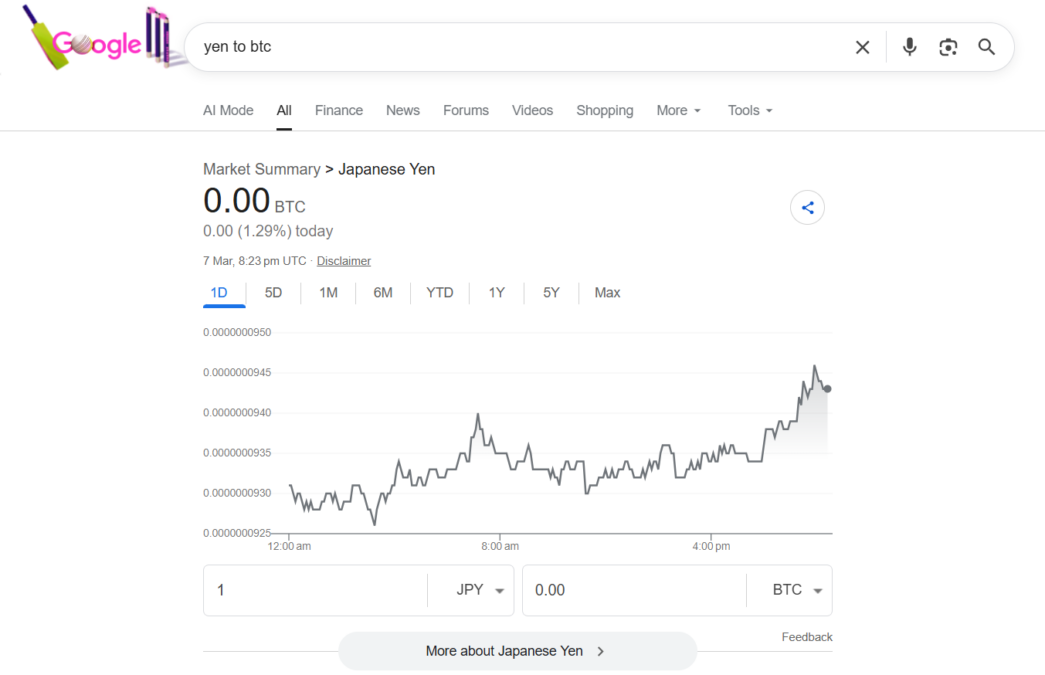
The Japanese Yen shows 0.00 BTC. The Indian Rupee shows 0.00 BTC. The U.S. Dollar the world’s reserve currency, still gets a decimal: 0.000015 BTC. But Google’s all-time chart for the Dollar-to-BTC pair tells its own story: it labels the move from 0.0016 BTC per dollar in October 2016 to 0.000015 today as a decline of 15.04 points, which it rounds to 100%.
The numbers are not wrong. They are just too small for Google’s interface to render in a way that looks meaningful
What the Numbers Actually Say
At a Bitcoin price of approximately $68,000, the math is straightforward but striking.
One U.S. Dollar buys roughly 0.0000147 BTC, or about 1,470 satoshis. Google’s interface can still display this barely as 0.000015. But for currencies with lower unit values, the conversion crosses below the threshold of what Google’s rounding can show.
One Japanese Yen buys approximately 0.00000009 BTC. One Indian Rupee buys approximately 0.00000016 BTC. These values exist on the blockchain and in exchange order books. But on Google’s Market Summary, they are displayed as 0.00 indistinguishable from zero.
The difference between the Dollar and the Yen or Rupee on Google’s display is not about economic strength in any absolute sense. It is about where each currency falls relative to the decimal limit of Google’s widget. The dollar is just above the line. The Yen and Rupee have crossed it.
7 of the Top 15 Currencies Already Round to Zero
To understand the scale of this, The Crypto Times reviewed the top 15 global fiat currencies by usage and calculated what 1 unit of each is worth in BTC at current prices. We then checked how Google’s Market Summary would render each conversion.
The results:
| # | Currency | Code | 1 Unit in BTC | Google Display | Rounds to Zero? |
|---|---|---|---|---|---|
| 1 | U.S. Dollar | USD | 0.00001465 | 0.000015 | No |
| 2 | Euro | EUR | 0.00001698 | 0.000017 | No |
| 3 | British Pound | GBP | 0.00001960 | 0.000020 | No |
| 4 | Swiss Franc | CHF | 0.00001672 | 0.000017 | No |
| 5 | Canadian Dollar | CAD | 0.00001075 | 0.000011 | No |
| 6 | Australian Dollar | AUD | 0.00001027 | 0.000010 | No |
| 7 | Chinese Yuan | CNY | 0.00000212 | 0.000002 | Approaching |
| 8 | Indian Rupee | INR | 0.00000016 | 0.00 | Yes |
| 9 | Japanese Yen | JPY | 0.00000009 | 0.00 | Yes |
| 10 | South Korean Won | KRW | 0.00000001 | 0.00 | Yes |
| 11 | Russian Ruble | RUB | 0.00000019 | 0.00 | Yes |
| 12 | Brazilian Real | BRL | 0.00000278 | 0.000003 | Approaching |
| 13 | Turkish Lira | TRY | 0.00000033 | 0.00 | Yes |
| 14 | Philippine Peso | PHP | 0.00000025 | 0.00 | Yes |
| 15 | Pakistani Rupee | PKR | 0.00000005 | 0.00 | Yes |
Seven of the fifteen currencies round to zero. Two more — the Chinese Yuan and Brazilian Real — are approaching the threshold. Only six currencies still register a visible decimal on Google: the Dollar, Euro, Pound, Swiss Franc, Canadian Dollar, and Australian Dollar.
The South Korean Won is the most extreme case. At roughly 101.4 million Won per Bitcoin, one Won buys 0.00000001 BTC, exactly one satoshi. Google has no way to display that as anything other than 0.00.
The Dollar’s 100% Decline Chart
The most visually striking element is not the Yen or Rupee rounding to zero — it is what Google shows for the U.S. Dollar.
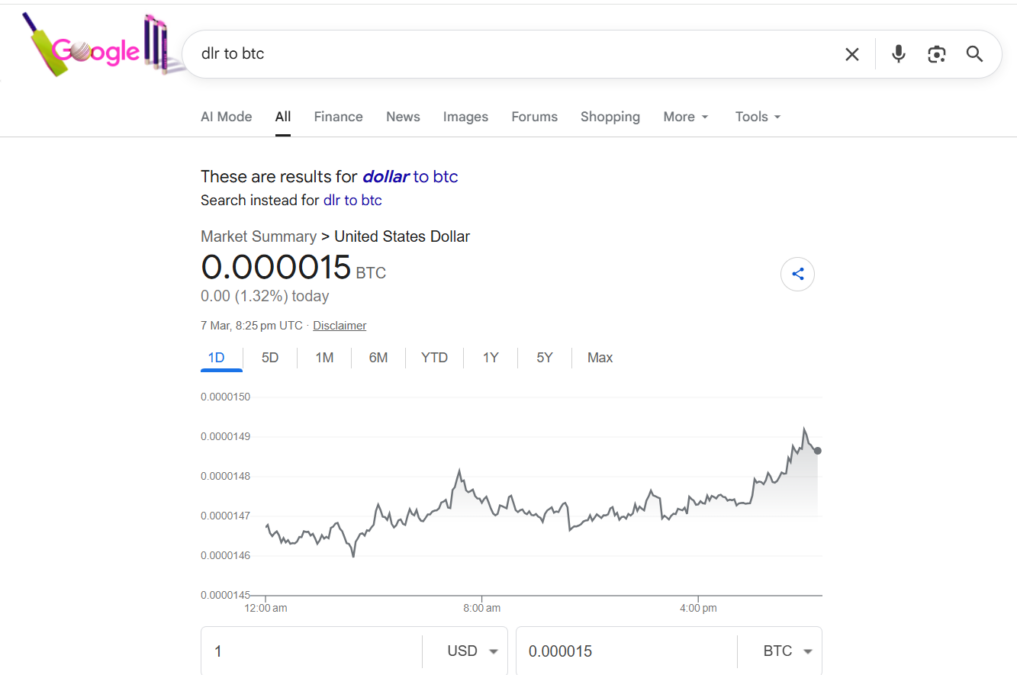
When a user searches “dlr to btc” or “USD to BTC,” Google’s Market Summary displays 0.000015 BTC with an all-time chart that starts at 0.0016 BTC per dollar in October 2016 — when Bitcoin traded near $600. The chart drops in a near-vertical line to the current level and labels the change as -15.04 (100.00%) ↓ all time.
The math is technically a 99.06% decline. Google rounds it to 100%.
That single chart, visible to anyone who types three words into the world’s most-used search engine, tells the story of what has happened to the dollar’s purchasing power when measured against a fixed-supply digital asset over the past decade. In 2016, one dollar could buy 0.16% of a Bitcoin. Today, it buys 0.0015% of one.
A Display Problem That Tells a Real Story
Google did not design its currency conversion tool for an asset that has appreciated 68,000x against the dollar in 15 years. The interface was built for fiat-to-fiat conversions where exchange rates move in single-digit percentages over decades not for a pairing where one side has gone parabolic while the other slowly erodes.
The result is a visual artifact that makes a statement the platform never intended to make: on Google’s own interface, most of the world’s major currencies are now worth zero Bitcoin.
This is not a bug in any technical sense. It is what happens when a deflationary asset with a hard supply cap of 21 million is measured against currencies whose supply has expanded by trillions over the same period. The Federal Reserve’s M2 money supply has grown from roughly $8.5 trillion in 2010 to over $22 trillion in 2026. The Bank of Japan’s monetary base has expanded even more aggressively. Bitcoin’s supply has grown from approximately 3 million to 20 million over the same period and will never exceed 21 million.
The divergence between these supply curves is now so extreme that Google’s interface cannot visually represent the relationship between fiat currencies and Bitcoin in a way that looks like anything other than a one-way collapse.
What Billions of Users Are Seeing
Google processes over 8.5 billion searches per day. Its Market Summary widget is one of the most visible financial data displays in the world more widely seen than any Bloomberg terminal, TradingView chart, or exchange interface.
When a user in Tokyo types “yen to BTC” and sees 0.00, or a user in Mumbai types “INR to BTC” and sees 0.00, or a user in New York types “dollar to BTC” and sees a chart labeled “100% decline all time,” they are encountering a data visualization that intentionally or not makes a statement about the relative trajectory of fiat and Bitcoin.
Whether this drives any trading behavior is unknowable. But as a cultural artifact, it is worth noting: the world’s largest search engine is now displaying most of the world’s major currencies as effectively worthless when measured against Bitcoin.
No one at Google decided to make that statement. The math made it for them.
Also Read: The Quantum Shadow on Bitcoin: Google’s Warning and the Race to Save Crypto