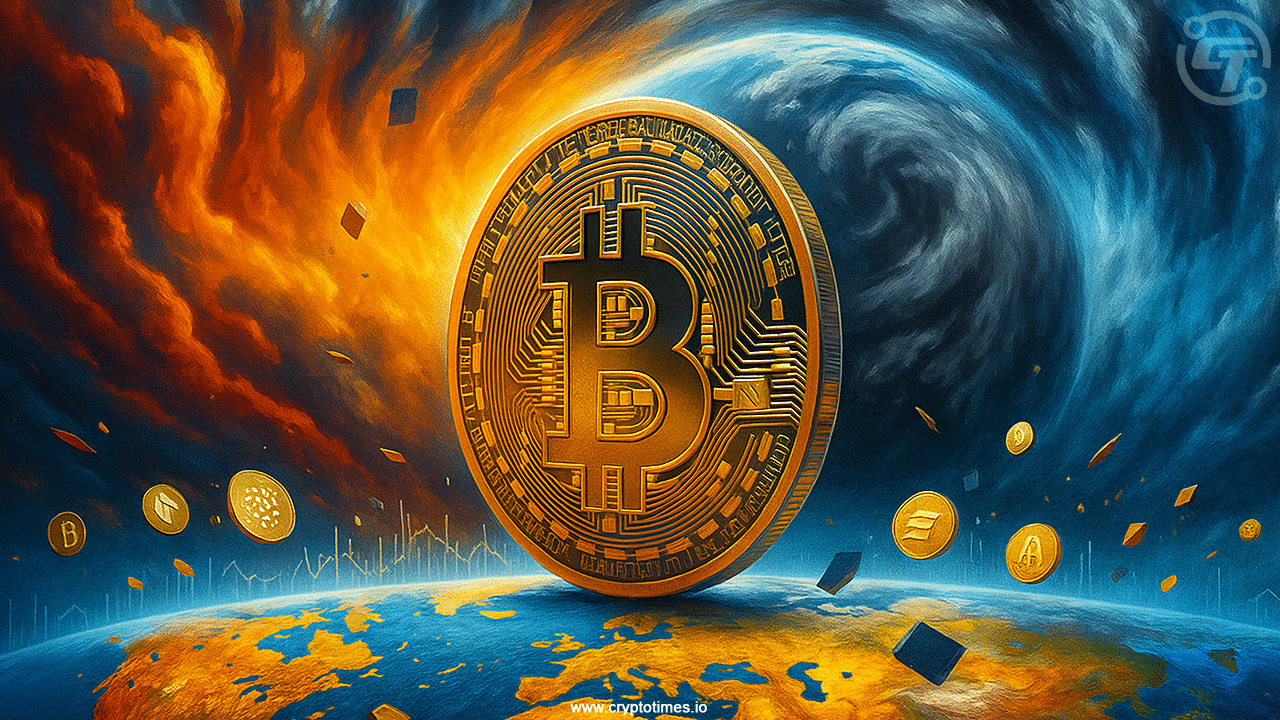
In the early days of Bitcoin, the factors moving its price were relatively simple: adoption rates, technological breakthroughs, and the sentiment of a small, niche community. Today, the landscape is profoundly different.
From military escalations in the Middle East to the slow-burn collapse of national currencies, geopolitical events have become a primary, and perhaps one of the most powerful, driver of the cryptocurrency market.
For investors, analysts, and even casual observers, understanding this complex relationship is no longer optional; it’s essential for navigating a market that has firmly arrived on the world stage.
This article will explore the dual role crypto plays in response to global tension, examine the specific events that have shaped its narrative, and provide a framework for how investors must adapt to this new reality.
What Is the Geopolitical Influence on Crypto?
At its core, the influence of geopolitics on cryptocurrency is a story of two conflicting narratives that often operate simultaneously: crypto as a decentralized safe haven and crypto as a global risk asset.
How the market behaves depends entirely on the nature, scale, and location of the crisis.
- The Safe Haven Narrative: This is the original cypherpunk vision for Bitcoin. In this scenario, crypto acts as a non-sovereign, censorship-resistant store of value when a specific country’s traditional financial (TradFi) system is under duress. When citizens lose faith in their government, their banks, or their currency, decentralized digital assets provide a vital escape route. This is a localized phenomenon, where capital flows from a failing system into the global crypto ecosystem.
- The Risk Asset Narrative: This narrative has emerged as the cryptocurrency industry has matured over years and attracted trillions of dollars in capital. In this scenario, crypto behaves like a high-growth tech stock. During times of widespread global uncertainty, such as a major war, a pandemic, or a financial crisis, large investors de-risk their portfolios. They sell assets they perceive as volatile (like stocks and crypto) and move into more stable stores of value (like gold, U.S. Treasury bonds, and the dollar). In this context, the price of Bitcoin and other cryptocurrencies moves in lockstep with traditional markets.
The tension between these two narratives defines the modern crypto market. Its reaction to a crisis in Lebanon is fundamentally different from its reaction to a conflict that threatens to draw in global superpowers.
Why Geopolitics Now Dominates the Crypto Market
The shift from a niche asset to a geopolitically sensitive one didn’t happen overnight. Several key factors have converged to create this new paradigm.
1. The Influx of Institutional Capital
The single biggest change has been the entry of institutional players. Hedge funds, asset managers, pension funds, and corporations now hold significant funds in crypto assets. These large, traditional investors do not view crypto in a vacuum; they place it within a broader portfolio of assets.
Their risk management models are built on macroeconomic principles. When global tensions rise, their automated systems and established protocols trigger a flight to safety across the board. For them, Bitcoin is not a hedge against the financial system; it is part of the system they are de-risking from. This is why a global conflict announcement can cause both the S&P 500 and the crypto market to plunge simultaneously.
2. Mainstream Media Amplification
As crypto has become more popular, its price movements are now front-page news. A headline reading, “Bitcoin Plummets as Middle East Tensions Flare,” creates a powerful feedback loop.
Retail investors, who may not understand the nuances of the underlying event, react to the headline, amplifying the sell-off. The media has learned that linking crypto to global events generates clicks, solidifying the connection in the public’s mind.
3. The Specter of Regulation and CBDCs
National governments are acutely aware of crypto’s potential to undermine their monetary control. The way a country chooses to regulate—or ban—digital assets is itself a geopolitical act. Furthermore, the global race to develop Central Bank Digital Currencies (CBDCs) adds another layer of tension. A CBDC represents a government’s attempt to co-opt the benefits of digital currency while retaining centralized control.
The struggle between decentralized, open networks like Bitcoin and state-controlled digital currencies will be a defining geopolitical battleground of the coming decade, and market sentiment will undoubtedly swing with every new development.
4. The Inherently Speculative Nature of the Asset
Unlike stocks, which are tethered to corporate earnings and balance sheets, most cryptocurrencies derive their value from market sentiment, network effects, and narratives about their future potential.
This lack of traditional fundamentals makes the asset class inherently speculative and highly susceptible to shifts in global mood. Geopolitical events are one of the most powerful drivers of collective human emotion.
When news of a conflict or crisis breaks, it injects a massive dose of fear and uncertainty into the world: the very forces that cause speculators to retreat. Because there are no earnings reports to anchor the price, sentiment becomes the dominant factor, making crypto an extremely high-beta asset that exaggerates the market’s reaction to global news.
Deep Dive: Crypto as a Safe Haven (Case Studies)
To understand the safe haven narrative, one must look at countries where the TradFi system has broken its promise to citizens.
Lebanon’s Banking Catastrophe
The collapse of Lebanon’s banking sector, which started in 2019, provides a textbook example. Faced with a sovereign debt crisis, the government imposed informal capital controls, trapping people’s life savings in the banks. The Lebanese pound entered a state of hyperinflation, losing over 98% of its value.
Citizens were left with few options. ATMs were shut down, and bank withdrawals were severely limited. In response, a grassroots crypto economy emerged.
- Wealth Preservation: People converted their rapidly devaluing pounds into Bitcoin and stablecoins like Tether (USDT) to protect their savings.
- Remittances: The Lebanese diaspora, a crucial source of income for the country, began using crypto to send money home, bypassing a crippled and expensive banking system.
- Peer-to-Peer Commerce: Local traders and businesses began accepting USDT for everyday goods and services, creating a parallel financial system.
In Lebanon, crypto was not a speculative investment; it was a tool for survival.
Venezuela and the Escape from Hyperinflation
A similar story unfolded in Venezuela. Years of economic mismanagement under the Maduro regime led to one of the worst hyperinflation events in modern history. The national currency, the bolívar, became virtually worthless.
Venezuelans, therefore, turned to Bitcoin and other cryptocurrencies for the same reasons as the Lebanese. They used it to receive remittances from family abroad, to preserve what little savings they had, and to engage in commerce. Platforms that facilitated peer-to-peer trading saw explosive growth in the region, as people sought ways to transact outside the government’s failing monetary system.
The Brexit Precedent (2016)
Brexit, the UK’s vote to leave the European Union in June 2016, demonstrated that the safe haven use case is not exclusive to developing nations. The immediate aftermath of the vote triggered immense economic uncertainty.
The British pound (GBP) plummeted to a 31-year low against the U.S. dollar. The FTSE 250, an index of UK-focused companies, fell sharply. In this environment of instability, investors sought alternatives.
Trading volume on UK-based crypto exchanges surged. The price of Bitcoin, when denominated in GBP, shot up, far outpacing its rise in USD terms. For a moment, Bitcoin functioned exactly as intended: as a hedge against the sudden devaluation of a major fiat currency.
Deep Dive: Crypto as a Global Risk Asset (Case Studies)
While the safe haven narrative is powerful, the risk asset narrative now governs crypto’s reaction to large-scale global events.
The Iran-Israel Conflict (2025)
The brief but intense conflict between Iran and Israel in June 2025 offered a clear example of crypto’s modern behavior. When the first airstrikes were launched, financial markets around the world went into “risk-off” mode.
- The Initial Sell-Off: Investors immediately panicked. The S&P 500, the NASDAQ, and global stock indices all fell. Bitcoin plunged in tandem, dropping over 10% to a two-month low of $98,900. There was no “flight to Bitcoin” as a safe haven. Instead, capital fled from Bitcoin into traditional safe havens like gold and U.S. Treasury bonds.
- The Ceasefire Rally: When a U.S.-brokered ceasefire was announced, the reaction was just as swift. Stock markets rallied on the news, and crypto markets mirrored the move, surging within minutes.
This episode perfectly illustrates the dominance of institutional thinking. The event was not about the collapse of a single currency but about global stability. For large funds, the calculus was simple: reduce exposure to all volatile assets, and crypto was at the top of that list.
How Crypto Investors Need to Adapt
Navigating a market driven by these dual narratives requires a more sophisticated approach. Simply “HODLing” is no longer enough.
- Develop a Geopolitical Monitoring Framework: Investors must now be amateur geopolitologists. This means paying close attention to elections in major economies, military buildups in conflict zones, international trade negotiations, and the monetary policy statements of central banks like the U.S. Federal Reserve and the European Central Bank. These are now primary crypto indicators.
- Diversify Beyond a Single Narrative: Your portfolio strategy should reflect crypto’s dual nature. Betting everything on the “Bitcoin as a safe haven” story is naive, as global risk-off events can decimate prices. Conversely, treating it only as a tech stock ignores its unique potential during currency crises. A balanced approach is necessary.
- Learn to Read Macroeconomic Data: Stop focusing only on crypto-specific news. Learn what the Consumer Price Index (CPI), Producer Price Index (PPI), and unemployment numbers mean. These traditional economic indicators heavily influence central bank policy, which in turn affects the risk appetite of the large investors who now move the crypto market.
- Utilize On-Chain Data for Context: On-chain analytics provide a crucial layer of insight. During a geopolitical event, watch for metrics like exchange inflows and outflows. Are whales moving their crypto onto exchanges to sell, or are they moving it off to hold in cold storage? This can help you gauge whether the market’s biggest players are truly panicking or simply weathering the storm.
The Future of Conflict and Crypto
The relationship between geopolitics and cryptocurrency is only going to deepen. The world is collectively entering an era where the financial battlefield is as important as the physical one.
Look for the weaponization of finance to accelerate. Nations will increasingly use sanctions, and crypto will be both a target of these sanctions and a potential tool to evade them. The ongoing debate over CBDCs will intensify, framing the conversation as a choice between state-controlled surveillance money and decentralized, sovereign money.
For the foreseeable future, crypto will continue to live a double life. It will be the last resort for citizens of failing states and a high-beta risk asset for global fund managers. Understanding both sides of this coin is the key to successfully navigating the market in the years to come. The world stage is now crypto’s stage.



Disclaimer: Some elements of this content may have been enhanced with the help of our artificial intelligence (AI) assistants for purposes such as basic refinement, review, image generation, and translation to deliver high-quality news in a shorter time frame. However, all AI-assisted content is reviewed and approved by our team to ensure accuracy, fairness, and editorial integrity.